
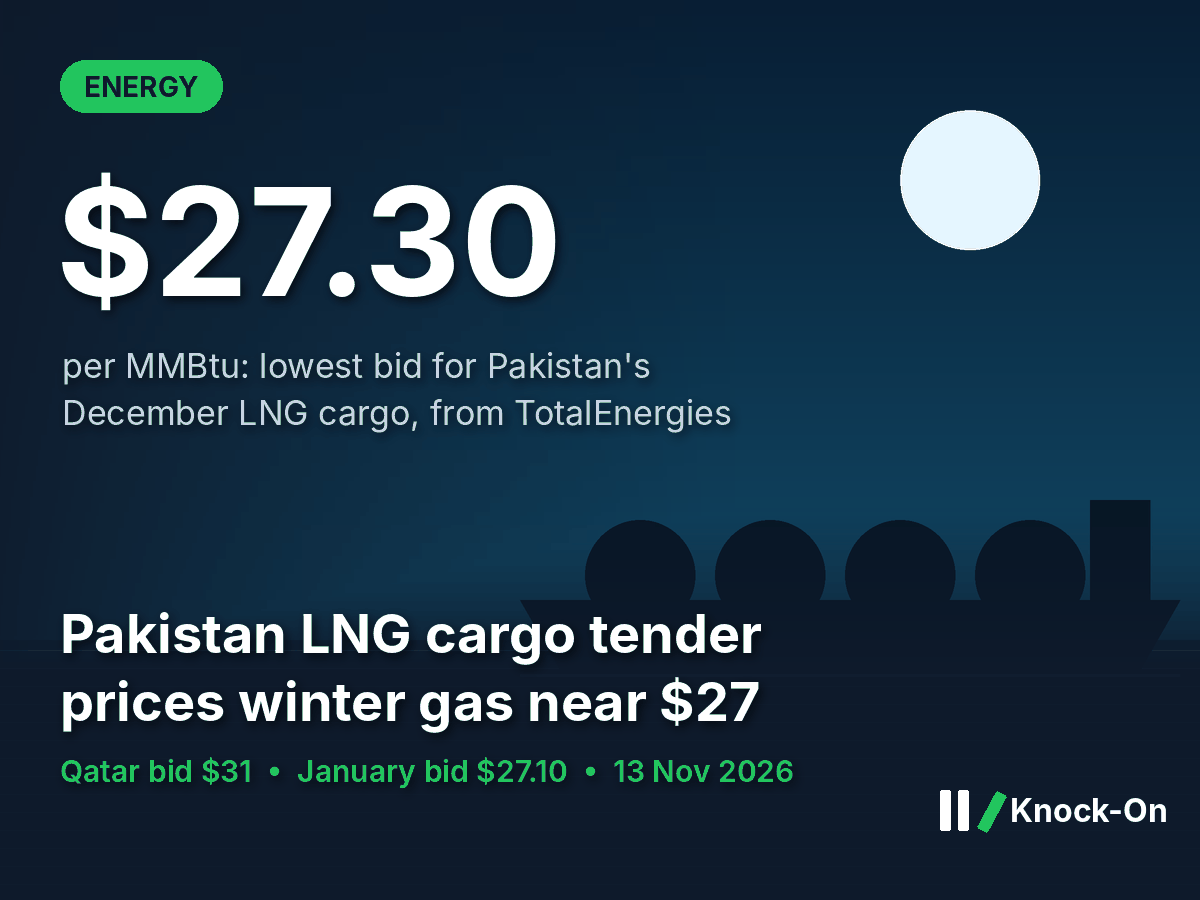
The first Pakistan LNG cargo tender for the winter peak has put a price on the gap left by Qatar. State-owned Pakistan LNG Limited (PLL) is seeking two spot cargoes for delivery at Port Qasim in mid-December and early January, and the lowest bid for December came in at $27.30 per million British thermal units (MMBtu), Business Recorder reported on Friday, 13 November. For textile mills, CNG stations and other gas users, it is an early signal of what imported winter gas will cost while Qatari contract supply is suspended.
The short version
- PLL invited bids for two LNG cargoes: 14–16 December 2026 and 9–11 January 2027.
- TotalEnergies Gas & Power was the lowest evaluated bidder for December at $27.30/MMBtu; QatarEnergy Trading bid $31.
- For January, TotalEnergies quoted $27.10/MMBtu and was again the lowest evaluated bidder.
- QatarEnergy’s force majeure on contract LNG to Pakistan runs until 29 December, officials said last month.
What happened
PLL issued the tender notice on Thursday for delivery-ex-ship (DES) cargoes at Port Qasim, Karachi. Bids for the December slot were received on Tuesday. TotalEnergies Gas & Power offered $27.30/MMBtu and was declared the lowest evaluated bidder, ahead of QatarEnergy Trading LLC at $31/MMBtu. For January, TotalEnergies offered $27.10/MMBtu, Business Recorder reported. The report did not give cargo sizes or say whether the cargoes have been formally awarded. PLL had earlier turned down two other spot LNG offers, the paper added.
TotalEnergies undercut Qatar’s trader by $3.70 for December gas
Bids for Pakistan LNG Limited spot cargoes, US$ per MMBtu, DES Port Qasim
Why it matters
Pakistan relied on Qatar for 35 of the 36 LNG cargoes it imported last winter, Pakistan Today reported. With QatarEnergy’s force majeure extended to 29 December, as Knock-On covered in the winter gas shortage in Pakistan, every Pakistan LNG cargo bought for the December peak has to come from the spot market. A Petroleum Ministry official told Arab News last month that a cargo normally costing about $30m could cost $80m–$90m on the spot market. The government had planned about 10 cargoes for December and January against an estimated need of 20, The News reported, so price will decide how much of that gap is filled.
The knock-on effects
First order: dearer RLNG for industry
Spot cargoes feed into the regasified LNG (RLNG) price paid by mills, captive power and CNG. Officials have said industrial, commercial and CNG users would bear a larger share of the cost, and that homes get priority for gas in the peak months.
Second order: the import bill and gas-sector debt
Every spot cargo adds to fuel imports at a time when oil has bounced back to about $94 after Trump’s Iran remarks. Any cost not passed on to users adds to arrears in the gas chain.
Third order: who supplies Pakistan after Qatar
Winning bids from a European major show Pakistan can buy outside its main term supplier, though at spot prices. The pace of Gulf diplomacy, and attacks such as the one covered in the Qatar LNG tanker attack, will decide when cheaper contract gas returns.
Who could benefit
- Domestic gas producers: local gas becomes more valuable when imports are costly.
- LPG and furnace oil sellers: users may switch fuel if RLNG is scarce or dear.
- Port Qasim terminal operators: steady throughput from spot cargoes.
Who may face pressure
- Textile exporters and other RLNG-based industry facing higher bills or rationing.
- CNG stations and cement makers, last in the supply queue.
- Gas utilities and the budget, if spot costs are not fully passed on.
What to watch
- Formal award of the two cargoes and any further PLL tenders.
- 14–16 December: first cargo’s delivery window at Port Qasim.
- 29 December: current end date of QatarEnergy’s force majeure.
- 9–11 January: second cargo’s delivery window.
Sources
- Business Recorder, Pakistan seeks two LNG cargoes for Dec, Jan as winter looms, 13 Nov 2026
- Arab News, Pakistan braces for winter gas crunch as Qatar halts LNG supply till end-December, 31 Oct 2026
- Geo News (The News), Pakistan faces winter gas crisis as Qatar extends LNG supply halt, 31 Oct 2026
- Pakistan Today, Qatar LNG squeeze raises fears of winter gas crunch in Pakistan, 1 Nov 2026
This is analysis, not investment advice. Figures are as of 13 November 2026.

Leave a Reply