
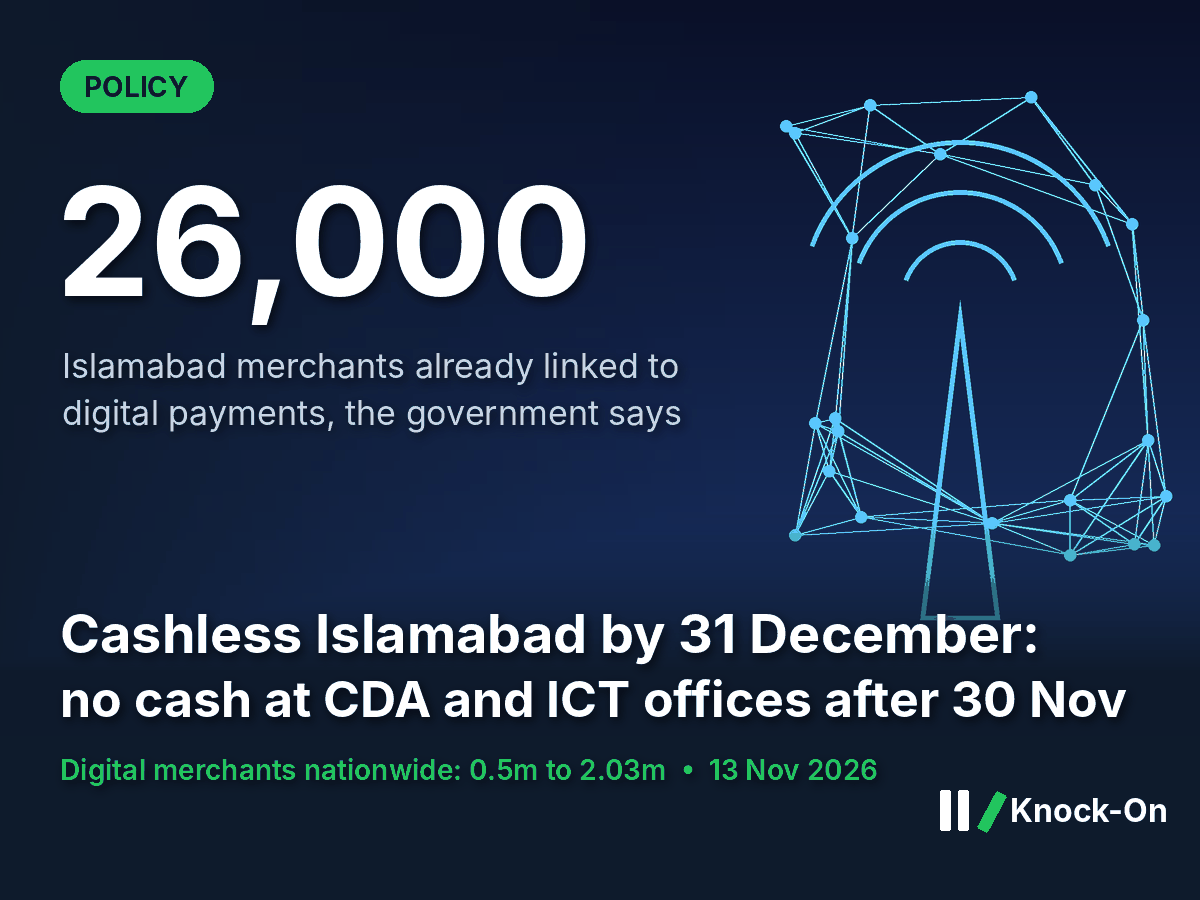
The government has set 31 December as the deadline for a cashless Islamabad, the capital’s push to put every merchant, from street vendors to large business centres, on digital payments. Government offices move first: no cash will be accepted at any Islamabad Capital Territory (ICT) or Capital Development Authority (CDA) department after 30 November. For shops, landlords and service firms in the capital, that leaves about seven weeks to change how they get paid.
The short version
- All Islamabad merchants are to be on the cashless payment system by 31 December.
- ICT and CDA departments will stop accepting cash after 30 November.
- About 26,000 Islamabad merchants are already connected, the Minister of State for Interior said.
- Nationally, merchants accepting digital payments have risen fourfold, from 0.5 million to 2.03 million.
What happened
Minister of State for Interior Talal Chaudhry chaired a meeting in Islamabad on Friday, 13 November, on the Cashless Islamabad initiative, attended by CDA Chairman Sohail Ashraf, banking sector representatives and senior officials, Business Recorder reported. He said around 26,000 merchants in Islamabad have already been connected to the digital payment system and that facilities will be provided “at every level, from street vendors to major business centres”. He also said the consultation and suggestions of all stakeholders are important for the plan to work, and is due to meet bank presidents and chief executives in Karachi.
The cashless Islamabad push sits inside a wider Cashless Pakistan drive. According to the same report, Raast payment QR codes have been placed on more than 45 million gas and electricity bills, all NADRA centres now carry Raast QR codes, and overall digital payment volume has doubled in a year. From 16 November, all Asaan Assignment Account payments nationwide will go through Raast. A separate Finance Division meeting chaired by Minister of State Bilal Azhar Kayani directed the State Bank of Pakistan (SBP) to prepare a working paper on a merchant discount rate (MDR) framework for Raast QR payments. No rate has been announced.
Digital merchants have quadrupled nationally; Islamabad is a small slice
Merchants accepting digital payments, millions, as reported 13 Nov 2026
Why it matters
A cashless Islamabad changes the cost and visibility of everyday business in the capital. Digital receipts create a record of sales that cash does not, which helps banks judge small firms for credit but also makes turnover easier for tax authorities to see. That link matters in a country where, as salaried workers paid far more tax than property dealers in recent months, widening the documented economy is a long-running policy aim. The unknown for merchants is cost: until the SBP’s MDR framework is settled, shops cannot be sure what each QR payment will cost them.
The knock-on effects
First order: cashless Islamabad changes how bills and fees are paid
From 1 December, anyone paying a fee, fine or charge at an ICT or CDA office will need a bank account, wallet or card. Contractors, property owners and small firms that deal with the CDA will need to plan for that before the cut-off.
Second order: banks and wallets compete for merchants
Bringing every remaining merchant on board in seven weeks is a sales opportunity for banks, microfinance banks and payment firms, which will compete on QR onboarding, settlement speed and fees. It also raises the stakes on fraud controls; Knock-On has reported that Pakistan’s cyber fraud losses are among the highest in Asia.
Third order: a test case for other cities
If the capital meets its deadline, the model is likely to be pushed elsewhere. If small traders resist over cost or tax worries, the deadline may slip, as similar documentation drives have before. A documented sales history could also help small firms qualify for schemes such as the PM youth loan scheme, where banks decide who gets credit.
Who could benefit
- Banks and payment firms: new merchant accounts and transaction flows in the capital.
- Small firms seeking credit: digital sales records can support loan applications.
- Customers: fewer cash-handling hassles at government counters.
Who may face pressure
- Street vendors and small shops with thin margins, if QR payments carry a fee.
- Customers without bank accounts or smartphones who deal with CDA and ICT offices.
- Businesses that rely on undocumented cash sales.
What to watch
- 16 November: Asaan Assignment Account payments move fully to Raast.
- 30 November: cash stops at ICT and CDA departments.
- 31 December: deadline for all Islamabad merchants to join.
- The SBP’s working paper on a Raast QR merchant discount rate, and the minister’s meeting with bank chiefs in Karachi.
Sources
- Business Recorder, Islamabad set to become Pakistan’s first fully cashless city by Dec 31, 13 Nov 2026
This is analysis, not investment advice. Figures are as of 13 November 2026.

Leave a Reply