
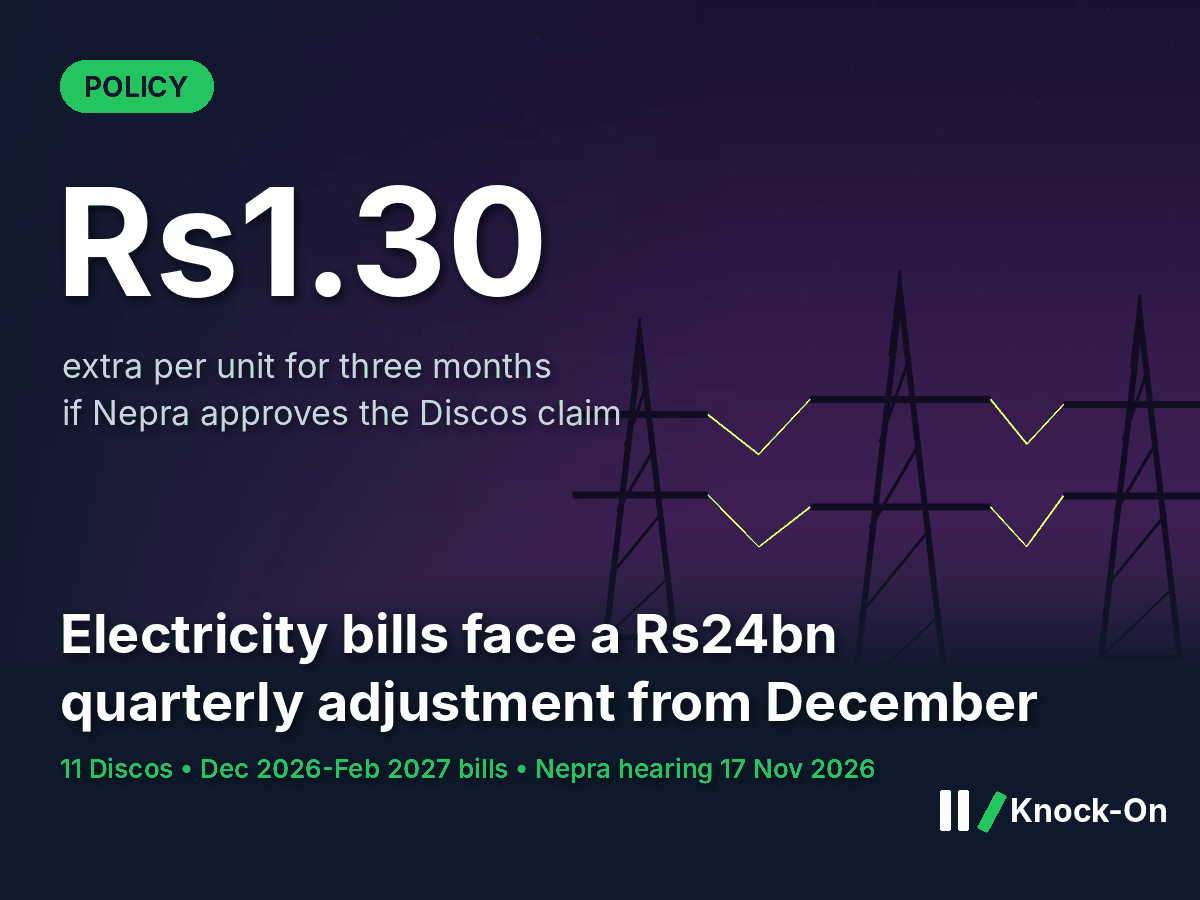
A new electricity tariff increase is on the table. Eleven state-owned distribution companies (Discos) have asked the power regulator, Nepra, for a Rs24bn quarterly tariff adjustment (QTA) for July to September 2026. If approved as filed, it would add about Rs1.30 a unit to bills for three months, from the December 2026 billing cycle to February 2027. At Nepra’s public hearing on Tuesday, industrial consumers challenged large parts of the claim.
The short version
- The Discos seek a net Rs24bn, about Rs1.30 a unit, to be recovered in December, January and February bills.
- Capacity charges across the 11 companies rose by Rs39bn in the quarter, according to the filings reported by Dawn.
- Under a 2023 government decision, an approved QTA would also apply to K-Electric customers.
- Nepra has not yet decided.
What happened
The hearing on 17 November was presided over by Nepra members Amina Ahmed, Maqsood Anwar Khan and Ghulamullah Shaikh, Dawn reported. Seven Discos sought about Rs37bn in recoveries, while four had negative adjustments worth about Rs13bn, giving the net Rs24bn. The largest claims came from Islamabad Electric (Rs10.833bn), Faisalabad (Rs10.46bn) and Peshawar Electric (Rs7bn). Tribal Electric (−Rs5.8bn), Quetta (−Rs4.1bn) and Hyderabad (−Rs1.95bn) would pass money back.
Three Discos account for Rs28bn of claims; three others pass money back
Quarterly tariff adjustment sought for July–September 2026, Rs bn, by distribution company
Industrial interveners Amir Shaikh of Lahore and Rehan Javed of Karachi disputed Rs39bn in extra capacity claims, Rs5.6bn for variable operation and maintenance, and Rs7.8bn for system losses. “This is like rubbing salt into our wounds,” Mr Shaikh said. Both linked part of the claim to the incremental consumption package, under which extra units are sold to industry at Rs10 below normal tariffs. Mr Javed said the Discos were claiming Rs29.25bn of package relief, a cost he said falls on other consumers, and argued that the wrong baseline year had been used. He asked Nepra to defer that amount until full data is filed. Power Division officials made a brief intervention; no decision was announced.
Why it matters
Power is one of the largest costs for Pakistani manufacturers, and business groups have repeatedly cited high energy costs at home as a drag on competitiveness, as in the debate over rising Pakistani investment abroad. An electricity tariff increase of Rs1.30 a unit through winter arrives soon after Nepra’s split decision that raised the industrial power tariff in the incentive package to Rs25.30 a unit. Unlike the monthly fuel charge adjustment, the QTA is built into base tariffs set by the federal government, so it applies across consumer groups.
The knock-on effects
First order: higher bills from December
If Nepra approves the claim as filed, households and businesses on the national grid, and K-Electric customers under the 2023 decision, would pay about Rs1.30 more per unit for three months.
Second order: factory costs and the incentive package
Industry argues that the package meant to lower its marginal power cost is now part of the bill being passed on. How Nepra treats the Rs29.25bn package claim will shape how much of the electricity tariff increase industry actually bears.
Third order: inflation and demand
Power costs feed into consumer prices, as with last month’s fuel charge rise. Higher grid tariffs also weaken the case for moving extra load onto the grid, which the package was designed to encourage.
Who could benefit
- Discos with large claims: Islamabad, Faisalabad and Peshawar would recover costs they say they have already incurred.
- Consumers of Tribal, Quetta and Hyderabad companies: their Discos filed negative adjustments.
- Solar and captive-power suppliers: each grid increase strengthens the case for self-generation.
Who may face pressure
- Manufacturers and exporters: a higher per-unit cost in the busy winter quarter.
- Retailers and small businesses: commercial tariffs rise alongside household ones.
- K-Electric customers in Karachi: an approved QTA would apply to them too.
What to watch
- Nepra’s decision, and whether it trims or defers the incremental-package and capacity claims.
- The 1 December 2026 billing cycle, when recovery would start if approved.
- The separate monthly fuel charge adjustments for October and November.
- Federal government notification extending the QTA to K-Electric.
Sources
- Dawn, Rs24bn additional QTA proposed by Discos draws protest from industrial consumers, 17 November 2026
This is analysis, not investment advice. Figures are as of 18 November 2026.
Leave a Reply