
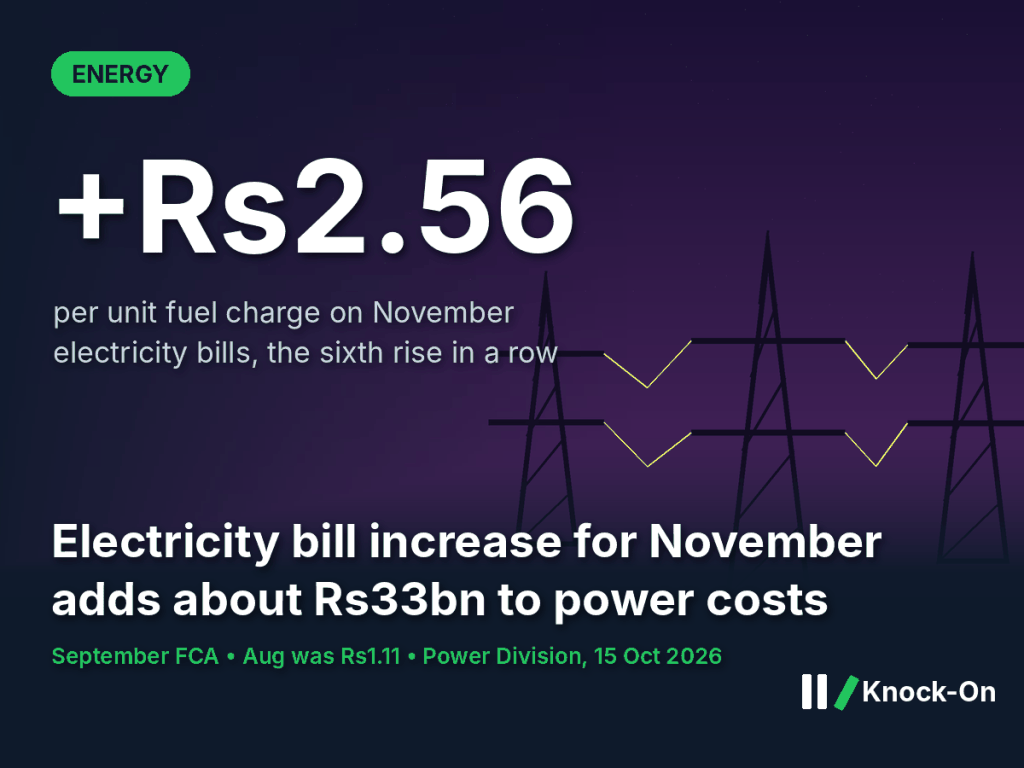
Another electricity bill increase is on the way. The Power Division said on Thursday that November bills are projected to carry a fuel charge of Rs2.56 per unit for September, worth about Rs33bn across consumers, Dawn reported. The government says the figure would have been much higher without load management and cheaper gas for power plants. For businesses already absorbing daily fuel price changes, it is one more cost that moves every month.
The short version
- November bills are projected to include a September fuel charge adjustment (FCA) of Rs2.56 per unit, with a total impact of about Rs32.7bn.
- That is Rs1.45 a unit more than August’s FCA of Rs1.11.
- The Power Division says load management and RLNG priced at domestic gas rates kept the charge up to Rs3.44 a unit lower than it would have been.
- The Nation reports it would be the sixth consecutive monthly fuel charge increase. NEPRA still has to approve it.
What happened
Fuel charge adjustments pass the difference between the fuel cost assumed in the base tariff and the actual cost of generation on to consumers, usually two months later. According to the Power Division’s statement, reported by Dawn, the September adjustment is projected at Rs2.56 per unit. The Central Power Purchasing Agency is set to ask NEPRA to approve it, The Nation reported.
The Division blamed higher international fuel prices linked to the Middle East conflict and the closure of the Strait of Hormuz, as well as limited LNG supply after Qatar declared force majeure. Dawn reported that Brent crude rose above $120 a barrel, against roughly $70 assumed in the base tariff. The Division said targeted load management of about two to two-and-a-half hours a day in September cut the use of expensive furnace oil and diesel, and that supplying imported RLNG to power plants at domestic gas prices reduced the charge by 83 paisa a unit.
September’s fuel charge is more than double August’s
Fuel charge adjustment, rupees per unit, as projected by the Power Division on 15 Oct 2026
Why it matters
The Division also said that fuel and quarterly adjustments for January to August together added only 65 paisa a unit, or 1.9% over the base tariff. The September charge on its own is several times that. Since April, consumers have paid more than Rs140bn in extra monthly fuel charges, including 18% sales tax, according to The Nation. For factories, shops and offices, the November electricity bill increase lands on top of a tariff debate that is already heated: industry is fighting the possible carry-over of old costs into next year’s base tariff (see our story on the Rs268bn of old costs in the 2027 electricity tariff).
The knock-on effects
First order: higher November bills
Every unit consumed in September will cost Rs2.56 more when it is billed in November, if NEPRA approves the request. For heavy users such as manufacturers, cold storage and large retailers, that is a direct hit to monthly operating costs, before sales tax.
Second order: the price of keeping bills down
The relief came partly from load management, meaning hours without power. Businesses that ran generators during those hours paid for diesel instead, which now costs Rs396.96 a litre. The cheaper RLNG for power plants also competes with other gas users this winter, which matters given the winter gas load shedding plan that puts industry and CNG behind homes.
Third order: industrial competitiveness
Industrial consumers dispute the benefit of the government’s incremental consumption package. Dawn reported that they say its Rs22.96 per unit rate helps only a few, while an actual marginal cost of about Rs34 a unit pushes roughly Rs11 a unit into the average tariff. NEPRA held a hearing last week on revising or suspending the package, with no decision yet. Exporters competing with regional rivals will watch that ruling closely.
Who could benefit
- Solar and battery suppliers: each new fuel charge strengthens the case for self-generation among shops and factories.
- Energy-efficiency firms: demand for audits, efficient motors and inverters tends to rise when unit costs climb.
- Users who consumed little in September: the charge scales with units used, so lighter users feel less of it.
Who may face pressure
- Power-intensive manufacturers, including textiles, steel and plastics.
- Small retailers and restaurants with heavy cooling and refrigeration loads.
- Businesses that ran diesel generators during load management hours.
- Distribution companies, if higher bills lead to slower payments.
What to watch
- NEPRA’s hearing and decision on the September fuel charge request.
- NEPRA’s ruling on the incremental consumption package for industry and agriculture.
- Whether load management continues into October, which would shape the December bill.
- Brent crude and LNG cargo availability while the Strait of Hormuz remains disrupted.
Sources
- Dawn, Power Division projects Rs2.56 per unit increase in Nov bills, says bigger hike averted due to load management, 15 October 2026
- Dawn, Power users face Rs33bn FCA hit in Nov bills, 16 October 2026
- The Nation, Consumers brace for another power price hike, 16 October 2026
- Daily Times, Pakistan electricity bills set to rise by Rs2.56 per unit in November, 15 October 2026
- Dawn, Govt reduces petrol price by Rs3.63 per litre, raises high-speed diesel rate by Re0.31, 15 October 2026
This is analysis, not investment advice. Figures are as of 16 October 2026. The fuel charge is a projection until NEPRA rules on it.


Leave a Reply