
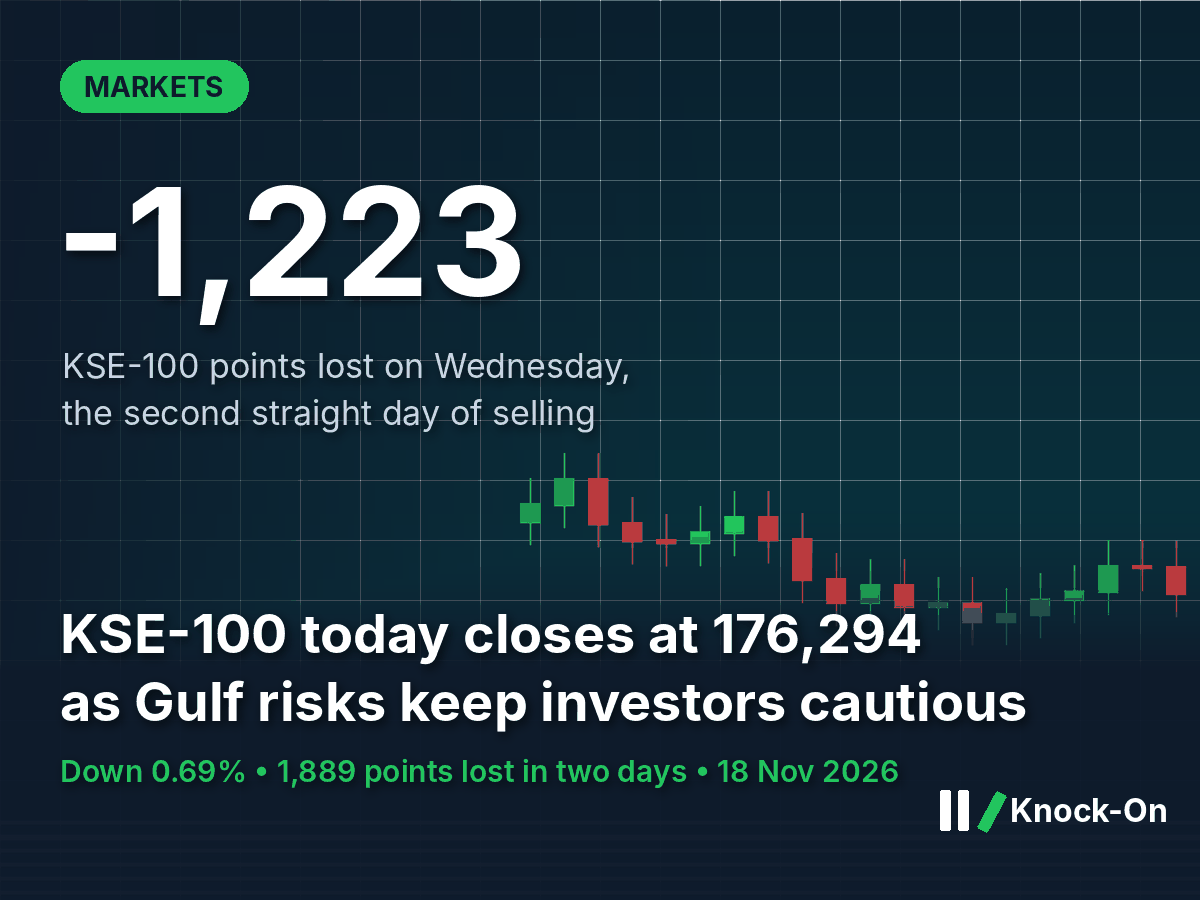
KSE-100 today closed at 176,294.33 at the Pakistan Stock Exchange on Wednesday, 18 November, down 1,223.40 points or 0.69%. Selling started shortly after the opening bell and a midday recovery attempt faded. It was the second straight losing session, and it leaves the benchmark below where it finished last week. For businesses, the message is that the market is pricing in a longer period of Gulf risk, high energy costs and tight money.
The short version
- The KSE-100 fell 1,223.40 points (0.69%) to 176,294.33, after a 665-point fall on Tuesday.
- The index has lost 1,889 points in two sessions and 1,580 points so far this week (Knock-On calculation).
- Heavyweight banks, cement, oil and gas, oil marketing, power and refinery shares led the decline.
- Reports linked the mood to US-Iran hostilities, Hormuz shipping disruption and the State Bank’s warnings about Middle East risk.
What happened
The index swung between an intraday high of 177,719.05 and a low of 176,053.63 before settling at 176,294.33, Business Recorder reported. At 1:19pm it had been down 770 points, according to The Express Tribune, which said heavyweight stocks in cement, commercial banks, oil and gas exploration, oil marketing, power generation and refineries were dragging the market lower.
The fall extends Tuesday’s loss of 665.22 points, which followed a small 309-point gain on Monday. Put together, the KSE-100 is now 1,580 points below last Friday’s close of 177,873.88. Wednesday’s close is also below the 177,374 level reached when profit-taking hit banks, oil and power stocks on 12 November, making it the index’s lowest close since the 10 November rally began.
Each day this week has been worse than the last
KSE-100 daily change in points, week of 16 November 2026
Why it matters
The KSE-100 today is reacting to the same forces that moved it up earlier in the month, only in reverse. The Tribune said investors stayed cautious amid continuing US-Iran hostilities and disruption to shipping through the Strait of Hormuz. Business Recorder pointed to the State Bank’s warning about “evolving external and domestic risks, particularly a prolonged conflict in the Middle East”. Oil itself eased on the day: Brent fell 1.4% to $91.86 a barrel by 0745 GMT after US stockpiles rose, the Tribune reported, but continued attacks in the Gulf limited the drop.
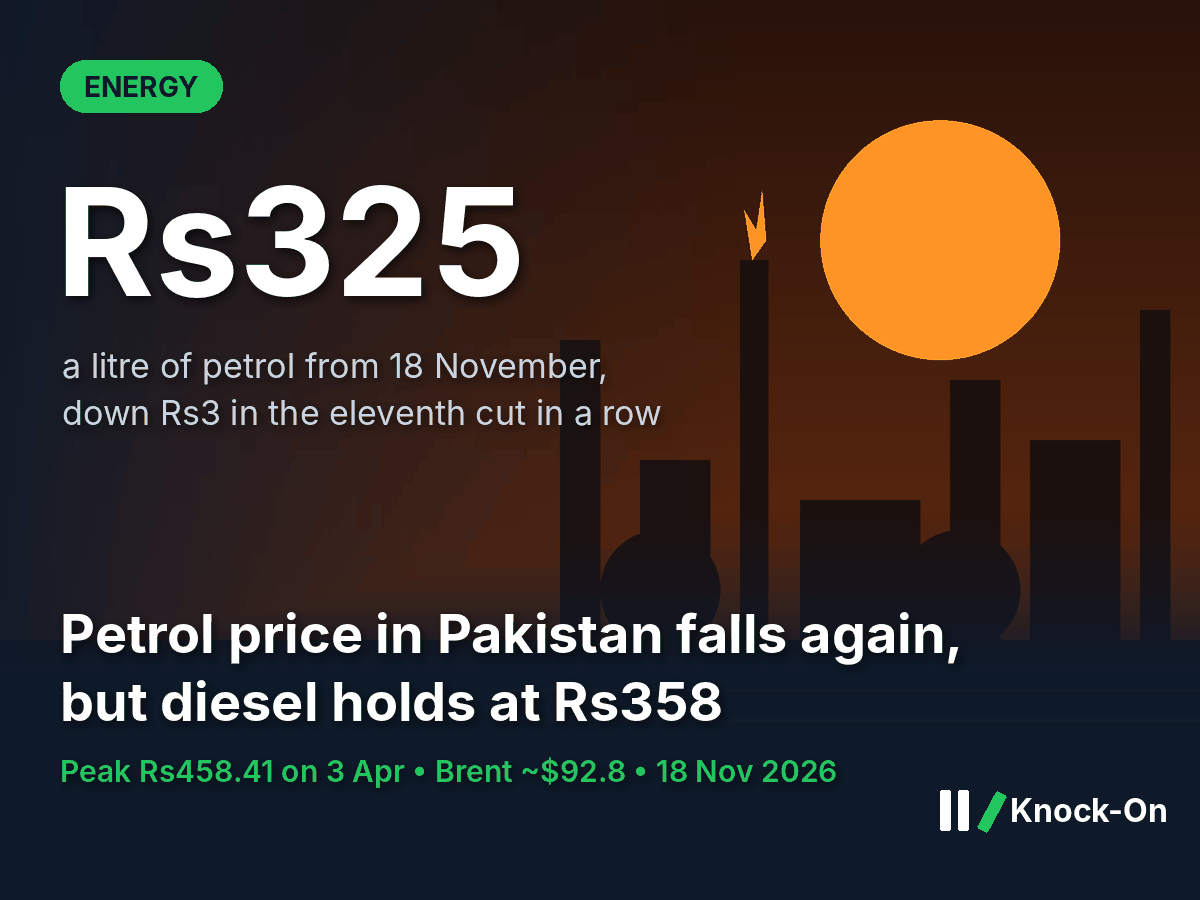
The domestic backdrop is mixed. The petrol price has just been cut for an eleventh time, to Rs325 a litre, but the SBP raised its policy rate by half a point to 12% in October, citing the inflation risk from high energy prices. That combination is good for fuel users and bad for the valuation of banks, cement makers and other rate-sensitive stocks.
The knock-on effects
First order: KSE-100 today trims portfolio values
Investors in index heavyweights, including mutual funds and pension funds, have seen two days of losses. The broad fall across banks, energy and cement means there was little place to hide within the large-cap market.
Second order: harder conditions for raising capital
Companies planning share sales or rights issues tend to wait for a firmer market. A run of losing days can delay those plans and push firms back towards bank borrowing at a 12% policy rate.
Third order: sentiment tied to the Gulf
As last week’s 3,987-point gain showed, the index can rise fast on calmer Gulf headlines. The reverse also holds, so business confidence indicators linked to the market may stay volatile until shipping risks ease.
Who could benefit
- Long-term buyers: lower prices give investors with cash a cheaper entry point, though not a guaranteed one.
- Fuel-heavy businesses: transporters and manufacturers still benefit from lower petrol and diesel prices.
- Fixed-income savers: a 12% policy rate keeps bank deposits and government securities attractive while equities wobble.
Who may face pressure
- Banks, cement and energy companies: the sectors that led the decline.
- Brokers: cautious markets can reduce trading activity and commission income.
- Firms planning listings: issuers may face lower valuations if the selling continues.
What to watch
- 19 November: the planned shutter-down strike in Balochistan.
- Friday 20 November: the weekly close, and whether the index recovers the 177,874 level.
- Gulf shipping and oil: any change in US-Iran hostilities or Hormuz traffic, the main swing factor this month.
Sources
- Business Recorder, PSX: selling continues, KSE-100 sheds over 1,200 points, 18 November 2026
- The Express Tribune, Selling pressure persists at PSX as KSE-100 sheds 770 points, 18 November 2026
- Business Recorder, PSX: selling returns, KSE-100 settles over 650 points lower, 17 November 2026
- Business Recorder, PSX: KSE-100 settles marginally higher amid late profit-taking, 16 November 2026
- The Nation, PSX gains over 500 points, 14 November 2026
- Arab News Pakistan, Pakistanis’ direct investment abroad rebounds to $342 million after sharp fall, 18 November 2026 (policy rate)
This is analysis, not investment advice. Figures are as of 18 November 2026 (market close).

Leave a Reply