
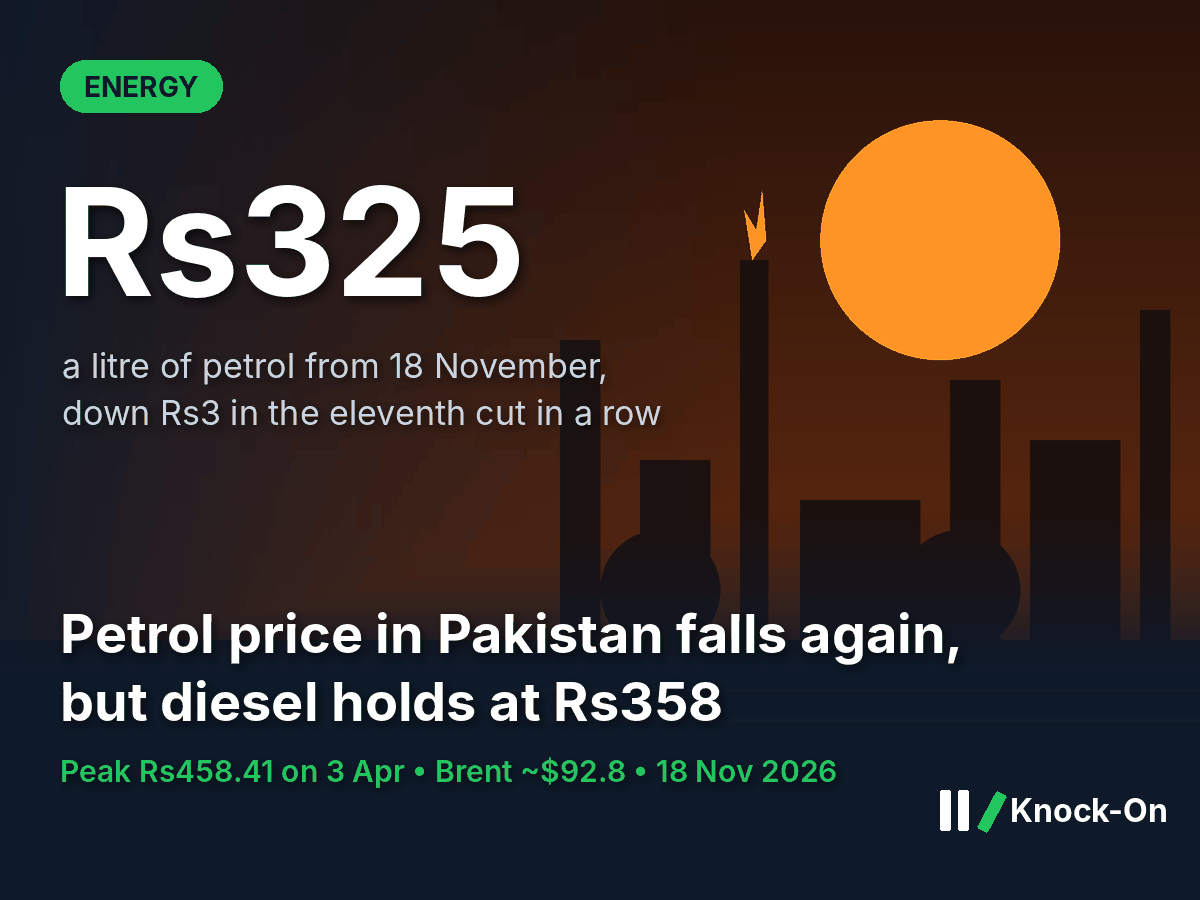
The petrol price in Pakistan fell by Rs3 to Rs325 a litre from Wednesday, 18 November, according to the Oil and Gas Regulatory Authority (Ogra). It is the eleventh consecutive reduction, Dawn reported, but high-speed diesel, the fuel that moves goods, buses and farm machinery, was left unchanged at Rs358. For businesses, the cut helps at the margin; the bigger cost question is still diesel, taxes and how long cheaper crude lasts.
The short version
- Petrol is now Rs325 a litre, down from Rs328; diesel stays at Rs358.
- Petrol has fallen Rs5 since 14 November, when it was Rs330.
- Both fuels are about 30% below their April peaks but still well above pre-war prices.
- Taxes and duties still add Rs114 a litre to petrol and Rs100 to diesel.
What happened
Ogra issued revised ex-depot prices on Tuesday evening under the pricing mechanism approved by the federal government, Business Recorder reported. Petrol went from Rs328 to Rs325 a litre. Diesel stayed at Rs358, after a Rs2 cut that took effect on 17 November. Before that, petrol was Rs330 and diesel Rs360 from 14 November.
Prices are now revised almost daily. According to Dawn, the petroleum minister said the cabinet and the prime minister had given Ogra responsibility for setting fuel prices daily based on international market trends. Brent crude was at $92.76 a barrel on 17 November, down 21% this month, Business Recorder reported.
Fuel is about 30% off its April peak, but still above pre-war levels
Pump price, Rs per litre: before the war (early March), peak (3 April) and 18 November 2026
Why it matters
By a Knock-On calculation, petrol is now Rs133.41 (29%) below its 3 April peak of Rs458.41 but still Rs59 (22%) above the Rs266 it cost in early March. Diesel is Rs162.35 (31%) below its Rs520.35 peak and Rs77 (27%) above its pre-war Rs281. So the petrol price in Pakistan is easing, but transport and logistics costs have not returned to where they were before the war.
Taxes are a large share of the pump price. Dawn reports that the government still levies Rs114 a litre in taxes and duties on petrol and Rs100 on diesel, about 35% and 28% of the current prices (Knock-On calculation). Part of the recent relief also comes from refineries: under an arrangement announced on 2 November for 30 days, refineries bear a cumulative Rs15bn of the petroleum levy, allowing a Rs14.71 reduction at the pump, according to the government. The IMF has separately asked Pakistan to phase out fuel subsidy support, which limits how far the government can absorb costs itself.
The knock-on effects
First order: petrol price in Pakistan eases for commuters
Motorcycle and car users, ride-hailing drivers and small delivery businesses pay Rs3 a litre less. The Prime Minister’s Fuel Relief Scheme, rolled out on 17 September for motorcycles, rickshaws and vehicles up to 800cc, remains in place, according to Dawn.
Second order: freight costs depend on diesel
Trucking, intercity buses, tractors and tube-wells run mainly on diesel, which did not move this time. Freight rates and food transport costs are therefore unlikely to fall from this revision alone.
Third order: inflation and the oil risk
Lower fuel prices feed through to inflation over time. But daily pricing means cuts can reverse quickly if crude rises. Gulf supply risks have not gone away: Houthi claims of drone attacks on Saudi Arabia’s East-West pipeline, covered in our Yanbu pipeline analysis, show how quickly sentiment can change, even after the IEA’s oil surplus forecast.
Who could benefit
- Commuters and two-wheeler users, whose main fuel is petrol.
- Ride-hailing and last-mile delivery firms, where petrol is a large running cost.
- Retailers, if lower household fuel bills free up spending.
Who may face pressure
- Fuel retailers and oil marketing companies, as frequent cuts reduce the value of stock bought at higher prices.
- Refineries, which are sharing Rs15bn of the levy burden under the 30-day arrangement.
- Transporters, who see no relief while diesel stays at Rs358.
What to watch
- Ogra’s daily price notifications, especially any diesel cut.
- The end of the 30-day refinery levy arrangement announced on 2 November.
- The OPEC+ meeting scheduled for 29 November on 2027 output.
- Gulf shipping and pipeline security, and the IMF’s position on fuel subsidies.
Sources
- Dawn, Petrol price reduced by Rs3 per litre, diesel remains unchanged, 17 Nov 2026
- Business Recorder, Govt decreases petrol price Rs3 per litre, keeps diesel rate unchanged, 17 Nov 2026
- Business Recorder, Govt slashes petrol, diesel prices by Rs2 per litre, 16 Nov 2026
- 5paisa, Crude oil price today, 17 November, 17 Nov 2026
- Dawn live blog (Reuters), Houthis say they launched drones towards Saudi East-West pipeline, 17 Nov 2026
This is analysis, not investment advice. Figures are as of 18 November 2026.
Leave a Reply