

The KSE-100 weekly gain at the Pakistan Stock Exchange was 3,987 points, or 2.29%, taking the benchmark to 177,874 at Friday’s close on 13 November. It was a four-session week, because Monday was the Iqbal Day holiday, and nearly all of the gain arrived in a single day. For businesses, the message is that the market is trading oil prices and Gulf headlines first, and local news second.
The short version
- The KSE-100 rose 3,987 points (2.29%) on the week to 177,874, after a 7,477-point gain the week before.
- Tuesday alone added 5,449 points; Wednesday and Thursday gave back 1,962, and Friday added 500.
- Brent crude averaged $94 a barrel, down 6.2% from $100, and October remittances reached $3.9bn.
- Trading picked up: average daily volume rose 27% to 1,083 million shares.
What happened
The week opened on Tuesday with a single large rally. As the KSE-100 jumped 5,449 points to 179,335, investors reacted to falling oil prices and signals of restraint between Washington and Tehran. The Express Tribune quoted Mohsin Shafi Qureshi of JS Global as saying oil “slid to its lowest level since late August” before rebounding on Thursday.
The index then slipped 252 points on Wednesday and fell 1,710 points on Thursday, when profit-taking hit banks, oil and power stocks and the index closed at 177,374. Friday brought a partial recovery of 500.11 points (0.28%) to 177,873.88, according to The Nation, after the index had touched 179,284 during the session.
One Tuesday rally made the whole week
KSE-100 daily change in points, week to 13 November 2026 (Monday was a holiday)
Why it matters
Two weeks of gains have taken the KSE-100 from 166,410 to 177,874, a rise of 11,464 points (Knock-On calculation). The drivers are mostly external. Arif Habib Limited said in its weekly note that “the continuously declining oil prices eased inflationary concerns”, and Brent’s slide matters because Pakistan imports most of the fuel it uses. Petrol was cut by Rs21 to Rs332 a litre and diesel by Rs22 to Rs360 during the week, the Tribune reported.
The home-grown support came from money sent by Pakistanis abroad. October remittances rose 13.8% to $3.9bn, and inflows for the first four months of the fiscal year reached $14.8bn, up 14%. SBP reserves stood at $21.6bn, about 3.03 months of imports, according to Arif Habib data cited by the Tribune.
The knock-on effects
First order: KSE-100 weekly gain lifts market value
Market capitalisation rose by Rs426bn during the week to about Rs19.34tr, Minute Mirror reported. Average daily traded value climbed 36% to $140m, so more money was changing hands, not just prices moving on thin trade.
Second order: cheaper borrowing and fuel
Lower oil prices and easing inflation also fed into the debt market: cut-off yields at the week’s treasury bill auction fell by 22 to 48 basis points as the government raised Rs587bn. Lower government borrowing costs tend to pull down the rates banks charge companies over time.
Third order: a market tied to the Gulf
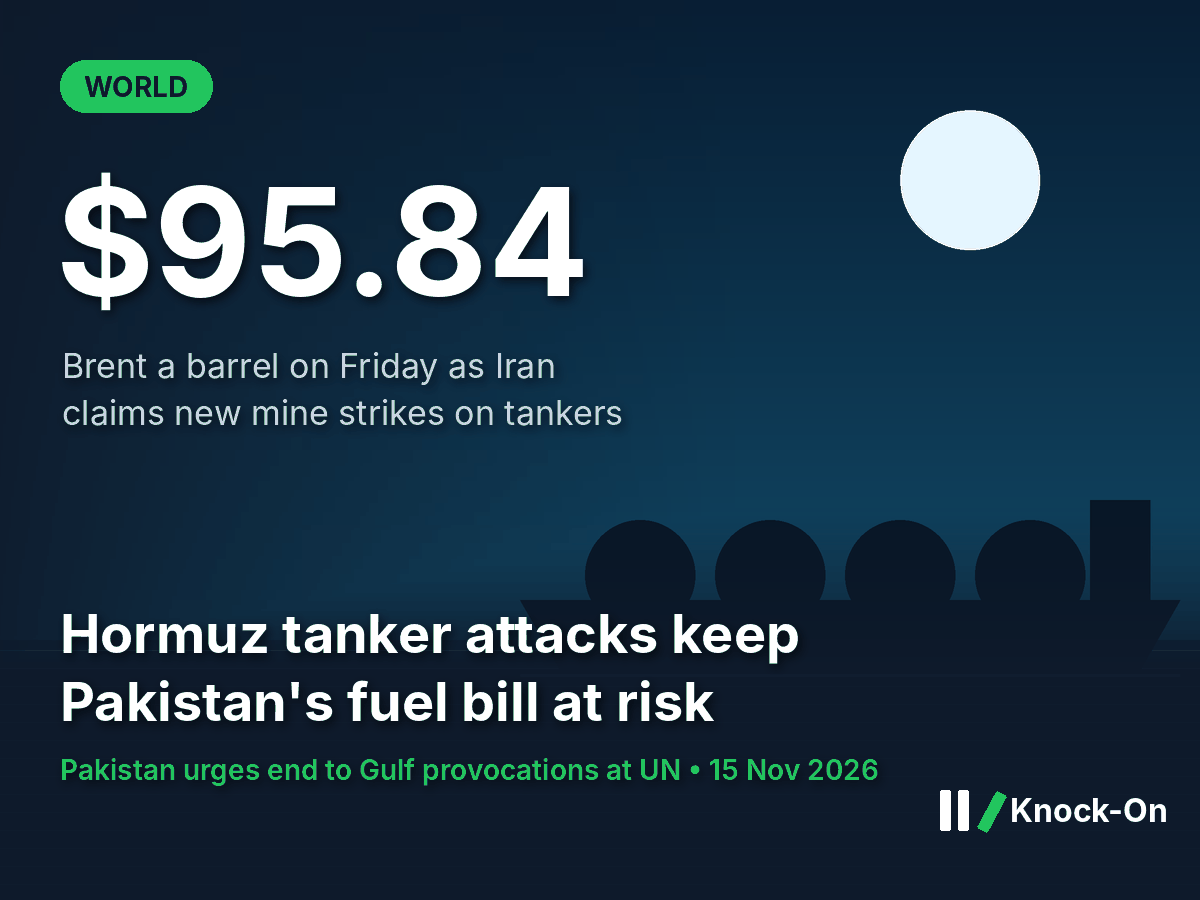
Because the rally rests on oil and US-Iran signals, it can reverse quickly. Brent rebounded on Thursday and closed the week at $96, and Thursday’s sell-off showed how fast investors book profits when Gulf headlines turn.
Who could benefit
- Fuel-heavy businesses: transporters, manufacturers and airlines gain from lower petrol and diesel prices while they last.
- Brokers and listed companies raising money: higher volumes and a firmer index make share sales easier.
- Auto sellers: October car sales of 24,400 units were up 41% on a year earlier, the Tribune reported.
Who may face pressure
- Late buyers: investors who bought at Tuesday’s peak were sitting on losses by Friday.
- Industrial power users: Nepra notified an incremental tariff of Rs25.30 a unit for industrial and farm users, up from Rs22.98, the Tribune noted.
- Oil and gas producers: lower crude prices squeeze their earnings even as they help the wider economy.
What to watch
- 16 November: outcomes of the ECO ministerial meeting in Islamabad on regional trade and transit.
- 19 November: the planned shutter-down strike in Balochistan.
- Oil prices and US-Iran news: the main swing factor for the index, as Gulf shipping attacks continue to be reported.
Sources
- The Express Tribune, Remittances, cheaper oil lift PSX, 15 November 2026
- The Nation, PSX gains over 500 points, 14 November 2026
- Minute Mirror, Stock Market investors see positive week as KSE-100 makes major gains, 14 November 2026
- The Express Tribune, PSX stages strongest rally in six months, 8 November 2026
This is analysis, not investment advice. Figures are as of 13 November 2026 (market close).

Leave a Reply