
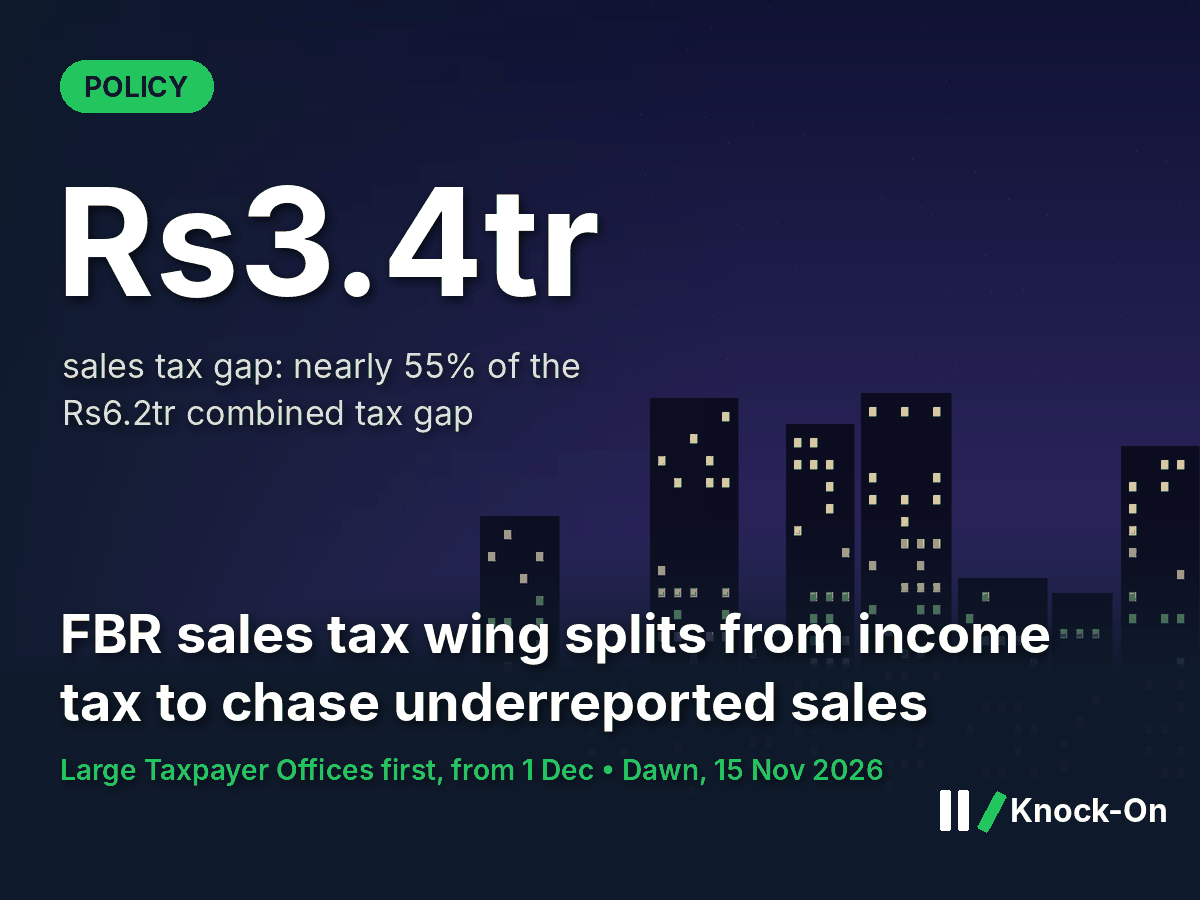
The FBR sales tax overhaul will separate sales tax enforcement from income tax work inside the Inland Revenue Service, reversing an integration that has lasted 17 years. Senior tax officials told Dawn the change is meant to close a sales tax gap of Rs3.4tr, nearly 55% of the Rs6.2tr in taxes that go uncollected. For businesses that file sales tax returns, it means dedicated officers looking more closely at reported sales and input tax claims.
The short version
- Sales tax and federal excise will get their own member at the Federal Board of Revenue, reporting directly to the chairman.
- Separate sales tax zones, headed by commissioners, will be set up within each chief commissioner’s area.
- Large Taxpayer Offices switch first, from 1 December, followed by corporate and regional offices within about two months.
- Officials point to a Rs3.4tr sales tax gap as the reason.
What happened
Sales tax and federal excise duty moved from Customs to the Inland Revenue Service in 2009 under a World Bank project, and since then the same officers have handled both sales tax and income tax. Under the new plan, reported by Dawn on 15 November, both taxes stay inside the IRS, but from commissioner level downwards some officers will work only on sales tax. The new member for sales tax and FED will oversee three chief commissioners and their teams, using data analysis, operations and follow-up on selected cases. Chief commissioners and the Member IRS (Operations) keep administrative control.
The FBR has started testing staff to find the right people. “We have already launched an exercise to identify competent officers,” one official told Dawn, adding that a recent proficiency test in Karachi showed officers did better on income tax than on sales tax.
Sales tax is more than half of the money Pakistan fails to collect
Estimated tax gap, rupees, as reported 15 November 2026
Why it matters
The FBR sales tax base is narrow. Internal FBR estimates cited by Dawn show about 90% of sales tax comes from 15,000 taxpayers. In early 2024 about 313,000 businesses were registered for sales tax, but only 190,000 filed returns, many declaring no taxable sales. That leaves documented firms carrying most of the load while competitors under-report. The pressure to collect more is already visible in the budget: Pakistan’s fiscal surplus shrank 40% in July-September as interest bills rose.
Officials also point to evidence that closer monitoring works. In 12 manufacturing sectors with production monitoring, the revenue gap fell by 12 percentage points of potential collections over two years; in seven sectors without it, the gap rose by 9 points.
Where output is monitored, the gap shrinks
Change in revenue gap over two years, percentage points of potential collections
The knock-on effects
First order: more FBR sales tax scrutiny for large firms
Large taxpayers move first, from 1 December. Specialised officers will pursue under-reported sales and questionable input tax claims, so big companies should expect more detailed questions on their returns and on the invoices behind their refunds.
Second order: pressure down the supply chain
When input tax claims are checked more closely, large buyers tend to insist that their suppliers are registered and file properly. Smaller distributors and wholesalers could find that documentation becomes a condition of doing business, much as the cashless Islamabad deadline is pushing merchants onto digital payments.
Third order: a test of FBR capacity
The plan depends on finding enough skilled sales tax officers during a two-month transition. Officials told Dawn that a common digital system run by Pakistan Revenue Automation Ltd (PRAL) has weakened the original case for keeping the two taxes together.
Who could benefit
- Compliant manufacturers: firms already paying in full could face fairer competition if under-reporting rivals are caught.
- The federal budget: any narrowing of the Rs3.4tr gap adds revenue without new tax rates.
- Tax advisers: demand for sales tax compliance work is likely to rise.
Who may face pressure
- Nil filers: registered businesses that report no taxable sales are an obvious target.
- Firms with large input tax claims: refunds and adjustments may take longer while they are checked.
- Unregistered suppliers: they may lose business from large buyers who need clean invoices.
What to watch
- 1 December 2026: the switch at Large Taxpayer Offices.
- Next two months: rollout to Corporate and Regional Tax Offices, with the transition expected to finish within about two months.
- Appointments: who is named as the new member for sales tax and FED, and any formal FBR notification.
- Monthly collections: whether sales tax receipts rise, alongside earlier shifts such as the 45% fall in real estate tax.
Sources
- Dawn, Sales tax gets new enforcement structure to cut collection gap, 15 November 2026
This is analysis, not investment advice. Figures are as of 15 November 2026.


Leave a Reply