
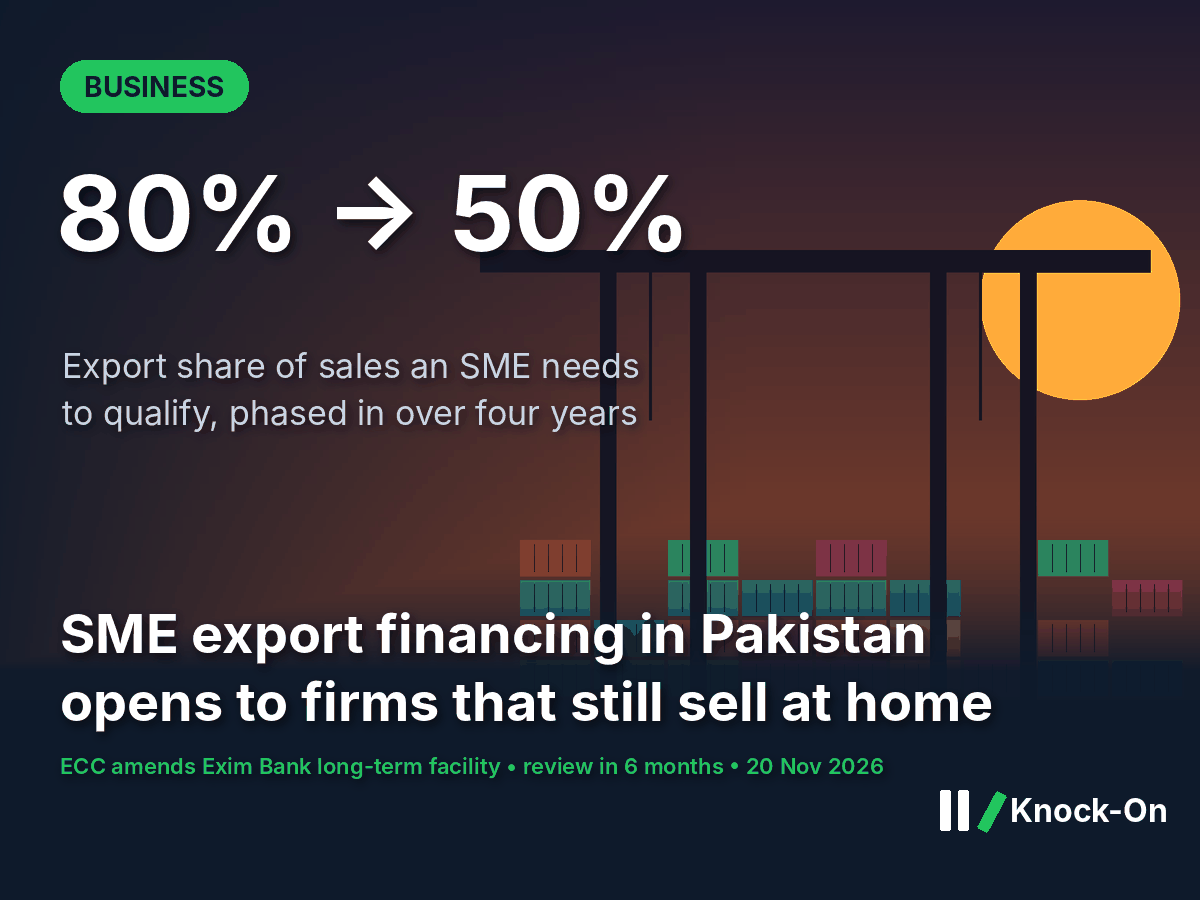
SME export financing in Pakistan has just become easier to reach. On Friday the federal cabinet’s Economic Coordination Committee (ECC) changed the rules of the Long-Term Export Growth Financing Facility, run through Exim Bank of Pakistan, lowering the minimum export threshold from 80% to 50% within four years. Until now, a small manufacturer that sold most of its output at home could not use the facility to buy machinery for an export push. The change opens long-term, export-linked credit to firms that are only starting to sell abroad.
The short version
- The ECC lowered the facility’s minimum export threshold from 80% to 50% within four years, to help SMEs and “emerging exporters”.
- It follows a 5 November instruction from Prime Minister Shehbaz Sharif to scrap the 80% export condition for SME long-term finance.
- The ECC asked for a progress review after six months.
- Rates, loan sizes and the total size of the facility were not announced.
What happened
The ECC, chaired by Finance Minister Muhammad Aurangzeb, met at the Finance Division on 20 November. According to the official statement carried by APP and Business Recorder, it approved amendments to the Long-Term Export Growth Financing Facility “to facilitate SME financing and support emerging exporters”. The amendments lowered the minimum export threshold from 80% to 50% within four years, and the committee directed a review of progress after six months. The statement does not spell out whether the four years is a phase-in period or the time a borrower has to reach the export share.
The move puts into effect a decision announced on 5 November, when the Prime Minister’s Office said the requirement for SMEs to earn at least 80% of their revenue from exports to qualify for long-term financing would be abolished. At that meeting officials put the number of export-oriented SMEs at about 17,000 and said the State Bank’s SME portal had received more than 10,000 loan applications since its 1 November launch. Separately, the Export Finance Scheme was raised to Rs1.5tr from Rs1tr, with Rs300bn set aside for SMEs and new exporters, Dawn reported on 17 November.
SME credit has grown fast, but the targets are much higher
Outstanding SME financing in Pakistan vs official targets, Rs bn
Why it matters
Long-term export finance is usually cheaper and longer than ordinary bank credit, but an 80% export test kept it mostly with established exporters. Most small firms grow into exporting gradually: they sell at home, win a first foreign buyer, then add capacity. Lowering the bar to 50% lets that middle group borrow for machinery and expansion before exports dominate their sales. It also fits the wider push on SME credit. Outstanding SME loans stood at Rs1,148bn in October, still well short of the State Bank’s Rs1,500bn goal for June 2027, as our earlier look at SME loans in Pakistan showed.
The knock-on effects
First order: more SMEs qualify for export financing
Firms with export shares between 50% and 80% are the immediate winners. Exim Bank and the commercial banks that lend through it should see a wider pool of applicants, especially in light engineering, food processing, surgical goods, sports goods and home textiles, where many producers sell both at home and abroad.
Second order: more machinery imports and capacity
Long-term facilities are mainly used to buy plant and equipment. If take-up rises, machinery imports and local fabrication orders should follow, which would support the recovery in manufacturing seen in first-quarter LSM growth. It also adds to import demand at a time when dollars are scarce.
Third order: exports only follow if costs allow
Cheaper capital does not fix high energy costs, taxes or freight. The payoff for the economy depends on whether new capacity turns into foreign sales. The six-month review will be the first test. Services exporters, whose IT export earnings hit a record in October, are not the main target of a machinery-focused facility.
Who could benefit
- Emerging exporters: small manufacturers selling half or more of output abroad, who were shut out by the 80% test.
- Exim Bank and partner banks: a larger pool of eligible, partly state-supported borrowers.
- Machinery suppliers: importers and local fabricators of industrial equipment.
Who may face pressure
- Large exporters: they may compete with more small firms for the same pool of concessional funds.
- Banks: SME lending carries higher risk and paperwork, and the PM has told regulators to show slow banks no leniency.
- Borrowers who miss the target: firms that fail to reach the export share could face penalties; the terms have not been published.
What to watch
- Exim Bank’s revised facility rules: rates, tenor and how the 50% share is measured.
- The ECC’s six-month progress review, due around May 2027.
- State Bank SME credit data against the Rs1,500bn June 2027 target.
- Monthly export figures for signs that new capacity is reaching foreign buyers.
Sources
- Business Recorder, ECC approves amendments to Long Term Export Growth Financing Facility, 20 Nov 2026
- APP, ECC approves SME export financing reforms, key TSGs, 20 Nov 2026
- Dawn, The Economic Coordination Committee lowers export threshold for SMEs, 21 Nov 2026
- Dawn, Financing for export sector raised to Rs1.5tr, 17 Nov 2026
- PKRevenue, PM Shehbaz abolishes 80% export condition for SME financing, 5 Nov 2026
This is analysis, not investment advice. Figures are as of 21 November 2026.

Leave a Reply