
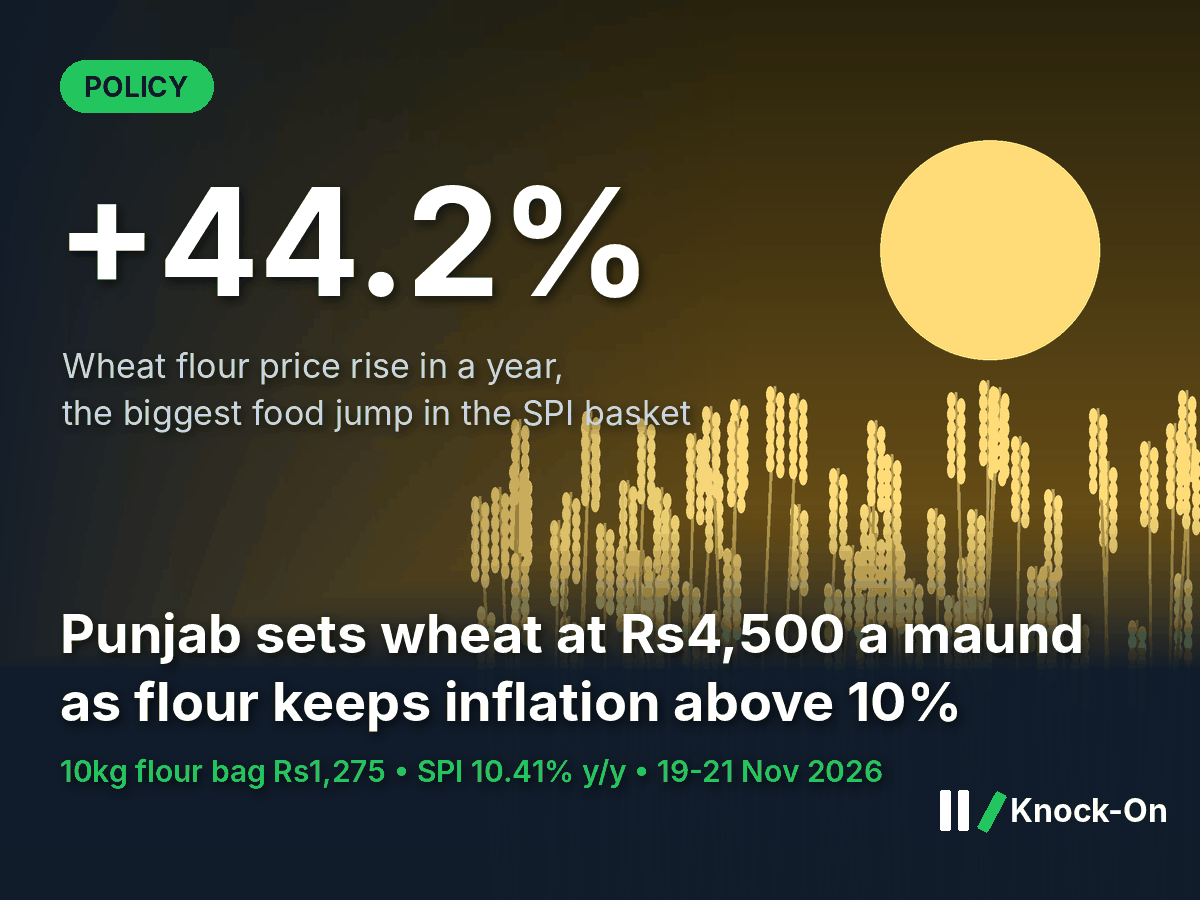
The flour price in Pakistan is now the single biggest food driver of inflation. Official weekly data show wheat flour costs 44.2% more than a year ago, and on Friday Punjab fixed the price at which it releases government wheat to flour mills at Rs4,500 per 40kg, with a 10kg flour bag set at Rs1,275. For mills, bakers, restaurants and employers, the question is whether a fixed release price will now cap flour costs, or simply lock them in at a higher level.
The short version
- Punjab has set the wheat release price for flour mills at Rs4,500 per 40kg and the 10kg flour bag at Rs1,275 (Dawn, 21 Nov).
- Wheat flour is up 44.2% year on year in the Sensitive Price Index (SPI), and rose 4.42% in the latest week alone.
- Headline SPI inflation eased to 10.41% for the week to 19 November, from 11.21% a week earlier, helped by cheaper petrol and diesel.
- The new release price is Rs700, or about 18%, above the Rs3,800 Punjab set in August (Knock-On calculation).
What happened
A notification issued on Friday, 20 November, by the Secretary of Punjab’s Food Safety and Consumer Protection Department fixed the release price of government wheat for flour mills at Rs4,500 per 40kg, Dawn reported. A 10kg flour bag is to retail at Rs1,275. Wheat will be released against advance payment, with quotas allocated to districts up to their urban population, mills limited to their existing roller capacity, an extraction ratio of 70:18:12 (flour, fine and bran), and daily reporting to the province’s food monitoring system. Supply will come from a mix of PASSCO stocks, aggregators and imports. In August, Punjab had set the release price at Rs3,800 per 40kg after provincial cabinet approval, Dunya News reported at the time.
The same day, the Pakistan Bureau of Statistics released the weekly SPI. Inflation on the 51-item basket was 10.41% year on year for the week ending 19 November and fell 0.65% week on week, the second weekly decline in a row. Twenty-three items rose, eight fell and 20 were unchanged. Wheat flour rose 4.42% in the week, behind only eggs (8.84%) and potatoes (8.07%), and is up 44.2% on a year earlier, according to Dawn.
Flour is rising four times faster than the SPI as a whole
Year-on-year price change, % — SPI week ending 19 Nov 2026
Why it matters
Flour is the staple that sits under almost every household budget and every wage negotiation. Fuel has been doing the opposite: petrol fell from Rs396.06 to Rs322 a litre over the 21 days to 20 November, and diesel from Rs398.80 to Rs355. That has pulled headline weekly inflation down, as we noted in our last weekly inflation analysis, but flour is now offsetting part of the relief. A fixed release price gives mills a known cost for government wheat, yet at Rs4,500 it confirms that wheat is far dearer than it was in the summer. The supply mix also matters: Punjab’s release relies partly on imports, which began arriving in October, as covered in our report on the wheat import in Pakistan.
The knock-on effects
First order: a higher, fixed flour price in Punjab
Mills that buy government wheat pay Rs4,500 per 40kg and must sell the 10kg bag at Rs1,275. Advance payment and district quotas tie up mill working capital and limit how much each mill can grind.
Second order: bakers, restaurants and food processors
Bread, biscuits, naan and restaurant meals all use flour heavily. With plain bread already up 12.35% in a year, businesses face a choice between raising prices again or absorbing costs while customers are also paying more for LPG and electricity.
Third order: wages and the interest-rate outlook
Sticky food inflation keeps pressure on wages and on the State Bank, which raised its policy rate partly on wheat prices in October, as we reported on the SBP interest rate hike. Falling fuel prices help, but flour limits how quickly overall inflation can come down.
Who could benefit
- Flour mills with secure quotas get a predictable input price and a set retail price to plan around.
- Wheat holders and aggregators supplying the release scheme sell at a higher official price than in August.
- Transport users may see fares fall: Planning Minister Ahsan Iqbal has directed provinces to cut passenger and freight fares in line with lower fuel prices, Dawn reported.
Who may face pressure
- Low-income households, for whom flour is a daily staple.
- Bakeries, tandoors and food processors with thin margins and price-sensitive customers.
- Smaller mills that struggle to pre-pay for wheat or sit outside urban quotas.
What to watch
- The next weekly SPI release, due Friday 27 November: does flour keep rising after the release price is fixed?
- Whether the Rs1,275 10kg bag price holds in retail markets, and how other provinces set their own prices.
- November CPI inflation, due in early December, and the SBP’s next policy decision.
- Further wheat import arrivals that feed the release scheme.
Sources
- Dawn, Punjab fixes wheat release price, 21 Nov 2026
- Dawn, Weekly inflation stays above 10pc, 21 Nov 2026
- Dunya News, Punjab govt fixes wheat release price at Rs3,800 per 40kg, 4 Aug 2026
This is analysis, not investment advice. Figures are as of 21 November 2026.



Leave a Reply