
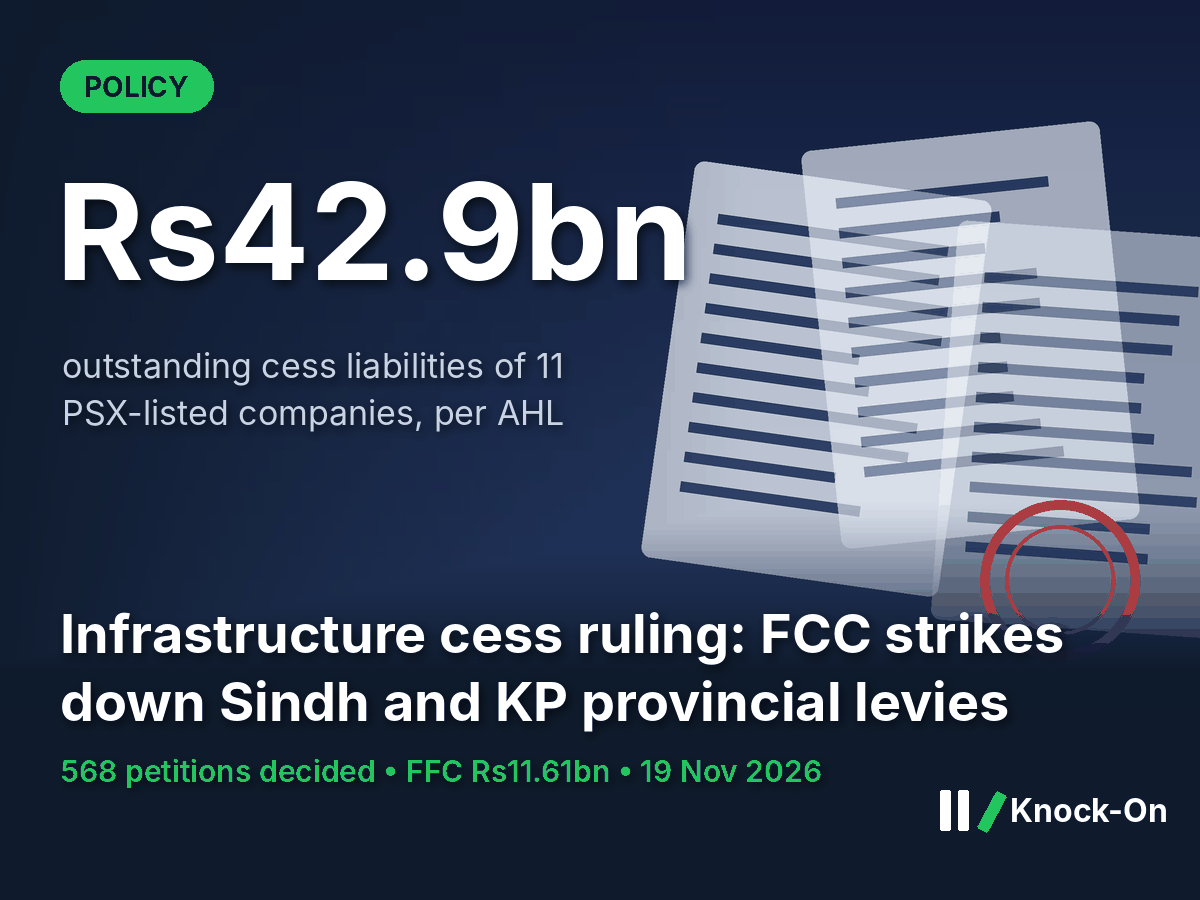
The infrastructure cess ruling handed down by the Federal Constitutional Court (FCC) on Thursday, 19 November, has struck down the laws Sindh and Khyber Pakhtunkhwa used to charge a cess on goods in trade, declaring them beyond provincial legislative competence. For business, the headline number comes from brokerage Arif Habib Limited (AHL): 11 PSX-listed companies have Rs42.9bn in outstanding cess liabilities that could eventually be reversed. The detailed judgment is still awaited, so the final financial effect is not yet settled.
The short version
- A two-member FCC bench set aside Sindh High Court and Peshawar High Court judgments that had upheld the provincial infrastructure cess, deciding 568 petitions.
- AHL estimates 11 listed companies carry Rs42.9bn in outstanding liabilities; Fauji Fertilizer alone accounts for Rs11.61bn.
- Reversing the liabilities could save about Rs5.15bn a year in financing costs, AHL estimates, assuming a 12% interest rate.
- Companies are expected to wait for the detailed judgment, and review petitions are possible.
What happened
The bench, headed by FCC Chief Justice Aminuddin Khan with Justice Aamer Farooq, ruled on the Sindh Development and Maintenance of Infrastructure Cess Act, 2017 and the Khyber Pakhtunkhwa Infrastructure Development Cess Act, 2022, as amended by the KP Finance Act, 2024, according to The Nation and the Express Tribune. The appeals were first filed in the Supreme Court and later transferred to the FCC.
Counsel for the FBR and the Revenue Division argued that imports, exports and customs duties are exclusively federal subjects under Article 142(a) and Entries 27 and 43 of the Federal Legislative List, and that a levy’s constitutionality depends on its nature and incidence, “not its label”. Counsel for KP petitioners argued the 2% cess on the customs value of goods, collected at export, “effectively imposed an export duty”. The Sindh and KP governments defended the laws as funding provincial roads and transport infrastructure and as within their competence, the Tribune reported.
One company holds over a quarter of the Rs42.9bn at stake
Outstanding infrastructure cess liabilities of 11 PSX-listed companies, Rs bn, AHL estimate, 20 Nov 2026
Why it matters
The infrastructure cess has been one of the longest-running disputes between importers, exporters and the provinces. Companies that contested it have carried the amounts as liabilities on their balance sheets. If those are reversed, the gain flows straight to reported profits. AHL puts the per-share benefit at Rs47.37 for Indus Motor and Rs25.47 for Honda Atlas Cars. Part of the money has already been recognised: AHL says Rs16.7bn was booked as present-value gains by companies that signed settlement agreements in February 2026. Carmakers matter here because, as Pakistan’s latest LSM data showed, vehicles are one of the few sectors still growing.
The knock-on effects
First order: one-off earnings boosts after the detailed judgment
Fauji Fertilizer, Indus Motor, Honda Atlas Cars, Nishat Mills, D.G. Khan Cement, Lucky Cement, Lotte Chemical, Engro Fertilizers, LCI, EPCL and International Industries are the 11 companies AHL names. Once the detailed infrastructure cess judgment is out and auditors accept it, reversals could lift reported earnings in the quarter they are booked.
Second order: lower financing costs and lighter trade costs
AHL’s Rs5.15bn a year in financing savings reflects money no longer tied up against the cess. For exporters in KP, losing a 2% charge on export value makes shipments cheaper at a time when trade with neighbours is already under pressure, as Pakistan’s widening regional trade gap shows.
Third order: a hole in provincial road budgets
Sindh and KP argued the cess paid for roads and transport infrastructure. Losing it means either finding money elsewhere, cutting spending, or seeking a new, federally compatible way to charge for the same services. That debate could feed into provincial budgets and the next round of federal-provincial fiscal talks.
Who could benefit
- Fertiliser makers: Fauji Fertilizer has the single largest liability at Rs11.61bn; Engro Fertilizers is also on the list.
- Carmakers: Indus Motor and Honda Atlas have nearly Rs10bn between them.
- Cement, chemicals and steel: Lucky, D.G. Khan, Lotte Chemical, LCI, EPCL and International Industries.
- KP exporters: no longer face a 2% charge on export value under the struck-down law.
Who may face pressure
- The Sindh and KP governments, which lose a revenue stream earmarked for infrastructure.
- Contractors and suppliers relying on provincial road and transport spending.
- Investors who price in reversals early: the gains depend on the detailed judgment and any review.
What to watch
- The FCC’s detailed judgment, including how amounts already paid or settled are treated (date not announced).
- Whether Sindh or KP file review petitions.
- Company disclosures to the PSX on reversals, and how the stocks trade next week after a choppy week for the KSE-100.
Sources
- Express Tribune, FCC quashes provincial infrastructure cess, 20 Nov 2026
- The Nation, FCC strikes down Sindh, KP infrastructure cess laws, 20 Nov 2026
- TechJuice (citing Arif Habib Limited), 11 PSX-Listed Companies to Receive Rs. 43 Billion Tax Relief, 20 Nov 2026
This is analysis, not investment advice. Figures are as of 20 November 2026.

Leave a Reply