
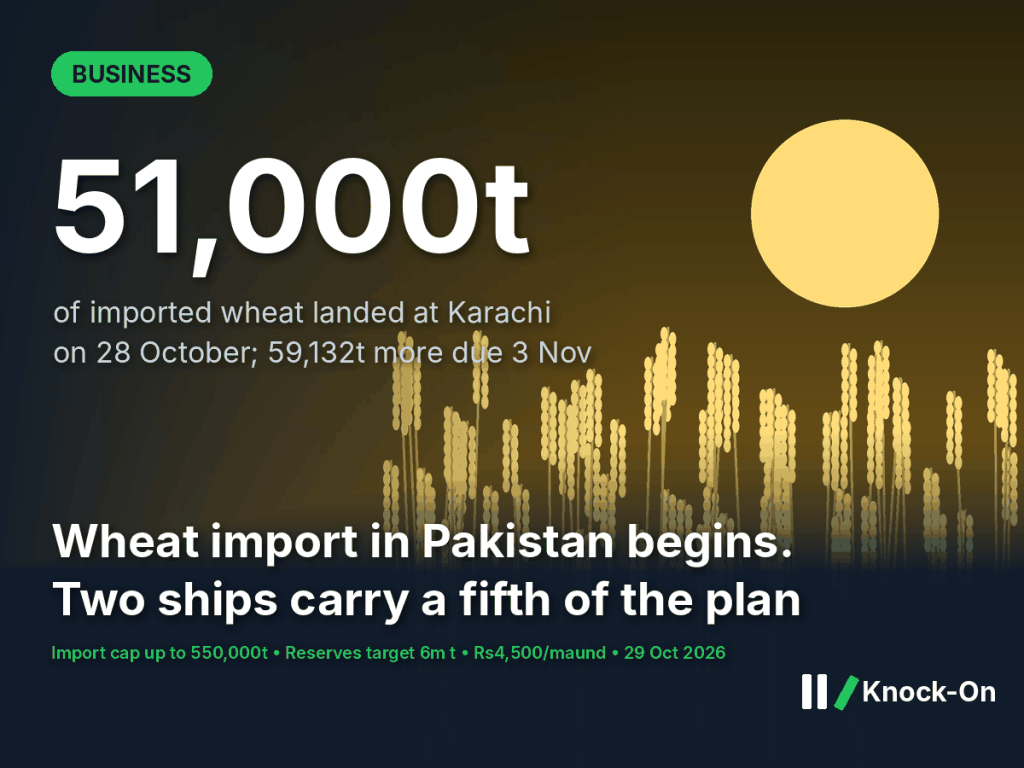
The wheat import in Pakistan has started to land. A vessel carrying 51,000 tonnes of wheat berthed at Karachi Port on 28 October, and a second carrying 59,132 tonnes is due on 3 November, according to the Karachi Port Trust as reported by Minute Mirror and ARY News. The government has said it may import up to 550,000 tonnes, so the two ships together carry about a fifth of that ceiling. For flour mills, bakers and food businesses, the question is whether these cargoes can calm a flour market that the food minister says has been pushed up by “artificial factors”.
The short version
- MV Gokova M, with 51,000 tonnes of wheat, arrived at Karachi Port at 12:25pm on 28 October.
- MV Great Rainbow, with 59,132 tonnes, is due on 3 November, taking the two cargoes to about 110,000 tonnes.
- The government plans strategic reserves of up to 6 million tonnes and may import up to 550,000 tonnes, depending on provincial demand.
- Imported wheat is expected to cost Rs4,500 to Rs4,900 a maund, at or above the Rs4,500 price set for local farmers.
What happened
The Karachi Port Trust said MV Gokova M, a geared bulk vessel, was allocated berths 16 and 17, and that its cargo is being handled at Karachi Gateway Terminal Multipurpose Limited (KGTML). The second ship, MV Great Rainbow, is carrying 59,132 tonnes and is scheduled to arrive on 3 November, Minute Mirror reported.
The shipments follow a press conference on 26 October at which Federal Minister for National Food Security Rana Tanveer Hussain said the government would keep strategic wheat reserves of up to 6 million tonnes this year. He said more than 1.3 million tonnes had been supplied to the provinces from PASSCO stocks, and that up to 550,000 tonnes could be imported in line with provincial requirements. Profit reported that he expected imported wheat to cost between Rs4,500 and Rs4,900 per maund. The government had already fixed an indicative price of Rs4,500 a maund for the 2027 crop, as Knock-On reported in its story on the wheat price for 2027 and what farmers asked for.
On 28 October, Deputy Prime Minister Ishaq Dar chaired a meeting of the Steering Committee on Wheat. According to Dawn, he said that “maintaining sufficient stocks and preventing any disruption in grain supply remain a top priority for the government” and directed authorities to monitor markets and keep atta prices on a downward trend.
Two ships carry about a fifth of the wheat Pakistan may import
Wheat volumes, tonnes, as of 29 October 2026
Why it matters
Wheat flour is the single most important food staple for Pakistani households, and its price feeds straight into wages, restaurant menus and bakery costs. Wheat prices were one of the reasons cited when the SBP interest rate was raised to 12%, and food items have been pushing up the weekly SPI inflation reading. The minister has said the recent increase in wheat prices was artificial rather than a real shortage, and that he expects prices to return to normal within days.
The wheat import in Pakistan is therefore mainly about supply and signalling, not cheap grain. At Rs4,500 to Rs4,900 a maund, imported wheat costs the same as, or up to about 9% more than, the Rs4,500 price set for local farmers (Knock-On calculation). Its value lies in showing traders that the government has stock to release.
The knock-on effects
First order: wheat import gives mills a second source
Flour mills, especially in Karachi and southern Sindh near the port, gain access to grain outside the local market. If the cargoes are released to mills on time, that could narrow the gap between wheat and atta prices that the government says speculation has widened.
Second order: inflation and interest rates
If flour prices do fall, the effect would show in the weekly SPI and later in monthly CPI. That matters for borrowers, because the State Bank has linked its recent hike partly to food prices. A calmer flour market would remove one source of upward pressure, although oil remains the bigger factor.
Third order: farmers and the next crop
Farmers are deciding how much wheat to sow for 2027. The minister has said local procurement will take priority over imports. If imports stay near the two cargoes already arranged, they are unlikely to undercut the Rs4,500 price; much larger volumes could change that calculation.
Who could benefit
- Flour mills that can buy released stocks, especially near Karachi.
- Bakeries, restaurants and food processors, if atta prices ease as the government intends.
- Port and bulk-handling operators, which earn from handling the cargoes.
Who may face pressure
- Traders holding wheat bought in expectation of further price rises.
- Farmers, if imports grow large enough to weigh on harvest prices.
- The import bill, since every imported tonne is paid for in foreign currency.
What to watch
- 3 November: arrival of MV Great Rainbow with 59,132 tonnes.
- Weekly SPI releases: whether wheat flour prices start to fall, as the minister expects.
- Provincial demand: whether provinces ask for imports beyond the two cargoes, up to the 550,000-tonne ceiling.
- Steering Committee on Wheat: any further decisions on releases and reserves.
Sources
- Dawn, Consignment of imported wheat arrives at Karachi port, 28 October 2026
- Minute Mirror, Pakistan receives 51,000 tonnes of wheat, more arriving, 28 October 2026
- ARY News, Wheat, flour prices expected to decline after imported wheat arrives, 28 October 2026
- Profit, Govt plans six million tonnes of strategic wheat reserves, sets price at Rs4,500/maund, 27 October 2026
This is analysis, not investment advice. Figures are as of 29 October 2026.


Leave a Reply