
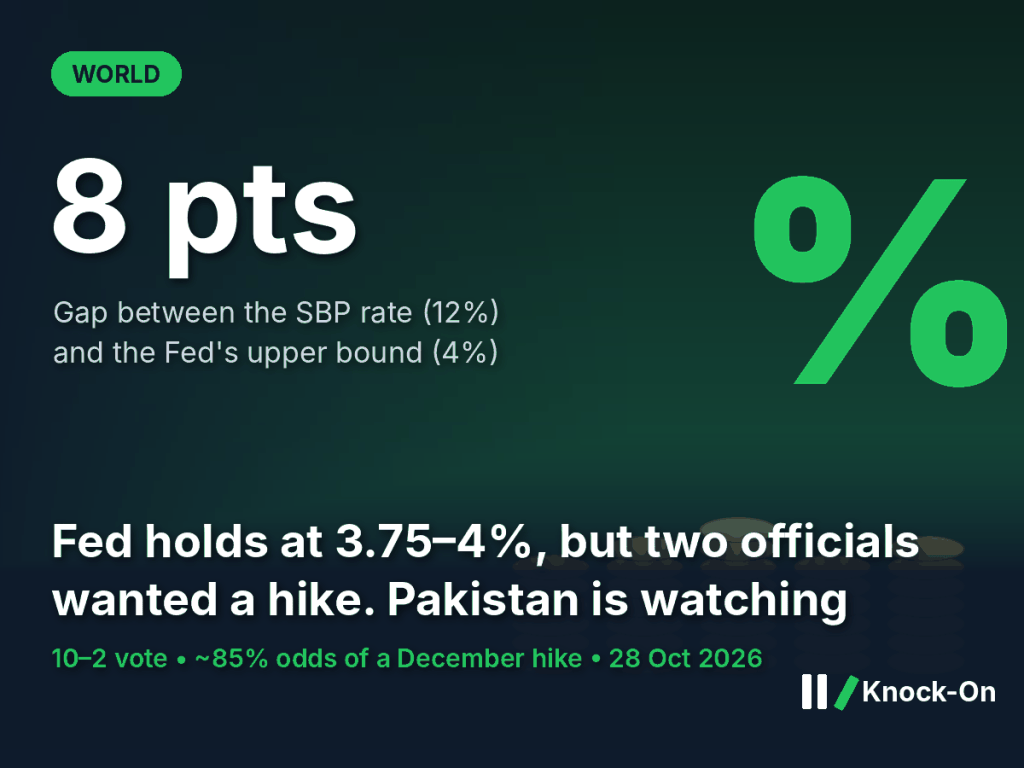
The US Federal Reserve kept its benchmark rate at 3.75% to 4% on 28 October, but two of its 12 voters wanted a hike. For Pakistan, this Fed rate decision matters because it sets the price of the dollar money the country borrows and attracts. With the State Bank of Pakistan at 12%, the gap between the two policy rates is 8 percentage points. Markets now expect the Fed to narrow that gap in December.
The short version
- The Fed held at 3.75–4% in a 10–2 vote. Governor Lisa Cook and Cleveland Fed President Beth Hammack voted for a quarter-point hike.
- Futures put the chance of a December hike at about 85%, Admiral Markets reported.
- Pakistan’s policy rate is 12%, after the SBP’s 50bp hike on 26 October. That is 8 points above the Fed’s upper bound (Knock-On calculation).
- Foreign money put a net $2.96bn into Pakistan’s government debt in July–September. Higher US rates make that money harder to keep.
What happened
In its 28 October statement, the Federal Open Market Committee said economic activity was expanding at a strong pace, inflation was elevated, and uncertainty remained high, partly because of geopolitical developments. The hold followed a quarter-point increase in September. Chair Kevin Warsh called the meeting “a heck of a family fight” and said politics played no role in the decision, according to Admiral Markets. He said returning inflation to 2% was “paramount”, investingLive reported.
Energy is a large part of the US inflation problem. US consumer prices rose 3.7% in the year to September, and energy prices were up 20.4%. Brent crude traded near $115 a barrel on 28 October amid Strait of Hormuz and US–Iran tensions, Kitco reported. On the day of the decision, the 10-year US Treasury yield was about 5.04% and the dollar index slipped about 0.2%. Spot gold held steady near $4,057 an ounce.
Pakistan still pays about three times US rates
Key interest rates, % a year, as of 28 October 2026
Why it matters
Pakistan’s recent strength in its reserves owes a lot to foreign money buying government debt. The finance ministry’s first-quarter scorecard showed a net $2.96bn of foreign public investment, against a net outflow of $512m a year earlier. That inflow helped push Pakistan’s forex reserves to a record $21.5bn. Much of this money compares Pakistani yields with US yields. When the Fed tightens, the extra return from holding rupee debt shrinks unless the SBP keeps pace. The SBP already raised its rate to 12% on 26 October, citing oil and food prices.
The real cushion is thinner than the headline gap. Mettis Global puts Pakistan’s real policy rate at 1.7 points over September inflation of 10.3%. On the same basis, the Fed’s upper bound sits about 0.3 points above US inflation of 3.7% (Knock-On calculation).
The knock-on effects
First order: the Fed rate decision sets the price of Pakistan’s dollar debt
Pakistan’s external debt service for FY27 is about $21.5bn, of which about $4bn is interest, according to Mettis Global. With US 10-year yields near 5%, any new Eurobond or commercial loan is priced off a high base. The government has already turned down a $490m loan at about 8% as too costly.
Second order: pressure on the SBP’s next move
If the Fed hikes on 9 December, the SBP meets on 14 December with a narrower gap. That could make another Pakistani rate rise more likely, which would raise borrowing costs for companies already paying more than 12%.
Third order: oil links both central banks
The same Gulf oil shock is lifting inflation in both countries. A ceasefire that cut oil prices would ease pressure on both the Fed and the SBP. Further escalation would do the opposite.
Who could benefit
- Banks holding government paper, if rates stay higher for longer.
- Exporters earning dollars, if a firmer US dollar weighs on the rupee.
- Savers in deposits and National Savings schemes.
Who may face pressure
- The finance ministry, which must roll over and refinance foreign debt.
- Importers and borrowers who need dollars or bank credit.
- Rate-sensitive PSX sectors such as cement, autos and steel.
What to watch
- 29 October: US third-quarter GDP and September PCE inflation data.
- 8–9 December: the next Fed meeting, where markets expect a hike.
- 14 December: the next SBP monetary policy meeting.
- Weekly T-bill auctions: whether foreign bids for Pakistani debt hold up.
Sources
- Federal Reserve, FOMC statement, 28 Oct 2026
- Admiral Markets, FOMC October 2026: Fed Holds at 3.75%-4%, Markets React, 28 Oct 2026
- investingLive, Recap: Fed holds at 3.75%-4% in 10-2 vote as Cook dissents for a hike, 28 Oct 2026
- Kitco, Gold steadies, silver falls as Fed holds rates, two officials favor hike, 28 Oct 2026
- Mettis Global, Half a point, and a longer road to target, 27 Oct 2026
- Profit (Pakistan Today), Pakistan’s forex reserves rise 52%, foreign investment up 20%, exports grow 11% in Q1 FY27, 27 Oct 2026
This is analysis, not investment advice. Figures are as of 28 October 2026. Knock-On is not affiliated with any political party.

Leave a Reply