
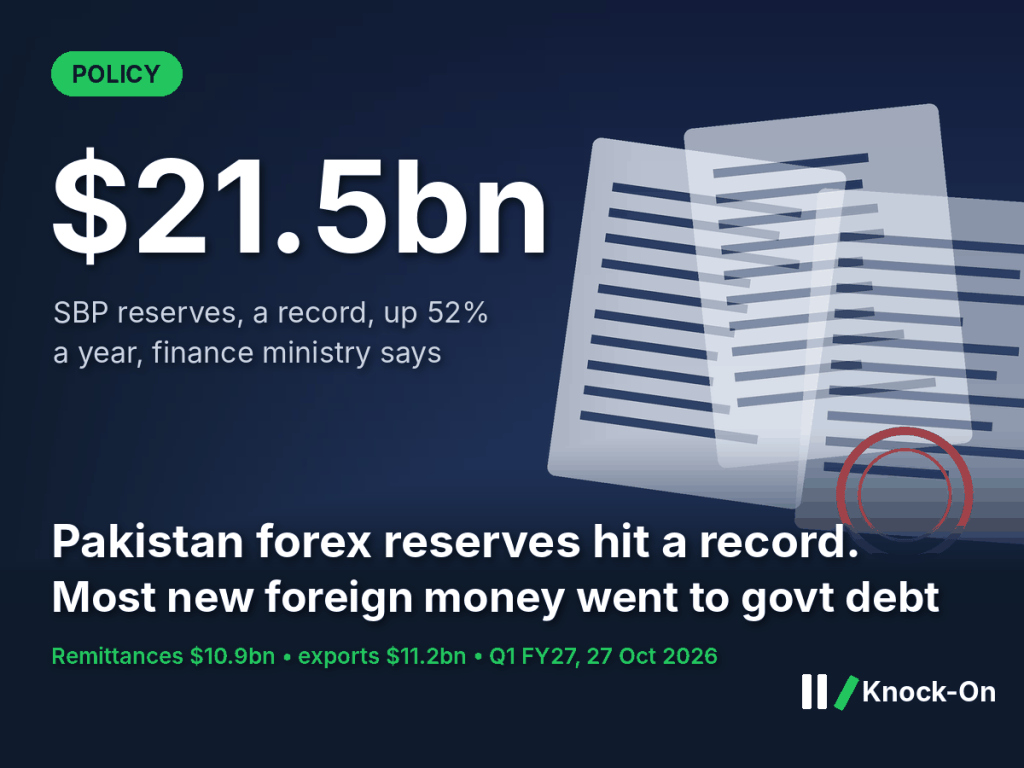
Pakistan forex reserves held by the State Bank of Pakistan (SBP) reached a record $21.5 billion at the end of the July–September quarter, up 52% from a year earlier, according to the finance ministry’s new quarterly scorecard. Remittances, exports and tax collection all grew. The scorecard also shows where the extra foreign money came from: most of the net foreign investment went into government debt rather than into businesses, and the current account deficit got slightly wider.
The short version
- SBP reserves rose 52% a year to a record $21.5bn; total liquid reserves were $26.8bn, enough for over three months of imports.
- Remittances rose 14% to $10.9bn and exports 11% to $11.2bn in the first quarter of FY27.
- Net foreign investment was $3.65bn, but $2.96bn of it (81%, Knock-On calculation) was foreign public investment.
- The current account deficit widened to $874m from $755m, before the full effect of oil above $100 a barrel.
What happened
The Ministry of Finance published its “Pakistan Macro, Reform and Investment Scorecard” for July–September 2026, reported by Profit and Daily Pakistan on 26–27 October. On the external side, it says Pakistan forex reserves at the SBP rose to $21.5 billion, while total liquid reserves reached $26.8 billion, covering more than three months of imports against 2.2 months a year earlier. Workers’ remittances rose 14% to $10.9 billion. Total exports rose 11% to $11.2 billion, with goods up 8% to $8.5 billion and services up 23% to $2.7 billion. IT exports grew 18% to $1.25 billion.
Foreign direct investment rose 20% to $720 million and foreign private investment 44% to $691 million. Foreign public investment brought a net inflow of $2.96 billion, against a net outflow of $512 million a year earlier. Net foreign investment as a whole was $3.65 billion, compared with a net outflow of $33 million. The current account deficit widened to $874 million from $755 million. At home, the FBR collected Rs3.1 trillion, 7% more than a year earlier and above its quarterly target, and private-sector credit grew 16.6% to Rs11.28 trillion.
Reserves grew far faster than the earnings behind them
Year-on-year growth, July–September 2026 (Q1 FY27), %
Why it matters
Bigger Pakistan forex reserves give importers more confidence that dollars will be available, help keep the rupee steady (the scorecard says it gained 1.5% in a year) and strengthen the country’s hand with lenders and rating agencies. But the mix matters. Of the $3.65 billion in net foreign investment, $2.96 billion, or 81%, came as foreign public investment, which covers foreign money going into government debt. That money can leave as quickly as it came if rates or risk change. Earned dollars, from exports and remittances, grew much more slowly than the reserves themselves.
The timing is also important. These figures end in September, before oil climbed above $100 a barrel and before the SBP raised its interest rate to 12% on Monday. A larger oil bill will press on the current account in the second quarter, and outflows such as profit repatriation by foreign companies also draw on the same reserves.
The knock-on effects
First order: Pakistan forex reserves buy time for importers
With more than three months of import cover, banks are better placed to open letters of credit for fuel, machinery and raw materials, even as oil prices rise. The risk of a sudden dollar squeeze, which hurt industry in earlier crises, is lower than it was a year ago.
Second order: the government borrows from a stronger position
Stronger reserves and the rating upgrades listed in the scorecard (Moody’s to B3, S&P to B) give the finance ministry more room to be choosy about debt, as it was when it turned down a $490m loan as too costly. The scorecard also says an IMF staff-level agreement could unlock $1.2 billion after Board approval.
Third order: the oil bill tests the cushion
If oil stays high and foreign holders of government debt pull back, the second-quarter numbers could look less comfortable. Businesses planning imports for the winter should watch whether reserves keep rising once higher fuel payments start to show up.
Who could benefit
- Importers and manufacturers that rely on steady access to dollars for inputs and machinery.
- IT and service exporters, whose earnings grew fastest among exports and who benefit from easier payment flows.
- Banks, with private-sector credit up 16.6% and SME and housing finance growing fast, according to the scorecard.
Who may face pressure
- Borrowers, now facing a 12% policy rate after Monday’s hike, up from 11.5% through September.
- Fuel-heavy businesses, if a rising oil bill widens the current account deficit and weighs on the rupee.
- Goods exporters, whose shipments grew 8%, slower than services and far slower than reserves.
What to watch
- The SBP’s weekly reserve figures, to see whether the record holds as oil payments rise.
- October current account data, due in November, the first full month of higher oil prices.
- IMF Board approval of the review that could release $1.2bn.
- Foreign flows into government debt after the rate hike to 12%.
Sources
- Profit (Pakistan Today), Pakistan’s forex reserves rise 52%, foreign investment up 20%, exports grow 11% in Q1 FY27, 27 October 2026
- Daily Pakistan, Pakistan forex reserves reach record $21.5 billion in Q1 FY2026-27, 26 October 2026
This is analysis, not investment advice. Figures are as of 27 October 2026.


Leave a Reply