
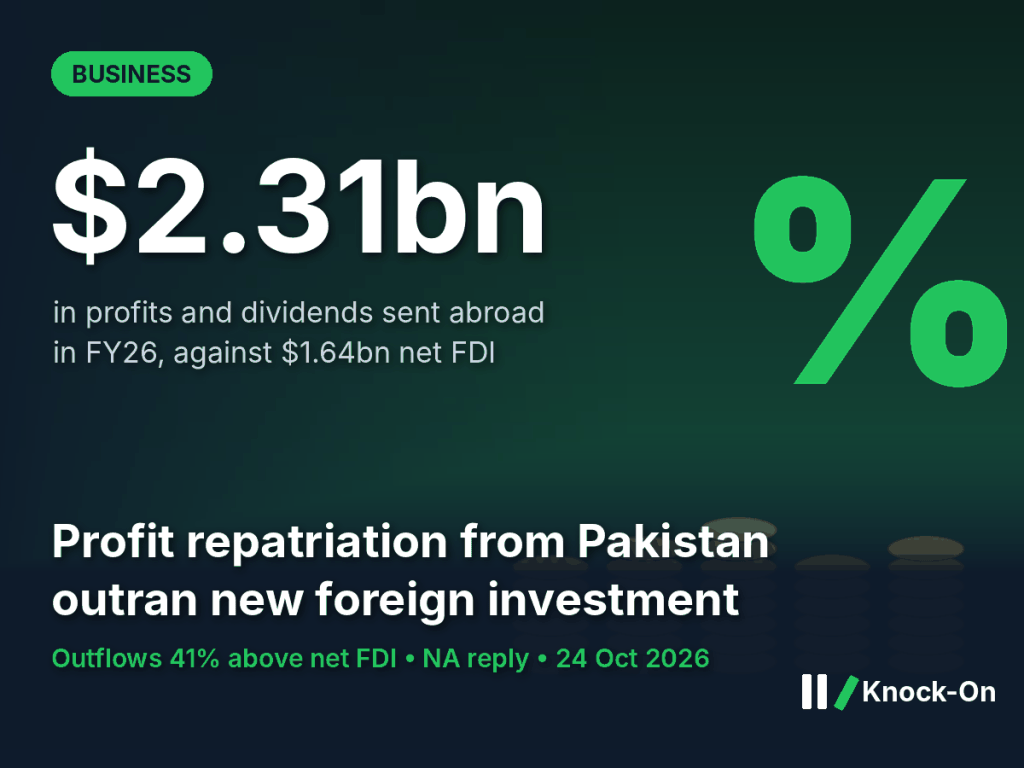
Profit repatriation from Pakistan reached $2.31bn in the 2025-26 fiscal year, while net foreign direct investment (FDI) was $1.64bn, the National Assembly was told on Friday. That means foreign investors took out about $665m more in profits and dividends than they brought in as net new direct investment, a gap of nearly 41%. The government says the comparison is misleading, but for the rupee and the reserves, every dollar that leaves counts.
The short version
- Profits and dividends paid to foreign investors were $2.305bn in FY26; net FDI was $1.64bn.
- Manufacturing ($564m), finance and insurance ($537m) and power and gas ($497m) paid out the most.
- The government says payments partly cleared earlier delays once foreign-exchange liquidity improved.
- The reply did not say how the outflows affected reserves or the current account; it left that to the SBP and Finance Division.
What happened
In a written reply to a question from Dr Mahreen Razzaq Bhutto, the minister in charge of the Special Investment Facilitation Council (SIFC) Division gave the profit repatriation figures for FY26, Business Recorder reported. Profit and dividend payments on direct investment were $2.202bn and payments on portfolio investment were $103.7m, a total of $2.305bn. Net FDI inflows over the same year were $1.64bn.
More profit left Pakistan than net direct investment came in
FY2025-26, US$ billion
By sector, counting direct and portfolio payments together, the biggest payers were manufacturing ($564.3m), financial and insurance activities ($537.4m), electricity, gas, steam and air-conditioning supply ($496.5m), wholesale and retail trade ($211.6m), information and communication ($166.9m), transport and storage ($162.1m) and mining and quarrying ($124.6m). These seven sectors paid more than $2.26bn.
Why it matters
Profit repatriation is a normal part of foreign investment: investors put money in expecting to take returns out. But Pakistan earns dollars slowly, so outflows of this size compete with import bills and debt payments for the same reserves. The government argues that annual net FDI and profit repatriation measure different things, since this year’s profits may come from investments made over many years. It also said better foreign-exchange liquidity let companies clear payments that had been held back, and pointed to gross FDI of $4.268bn in FY25 and $3.603bn in July–April FY26 as evidence that investment continues.
The outflows also tell investors something useful: money can now leave. Financial and insurance firms were the second-largest payers, which fits a year in which the sector earned strongly, as our look at bank profits topping Rs200bn at four big lenders showed.
The knock-on effects
First order: demand for dollars
Each dividend payment abroad is a demand for dollars in the interbank market. When oil is above $110 a barrel, as covered in our look at the IMF’s warning on the Iran war impact on Pakistan, those dollars compete with a bigger fuel import bill.
Second order: the investor-confidence trade-off
Allowing profit repatriation freely helps Pakistan’s reputation with investors; delaying it protects reserves in the short term but discourages new money. The reply shows the government has chosen to let payments flow for now.
Third order: the push for export-led FDI
Investment in sectors that sell at home, such as power and retail, earns rupees but pays dividends in dollars. Investment in exporters earns its own dollars. That is why the government is promoting special economic zones, such as the Karachi Industrial Park, approved as a federal SEZ on Friday.
Who could benefit
- Foreign shareholders: in listed Pakistani subsidiaries, who can receive dividends without long delays.
- Export-oriented investors: who may get more policy support through SEZs and SIFC facilitation.
Who may face pressure
- Importers competing for dollars when reserves are tight.
- Foreign-owned firms selling mainly at home, if dollar shortages ever slow dividend payments; minority shareholders in deals such as the Unilever Pakistan Foods takeover have a stake in how freely money can move.
What to watch
- 26 October: the SBP’s interest rate decision and its comments on reserves.
- Monthly SBP data on FDI and profit repatriation for FY27.
- Any SBP or Finance Division assessment of the outflows’ effect on the current account, which the reply did not provide.
Sources
- Business Recorder, SIFC informs NA: FY26 foreign profit repatriation 41pc higher than FDI, 24 October 2026
- Business Recorder, Govt approves Karachi Industrial Park as federal SEZ, 24 October 2026
This is analysis, not investment advice. Figures are as of 24 October 2026.



Leave a Reply