
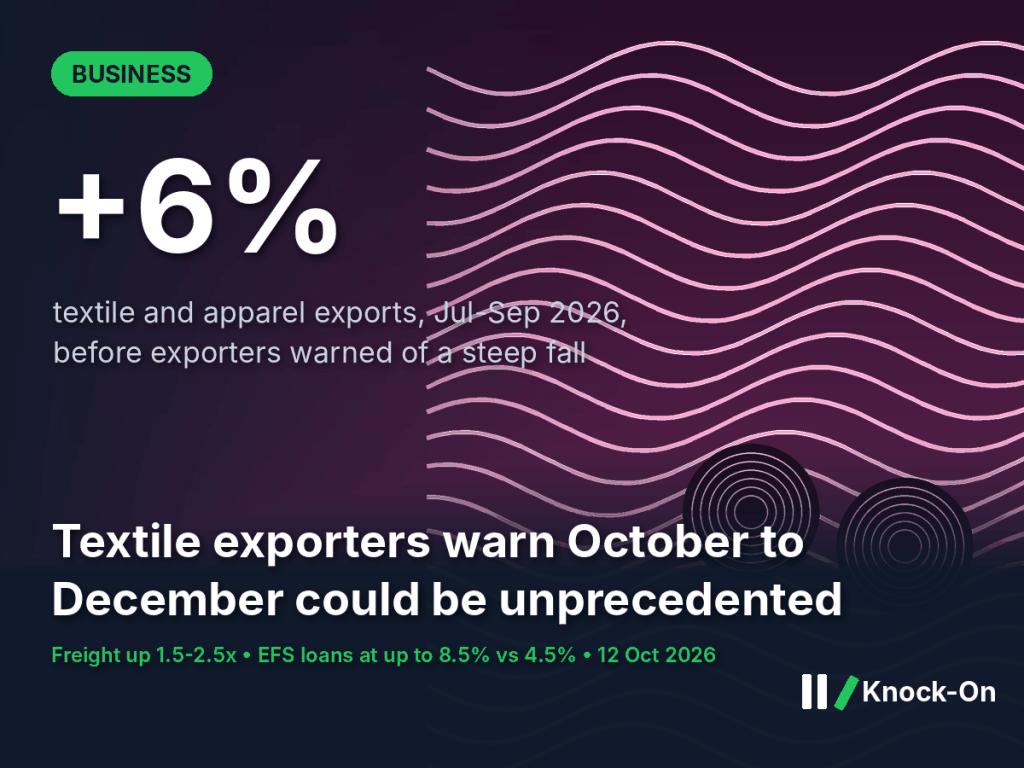
Pakistan’s textile exports have just had a decent quarter, but the people who make them say the next one could be the worst in memory. Khurram Mukhtar, patron-in-chief of the Pakistan Textile Exporters Association (PTEA), warned on Sunday of a steep fall in textile exports from October to December, saying “the decline in export trade volume is unprecedented”, Dawn reported. Textiles are Pakistan’s largest export, so a slump would hit factory jobs, the trade balance and the rupee at the same time.
The short version
- Textile and apparel exports rose about 6% year on year in July-September, according to government data.
- The PTEA says weak Western demand, sea freight up 1.5 to 2.5 times and rising input costs will drive a sharp fall this quarter.
- Exporters say banks charge at least 5.5%, and up to 8.5%, on export finance the budget fixed at 4.5%.
- The association wants a Rs140bn modernisation package, faster refunds and cheaper industrial power.
What happened
Government figures shared by Khurram Shehzad, adviser to the finance minister, show Pakistan’s total exports reached $8.42bn in July-September 2026, up 10.8% on a year earlier, with textiles and apparel up 6%, ProPakistani reported on 5 October. September alone brought $2.94bn of exports, up 17.6%.
The PTEA says that picture is about to change. Mukhtar said inflation in Western markets has weakened buyers’ demand, higher freight is squeezing thin margins, and rising input and logistics costs are eroding competitiveness, with the damage spreading across ginning, spinning, weaving, processing and knitting. He warned that “only financially strong exporters would survive the prevailing conditions.” Dawn’s report did not give a forecast figure for the decline.
A large part of the complaint is about the State Bank’s Export Finance Scheme (EFS). The FY27 Finance Bill fixed the EFS rate at 4.5%, but exporters say banks are charging more. The PTEA also says about Rs200bn of EFS financing went to yarn exporters even though yarn is on the scheme’s negative list, and that a Rs100bn SME allocation from last year lapsed unused.
Cheap export loans are not cheap at the bank counter
Export Finance Scheme rate, % a year: official rate vs rates exporters say banks charge, October 2026
Why it matters
Textile exports earn more foreign exchange than any other sector, and much of it comes from a small group of firms: the PTEA says the top 100 exporters account for up to 60% of volume. When margins are thin, a few percentage points on finance or a doubling of freight can decide whether smaller mills take orders at all. Shipping links have improved, with Karachi’s direct line to Europe back in service, but reliability does not offset a 1.5x to 2.5x rise in freight charges.
The knock-on effects
First order: orders and margins for textile exporters
Mills facing weaker orders and higher costs may cut shifts or turn down low-margin business. Smaller exporters without access to cheap credit are most exposed.
Second order: jobs and suppliers
Textiles employ large numbers in Punjab and Karachi. A slowdown would travel back to cotton ginners, chemical and dye suppliers, packaging firms and transporters.
Third order: the external account
Weaker export receipts would put more weight on remittances to finance imports, at a time when oil prices are high. The PTEA also wants cross-subsidies removed from industrial power tariffs, a debate now live as distribution companies seek Rs268bn of old costs in 2027 electricity tariffs.
Who could benefit
- Large, well-capitalised exporters, which can win orders from weaker rivals.
- Exporters with direct EU shipping contracts, if freight eases on those routes.
- Machinery suppliers, if a modernisation package is approved.
Who may face pressure
- Small and mid-sized mills paying above the official EFS rate.
- Weaving and processing units, where the PTEA sought Rs50bn each for upgrades.
- Banks with heavy textile exposure, if cash flows weaken. The government’s push to double SME lending also gets harder.
What to watch
- October trade data from the Pakistan Bureau of Statistics, due in early November.
- Any SBP action on enforcing the 4.5% EFS rate or reviewing allocations.
- Government response to the PTEA’s requests, including DLTL support at 6% to 8% and refund clearance.
- Sea freight rates on Gulf and Red Sea routes.
Sources
- Dawn, Textile makers warn of steep decline in exports from Oct to Dec, 12 October 2026
- ProPakistani, Pakistan Exports Record Sharp Increase in September, 5 October 2026
This is analysis, not investment advice. Figures are as of 12 October 2026.





Leave a Reply