
Small and medium-sized businesses employ much of Pakistan’s workforce but receive a small share of bank credit. The government has now set an ambitious goal to change that, along with a deadline for a digital portal to make borrowing easier. The numbers released alongside the target show how much would need to change.
The short version
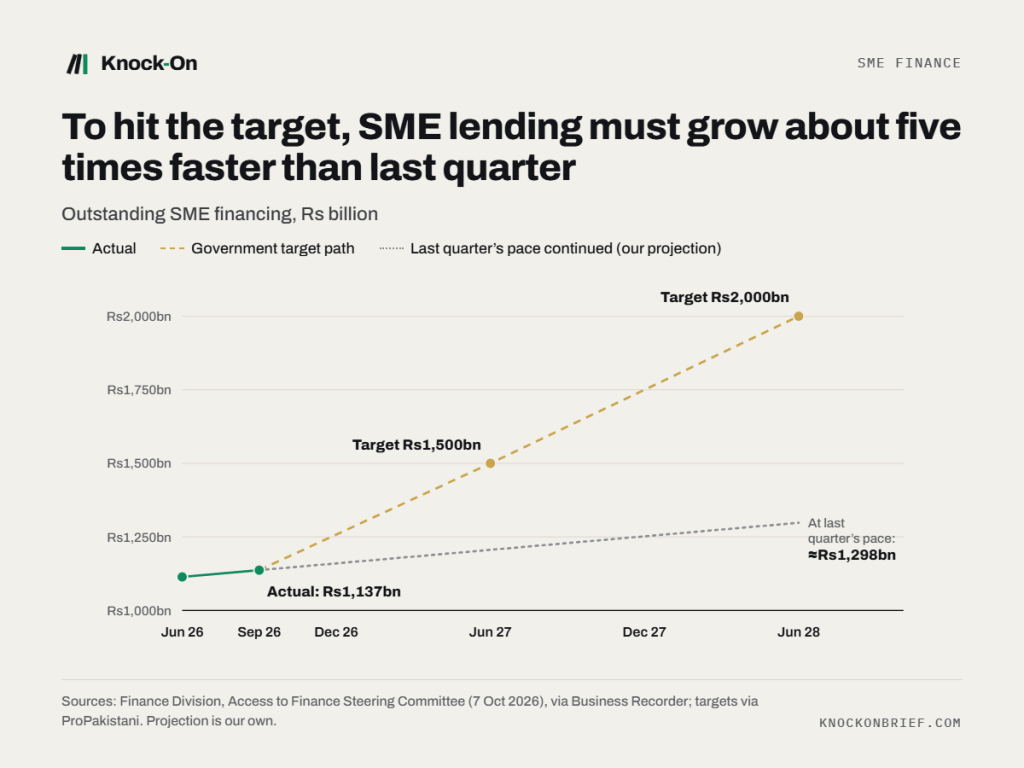
- SME financing stood at about Rs1.137 trillion at end-September 2026, up Rs23 billion in the quarter, with about 350,862 borrowers.
- The government’s targets are Rs1.5 trillion and 565,000 borrowers by June 2027, then Rs2 trillion and 775,000 borrowers by June 2028.
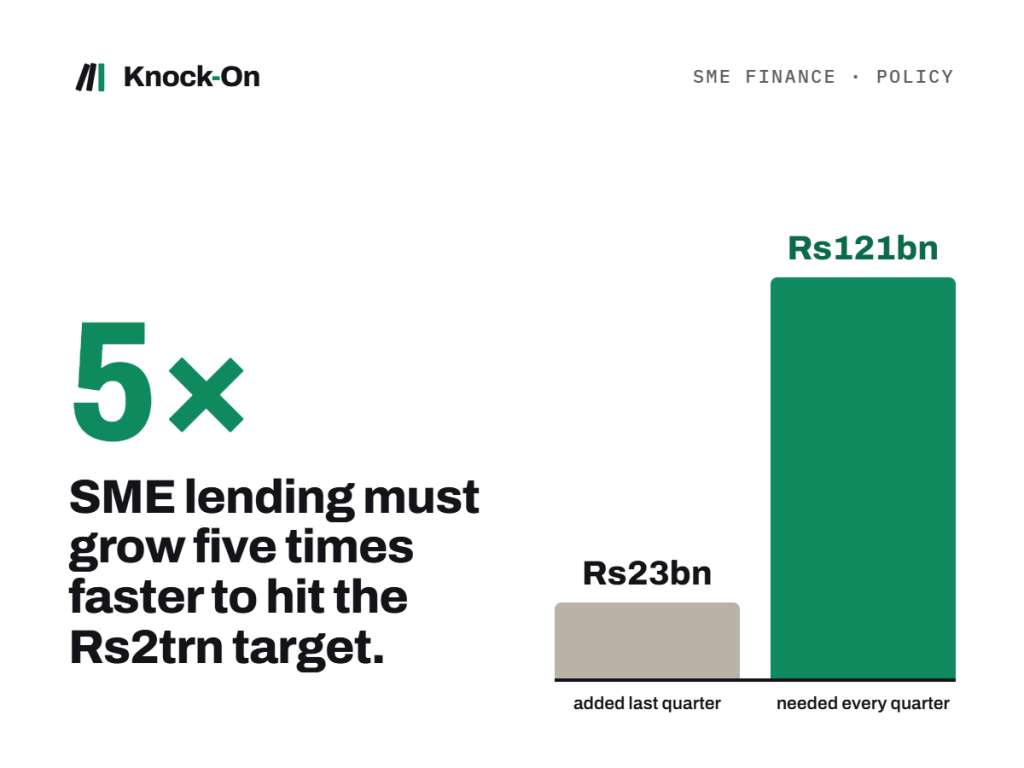
- Reaching the June 2027 target requires about Rs121 billion of net new SME lending per quarter, more than five times last quarter’s Rs23 billion.
- A digital portal for SMEs to track and apply for bank credit is due by the end of November.
What happened
Finance Minister Muhammad Aurangzeb chaired the fifth meeting of the Access to Finance Steering Committee on 7 October. Figures presented there showed outstanding SME financing rising from Rs1.114 trillion in June to over Rs1.137 trillion at end-September, with the number of borrowers up by more than 25,000. SME lending is about 9.9% of banks’ domestic private-sector advances. The goal is 13%.
At a separate review meeting, Prime Minister Shehbaz Sharif set an end-November deadline for a digital portal. It would let businesses see the status of their credit facilities and letters of credit and apply for bank loans without repeated branch visits. Measures under consideration include revised SME regulations, risk-sharing arrangements, supply-chain financing and verified data sharing.
Why it matters
The gap between the target and the current pace is large. Our calculations, based on the official figures:
- June 2027 target (Rs1.5 trillion). About Rs363 billion of additional lending is needed over three quarters, roughly Rs121 billion a quarter, against Rs23 billion last quarter.
- Borrowers. Reaching 565,000 by June 2027 means adding about 71,000 a quarter, against roughly 25,000 last quarter.
- June 2028 target (Rs2 trillion). About Rs123 billion a quarter for seven consecutive quarters.
Two forces make this harder. First, the cost of credit: the State Bank’s policy rate is 11.5%, and the IMF has asked for monetary policy to stay appropriately tight. Small businesses borrowing at a margin above that rate face high debt-service costs. Second, banks’ incentives: lending to small, often under-documented firms carries more risk and higher processing costs than lending to the government or large corporates.
The knock-on effects
First order: easier access, if the portal works
A working portal could cut the paperwork and branch visits that discourage small borrowers. It could also give businesses visibility of their credit lines and letters of credit.
Second order: documentation becomes an advantage
Banks will lend first to businesses with tax records, bank statements and digital sales data. SMEs that formalise their accounts will be first in line, which also brings them further into the tax net.
Third order: credit quality
Pushing lending growth from Rs23 billion a quarter to over Rs100 billion would test banks’ credit assessment. Risk-sharing schemes can help, but if growth outpaces underwriting, non-performing loans tend to follow a year or two later.
Who could benefit
- Documented SMEs with clean records and steady cash flows.
- Banks and fintechs with digital lending capability, which can process small loans cheaply.
- Suppliers to SMEs, if better working-capital access shortens payment cycles.
Who may face pressure
- Informal businesses without records, which may remain outside the system.
- Banks with weak SME credit assessment, if pushed to grow quickly.
What to watch
- Launch of the SME portal by end-November, and whether it connects to bank systems or simply collects applications.
- Details of any risk-sharing or credit-guarantee scheme.
- State Bank Monetary Policy Committee, 26 October.
- Quarterly SME financing data, especially the end-December figure.
Our forecast
We expect outstanding SME financing at end-December 2026 to be below Rs1.25 trillion. A straight-line path to the June 2027 target would put it at about Rs1.26 trillion by then. Reasoning: high borrowing costs and the time needed to launch the portal and any risk-sharing scheme. Confidence: moderate.
Sources
- Business Recorder, Rs2trn target set for SME financing, 8 October 2026
- ProPakistani, Small businesses to get new loan portal by November, 8 October 2026
- TechX Pakistan, SME financing reaches Rs1.137trn in September, 8 October 2026
- State Bank of Pakistan, Monetary Policy Committee calendar
This is analysis, not investment advice. Calculations are our own, based on official figures as of 9 October 2026.


Leave a comment