
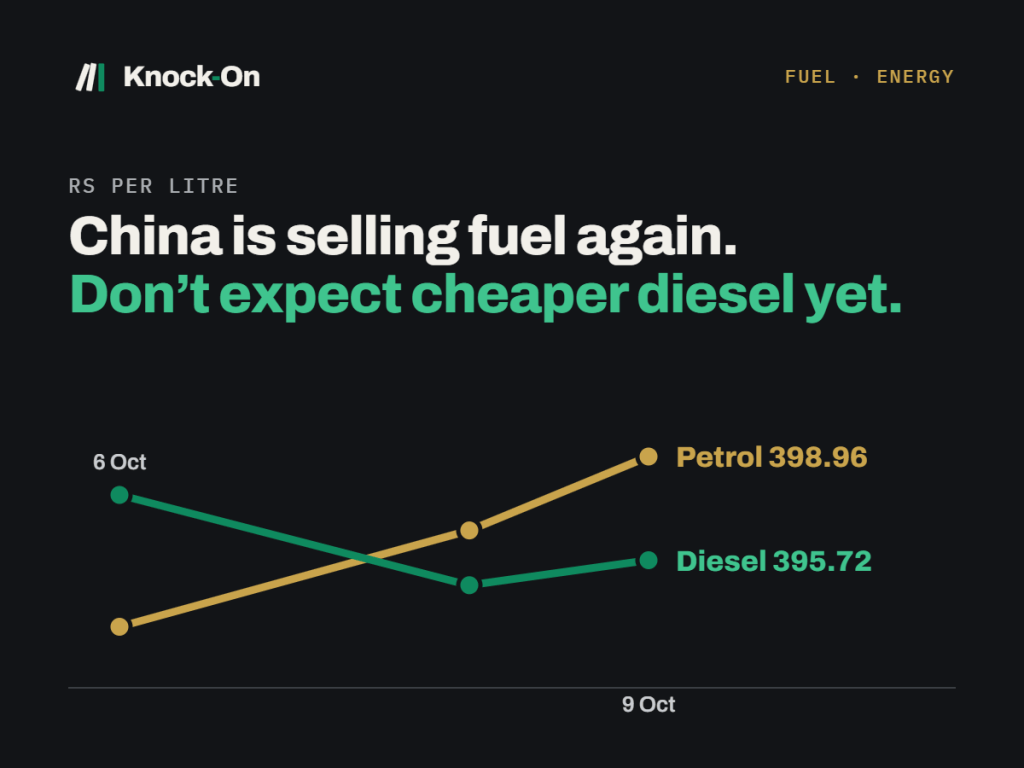
For a week, one of Asia’s largest fuel exporters went quiet. China paused most refined-fuel exports during its Golden Week holiday, at a time when the world was already short of diesel. That pause is now ending. The relief for Pakistani businesses, however, is likely to be limited, because crude oil itself has climbed back above $100 a barrel.
The short version
- China is set to resume October exports of diesel, gasoline and jet fuel. Approved volumes total about 3.7 million tonnes, according to Reuters’ industry sources.
- Brent crude rose to about $104.75 a barrel on 8 October as attacks on shipping in the Gulf and the Strait of Hormuz continued.
- In Pakistan, diesel was Rs395.72 a litre and petrol Rs398.96 from 9 October. Earlier this month, diesel was priced above petrol.
- Diesel moves freight, tractors and generators. Its price reaches almost every delivered good.
What happened
China halted most refined-fuel exports over the 1–7 October holiday. On 8 October, Reuters reported, citing four trade sources, that exports would resume, with approved October volumes of the three main fuels at about 3.7 million tonnes. Chinese supply matters to the region because it helps balance the Asian diesel market from which Pakistan’s import prices are derived.
At the same time, the wider picture has worsened. Brent settled at $100.20 on 7 October and rose by more than $4 the next day, on concerns over attacks on tankers in the Gulf and Hormuz and a hurricane-related output cut in the United States. Members of the International Energy Agency have agreed to prioritise releases of diesel from emergency stocks.
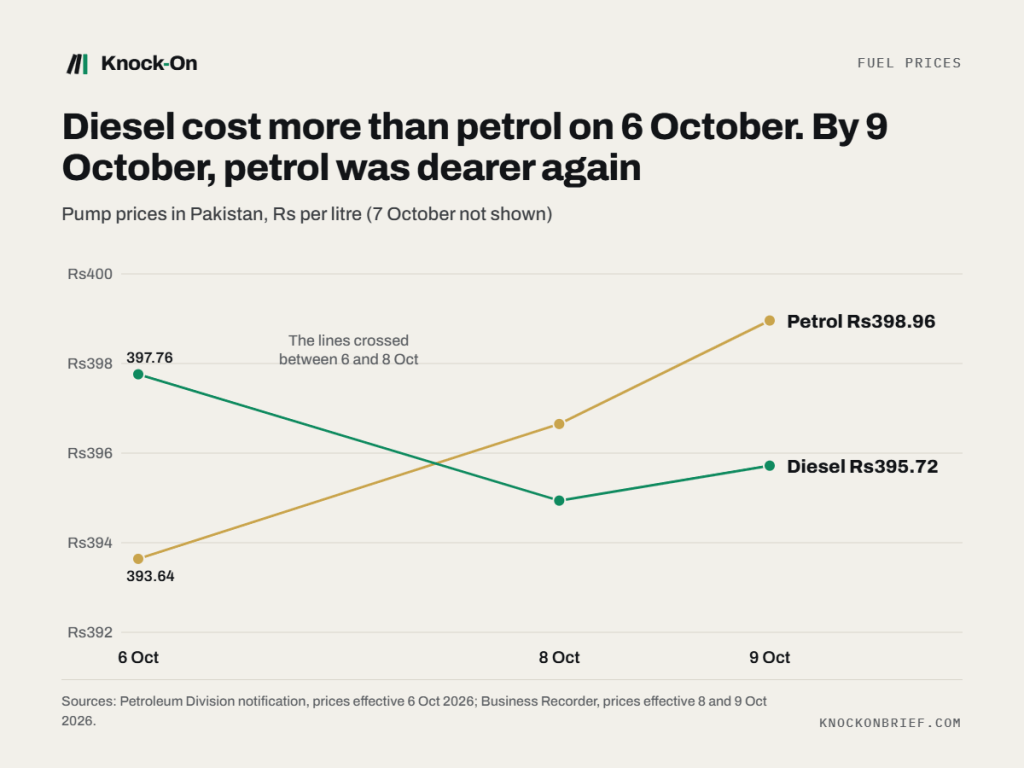
Pakistan’s pump prices have been revised almost daily this month. On 6 October, diesel stood at Rs397.76 a litre against Rs393.64 for petrol, an unusual inversion. By 9 October petrol had moved back above diesel, at Rs398.96 against Rs395.72.
Why it matters
Most consumers watch petrol. Most businesses should watch diesel. It powers trucks, tractors, tube-wells, buses and the back-up generators many shops and factories still run. When diesel stays expensive, costs rise across logistics, agriculture and distribution, and those costs eventually appear on the shelf.
There are early signs that this is already under way. In September, wholesale prices rose 13.3% year on year while consumer prices rose 10.26%, according to the Pakistan Bureau of Statistics. Costs at the factory gate are running ahead of retail prices. That gap does not usually stay open for long.
The knock-on effects
First order: transport and farm costs
Freight rates, bus fares and the cost of running tractors and tube-wells track diesel closely. Farmers preparing for the wheat-sowing season face higher field costs.
Second order: distribution and retail
FMCG companies and distributors pay more to move goods. Many absorb part of the increase for a time, then pass it on through price increases or smaller pack sizes.
Third order: inflation and interest rates
Sustained fuel pass-through keeps inflation elevated, which reduces the State Bank’s room to cut rates. Fuel prices therefore feed back into borrowing costs.
Who could benefit
- Oil and gas producers, whose revenues are linked to international prices.
- Businesses with fuel-efficient fleets or solar back-up, which gain a relative cost advantage.
Who may face pressure
- Logistics and transport companies, especially those on fixed-price contracts.
- Agriculture, through diesel for tractors and irrigation during sowing.
- FMCG distributors and small retailers, which operate on thin margins.
What to watch
- Daily fuel price notifications, particularly for diesel.
- Brent above or below $100, and further incidents in the Strait of Hormuz.
- State Bank Monetary Policy Committee, 26 October.
- October inflation data from PBS, early November. This will show how much fuel pass-through has reached consumers.
Our forecast
We expect diesel to stay above Rs390 a litre through the end of October. Reasoning: Brent above $100, continuing Gulf shipping risk and tight global diesel stocks outweigh the modest relief from China’s resumption. Confidence: moderate.
Sources
- Reuters, “China to resume October fuel exports after a brief halt, four trade sources say”, 8 October 2026, via Investing.com
- Business Recorder, fuel prices effective 9 October 2026, and Brent close on 8 October
- Petroleum Division notification, fuel prices effective 6 October 2026
- CNBC, Brent settlement and IEA stock releases, 7 October 2026
- Pakistan Bureau of Statistics, Monthly Review, September 2026
This is analysis, not investment advice. Figures are as of 9 October 2026. Fuel prices change frequently. Check the latest notification before making decisions.


Leave a comment