
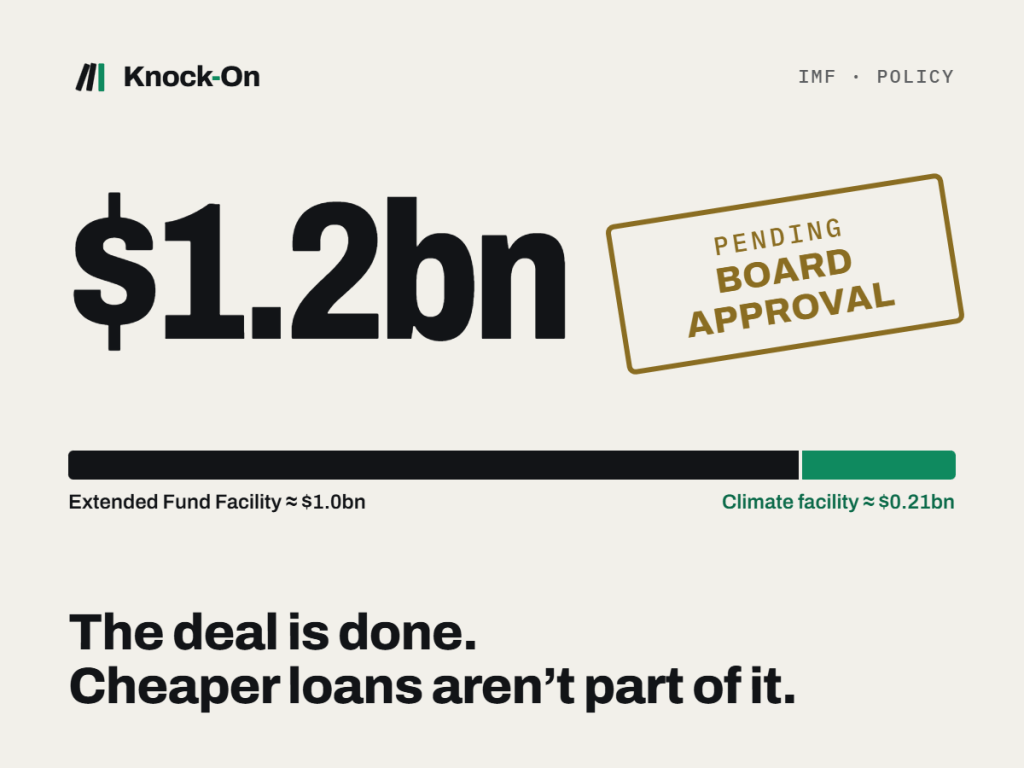
Pakistan and the International Monetary Fund have reached a staff-level agreement that, once approved by the IMF Executive Board, will release about $1.2 billion. The headline number has attracted most of the attention. For businesses, the conditions attached to it matter more: they point to interest rates staying where they are for some time.
The short version
- IMF staff and Pakistan agreed on the fourth review of the Extended Fund Facility (EFF) and the third review of the Resilience and Sustainability Facility (RSF): about $1.0 billion plus about $210 million.
- The money is not yet released. It requires approval by the IMF Executive Board, which had not set a date at the time of writing.
- The Fund wants a primary budget surplus of 2% of GDP this fiscal year and monetary policy that stays “appropriately tight”.
- If your plans assume cheaper borrowing soon, revisit them.
What happened
The IMF said its mission, which ran from 23 September to 7 October in Karachi and Islamabad, reached a staff-level agreement with the authorities. On Board approval, Pakistan would receive about $1.0 billion under the EFF and about $210 million under the RSF, the climate-linked facility, taking total disbursements under the arrangements to about $5.7 billion.
According to reporting of the IMF statement, the agreement rests on two commitments: an underlying primary surplus of 2.0% of GDP in FY27, and a central bank that keeps monetary policy appropriately tight. Gross reserves stood at about $21.5 billion at end-September, a figure consistent with the record level cited by the Finance Minister.
Markets welcomed the news. The KSE-100 rose more than 500 points in early trading on 8 October, and the rupee settled at about 277 per dollar.
Why it matters
An IMF agreement is usually read as good news, and it is. It reduces near-term financing risk, supports the rupee and keeps other lenders engaged. But it does not change the cost of money.
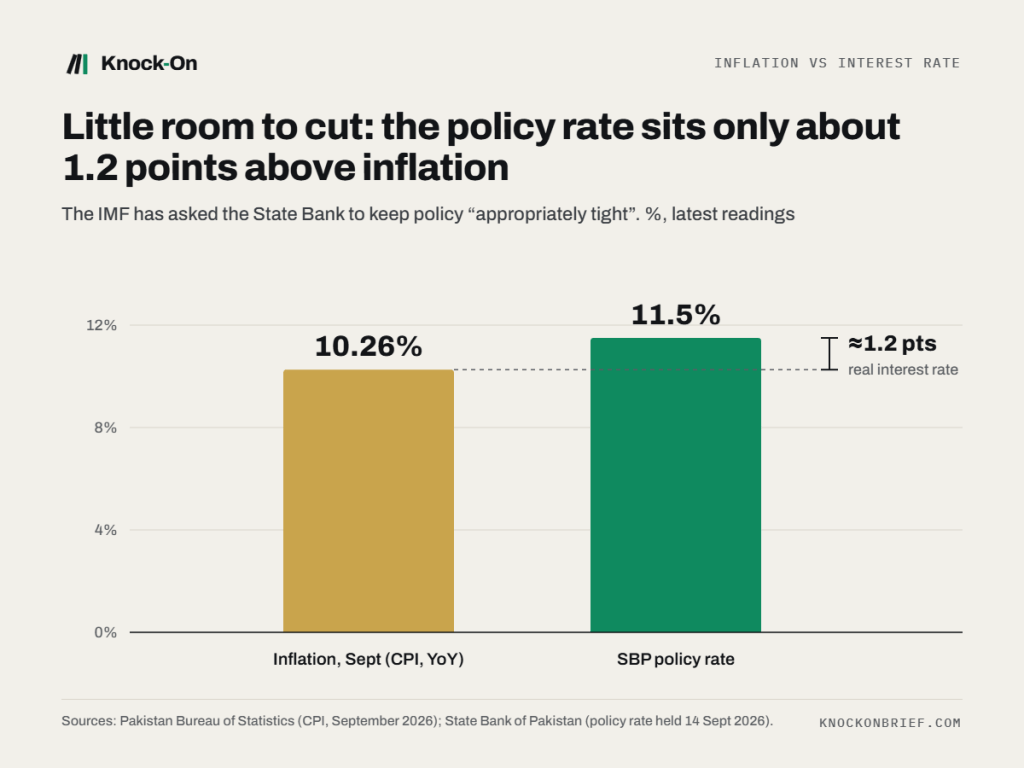
Consider the numbers. Consumer inflation was 10.26% in September, according to the Pakistan Bureau of Statistics. The State Bank’s policy rate is 11.5%, held at its September meeting. That leaves a real interest rate of only about 1.2 percentage points. A central bank told to stay “appropriately tight” has little room to cut when that margin is already thin, and with Brent crude now above $100 a barrel, inflation risks lean upwards.
The knock-on effects
First order: stability, not stimulus
The agreement lowers the risk of a disorderly rupee move and supports confidence. Importers who need a predictable exchange rate benefit first.
Second order: borrowing costs stay high
Running finance, working-capital lines and floating-rate loans in Pakistan are priced off benchmarks that follow the policy rate. If the policy rate holds, those costs hold. Expansion plans that were built on the assumption of rate cuts in the coming months may need to be re-run at current rates.
Third order: tight money travels down the supply chain
When working capital is expensive, retailers hold less stock, distributors place smaller orders and suppliers wait longer to be paid. Businesses with thin cash buffers can feel the squeeze through their customers’ payment terms, even if they do not borrow themselves.
Who could benefit
- Banks, whose earnings benefit from rates staying higher for longer.
- Importers, who gain from a steadier rupee and better reserve cover.
- Businesses with net cash, which continue to earn high returns on deposits and treasury placements.
Who may face pressure
- Leveraged small and medium-sized businesses that depend on running finance.
- Rate-sensitive sectors such as autos and real estate, where demand relies on financing.
- Suppliers to large buyers, if customers stretch payment terms to protect their own cash.
What to watch
- IMF Executive Board date. Disbursement follows approval.
- State Bank Monetary Policy Committee, 26 October. This is the first test of the “appropriately tight” guidance.
- October inflation data from PBS, due early November. Fuel prices will shape the reading.
Our forecast
We expect the State Bank to hold the policy rate at 11.5% at its 26 October meeting. Reasoning: the IMF’s explicit guidance, a real rate of only about 1.2 points and oil above $100. Confidence: moderate to high. We will record the outcome in our predictions tracker.
Sources
- IMF staff statement on the fourth EFF review and third RSF review, via Geo News, The News and ProPakistani (8 October 2026)
- Pakistan Bureau of Statistics, CPI press release, September 2026
- State Bank of Pakistan, Monetary Policy Committee calendar
- Market and rupee data: Business Recorder, 8 October 2026
This is analysis, not investment advice. Figures are as of 9 October 2026. If any figure changes, we will update this article and log the change on our corrections page.


Leave a comment