
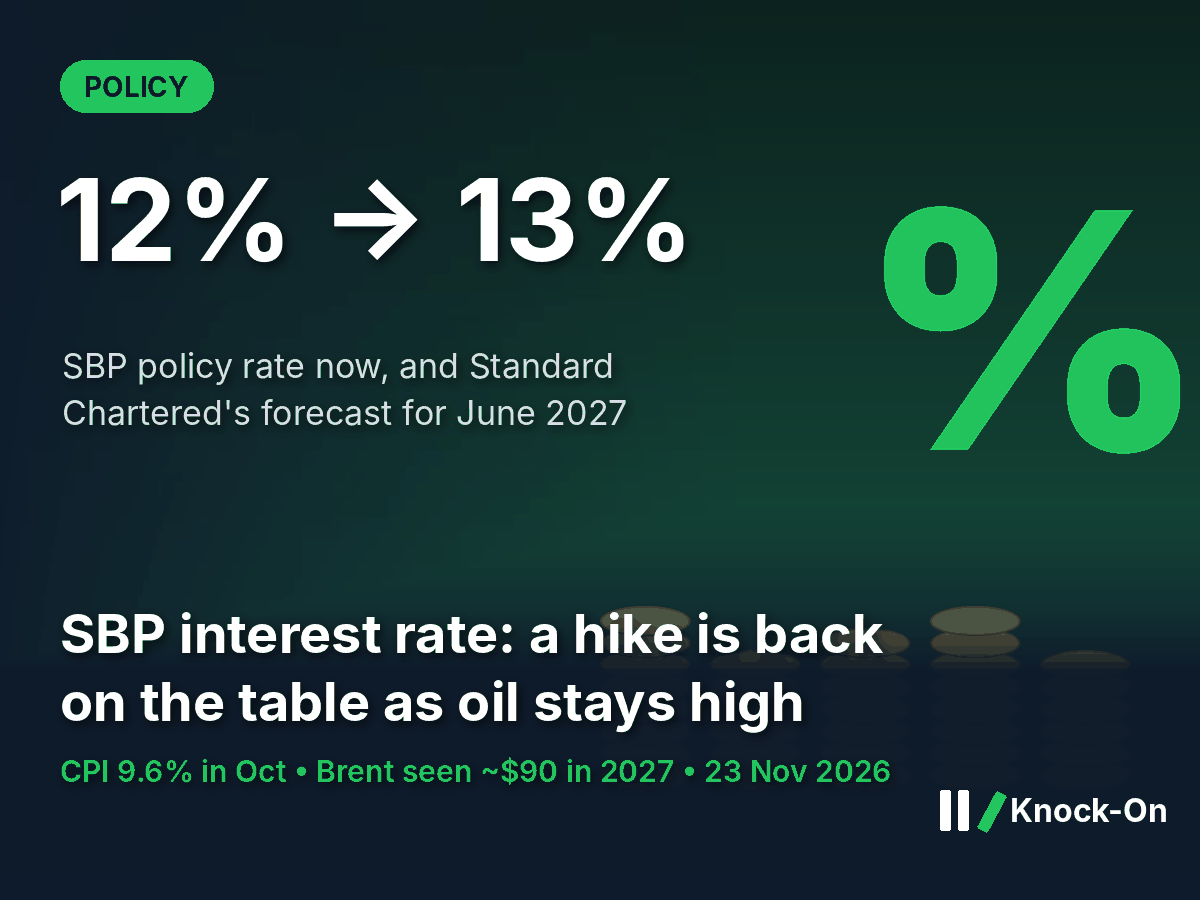
The SBP interest rate may be heading up, not down. Standard Chartered expects the State Bank of Pakistan to raise its policy rate from 12% today to 13% by June 2027, Business Recorder reported on 22 November. The bank’s economists say oil prices of $90 to $100 a barrel through December 2027 could keep inflation near double digits, and the central bank is likely to respond with tighter money. For businesses that borrow, that means financing costs are unlikely to ease soon. It is a forecast, not a decision: the SBP sets the rate at its own monetary policy meetings.
The short version
- Standard Chartered forecasts the SBP policy rate at 13% by June 2027, up from 12% now.
- It expects average inflation of around 10% in FY27; October CPI was 9.6%, down from 10.3% in September.
- It forecasts GDP growth of 3% in FY27, below last year’s 3.7% and the government’s 4% target.
- The bank links its outlook to Brent near $101 this quarter and about $90 through 2027, tied to the Middle East crisis.
What happened
At a media roundtable in Karachi, Talha Nadeem, Standard Chartered’s economist for the Middle East and Pakistan, said: “by June 2027, we expect the State Bank’s policy rate to be at 13%.” He said the bank expects Brent crude to hover around $101 a barrel in the quarter ending December 2026 and around $90 a barrel throughout 2027. “When inflation is in double digits, we expect that the central bank will hike [its policy rate] further,” he said, adding that a higher rate would also squeeze growth. The bank’s global geopolitical strategist, Philippe Dauba-Pantanacce, said oil prices could take a long time to normalise even if the Middle East conflict ends soon, citing damaged energy infrastructure, depleted reserves and refinery damage that is disrupting diesel supply.
Standard Chartered expects the SBP to keep its rate well above inflation
Inflation and SBP policy rate, %, actual and forecast, as of 22 Nov 2026
Why it matters
With the policy rate at 12% and October inflation at 9.6%, the real interest rate is about 2.4 percentage points; at Standard Chartered’s forecast of 13% against roughly 10% inflation, it would be about 3 points (Knock-On calculation). In plain terms, the forecast implies the SBP keeping money tight to stop oil-driven price rises from spreading. That affects every rupee loan, running-finance line and government borrowing bill. It also cuts against the growth story: the SBP itself sees FY27 GDP growth at 3.5-4.5%, while Standard Chartered expects 3%. The bank’s view also depends on oil; the recent oil price fall shows how fast that assumption can shift.
The knock-on effects
First order: a higher SBP interest rate raises borrowing costs
Bank lending rates are priced off KIBOR, which tracks the policy rate. A move to 13% would lift working-capital and leasing costs for companies and consumers, and raise the government’s interest bill.
Second order: slower investment and spending
Mr Nadeem said a higher rate would “squeeze” growth. Rate-sensitive sectors such as autos, cement, construction and consumer credit tend to feel this first, while banks usually earn more on their deposits and government bonds.
Third order: the IMF and the post-programme path
Pakistan’s $7bn IMF programme ends in October 2027. Mr Nadeem said most investors are “more comfortable with Pakistan being with the IMF”. Standard Chartered’s Pakistan chief executive, Adil Salahuddin, said relying on remittances is “not sustainable” and called for faster export growth and a broader tax base.
Who could benefit
- Banks: higher yields on government securities and lending.
- Savers and money-market funds: better returns on deposits and short-term paper.
Who may face pressure
- Leveraged companies: higher interest on running finance and term loans.
- Autos, cement and property: demand that depends on credit.
- The federal budget: a bigger debt-servicing bill.
- Equity investors: higher rates usually weigh on valuations, as the flat KSE-100 close today showed the market is already cautious.
What to watch
- November CPI from the Pakistan Bureau of Statistics, due in early December.
- The SBP’s next monetary policy statement (date not given in the source).
- Brent crude: Standard Chartered’s view assumes about $101 this quarter and $90 in 2027.
- The end of the IMF programme in October 2027 and any talk of a successor.
Sources
- Business Recorder, SBP policy rate may rise to 13% by June 2027: Standard Chartered, 22 Nov 2026
This is analysis, not investment advice. Figures are as of 22 Nov 2026.

Leave a Reply