
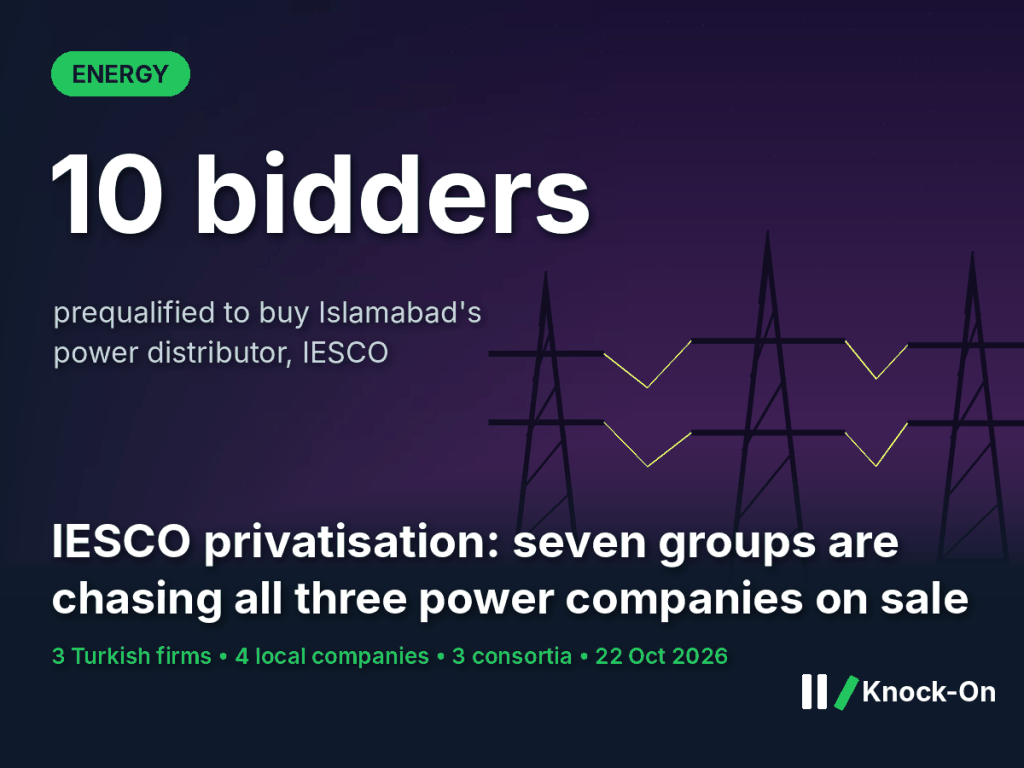
IESCO privatisation moved a step closer on Thursday when the Privatisation Commission prequalified 10 parties to bid for the Islamabad Electric Supply Company, the power distributor serving Islamabad, Rawalpindi and nearby districts. The shortlist mixes three Turkish energy firms with some of Pakistan’s largest industrial groups. Seven of the same lead groups have now been prequalified for all three distribution companies in the government’s first sale batch, which tells us who is serious about owning Pakistan’s power grid.
The short version
- The Privatisation Commission Board prequalified 10 parties for IESCO at its 260th meeting on 22 October.
- They include Aktor, Genvera and Cengiz of Türkiye, Engro Energy, a Hub Power-led consortium and Bestway Cement.
- Bidders will now get access to a virtual data room for due diligence. No sale price or deadline has been published.
- IESCO sits in the first batch with FESCO and GEPCO, which drew 10 and 9 prequalified parties.
What happened
The board, chaired by Muhammad Ali, Adviser to the Prime Minister on Privatisation, approved the IESCO shortlist on Thursday, Business Recorder reported. The 10 parties are: Aktor Elektrik Enerji Yatirimlari, Genvera Enerji and Cengiz Enerji, all from Türkiye; Engro Energy Limited; a consortium led by Artistic Milliners with The Lake City Holdings, Fatima Capital, Din Ventures and Fazal Cloth Mills; a consortium led by Hub Power Holding with Lucky Cement, Kohat Cement and Metro Ventures; Sapphire Fibers; Novatex; Bestway Cement; and a consortium led by Hasnaat Brothers Construction with Dhilal Holding Group, Pak Steel, Bio-Labs and Farid Steel Casting.
The commission had received 10 expressions of interest by the September deadline, with bidders seeking between 51% and 100% of the company with management control, Geo News reported at the time. All 10 have now passed the first test. The same meeting let Artistic Milliners add members to its consortium for FESCO, approved a revised structure for selling Zarai Taraqiati Bank, and ranked a Deutsche Bank-led consortium first to advise on the sale of State Life Insurance.
The same seven groups are chasing all three power companies
Parties prequalified for each first-batch DISCO sale, 2026
Why it matters
The government says it wants to sell loss-making distributors to stop a heavy drain on public money, as we set out in our piece on DISCO privatisation and the Rs850bn yearly loss. A full shortlist for the IESCO privatisation suggests that private investors still see value in the grid’s better-run companies. But the price they will pay depends on the books they inherit. IESCO has asked the regulator for a 54% higher average tariff for 2027, much of it to clear past costs, as explained in our story on the IESCO tariff hike request.
The knock-on effects
First order: due diligence on IESCO’s books
Bidders will now study IESCO’s accounts, losses and tariff assumptions in the data room. What NEPRA allows the company to recover in 2027 will feed directly into what they are willing to offer.
Second order: industrial groups move into utilities
Textile, cement and steel groups make up much of the shortlist. For large power users, owning a distributor could mean more control over supply in their own regions. Hub Power, which is also building a car plant with BYD, would be adding power distribution to an already wide portfolio if its consortium wins.
Third order: one buyer could end up with several DISCOs
Because seven groups are bidding for all three companies, the final results could leave one investor owning more than one distributor. How the commission handles that, and whether rules on market concentration apply, is a question the published decisions do not yet answer.
Who could benefit
- The federal budget, if sales cut the cost of covering distribution losses.
- Listed bidders such as Engro and Hub Power, if they win assets at prices that reward the risk.
- Metering, grid and software suppliers, as new owners invest to cut theft and losses.
Who may face pressure
- Electricity users, if past costs are cleared through tariffs before the sale.
- Weaker DISCOs outside the first batch, which may struggle to attract the same interest.
- Bidders’ shareholders, who will want to see that utility ownership fits each group’s balance sheet.
What to watch
- The opening of IESCO’s virtual data room and any published bidding timetable.
- NEPRA’s decision on IESCO’s 2027 tariff petition, including the past-cost adjustment.
- Whether any bidder drops out after due diligence, and whether FESCO or GEPCO reach the bidding stage first.
Sources
- Business Recorder, Privatisation Commission prequalifies 10 parties for IESCO sale, 22 Oct 2026
- ProPakistani, Govt shortlists 10 investors for IESCO sale, 22 Oct 2026
- Business Recorder, Privatisation Commission prequalifies 9 parties for GEPCO sale, 5 Oct 2026
- Business Recorder, PC Board prequalifies 10 interested parties for FESCO privatisation, 28 Aug 2026
- Geo News, Iesco privatisation receives strong investor interest as 10 EOIs submitted, 21 Sep 2026
This is analysis, not investment advice. Figures are as of 22 Oct 2026.


Leave a Reply