
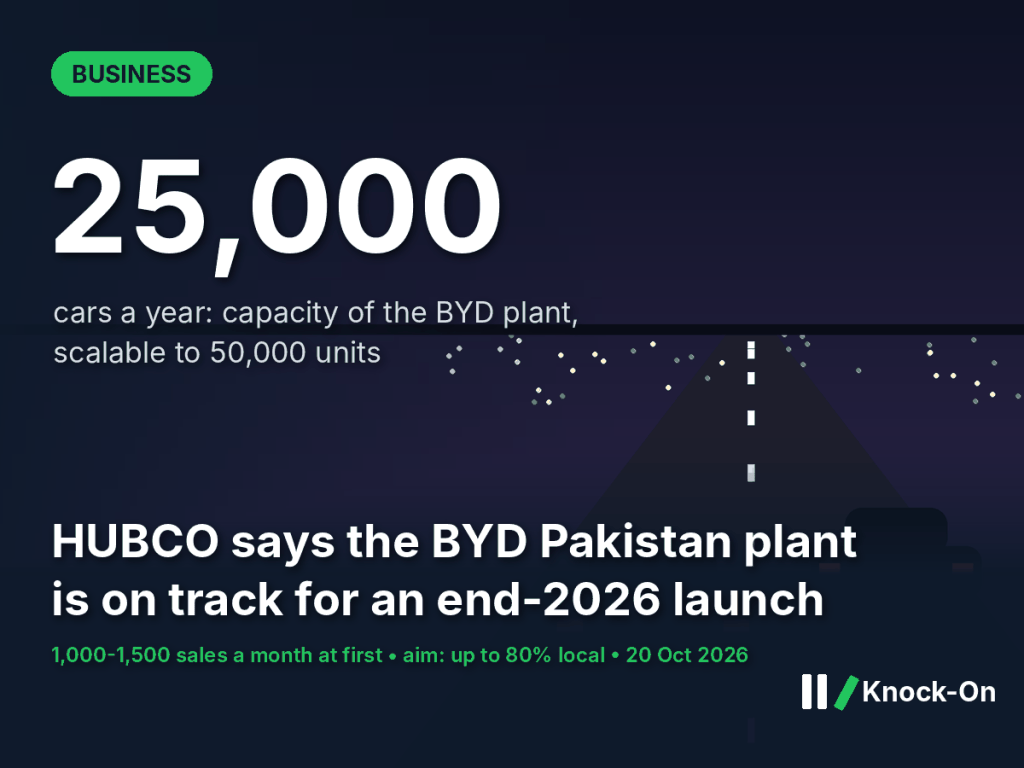
The BYD Pakistan plant will start production by the end of 2026, the management of Hub Power Company (HUBCO) said on Tuesday 20 October, denying reports of a delay, according to Business Recorder. The plant, being built by HUBCO’s car arm Mega Motor Company with China’s BYD, can assemble 25,000 new energy vehicles a year, scalable to 50,000. Brokerage AHL expects early sales of 1,000-1,500 vehicles a month. For a car market squeezed by high fuel prices and tax uncertainty, a local electric and hybrid line is a real change in competition.
The short version
- HUBCO says the BYD Pakistan plant remains on course to come online by the end of 2026.
- Capacity is 25,000 units a year, scalable to 50,000; BYD expects more than 1,100 jobs.
- Production will start with fully imported parts, with a long-term goal of localising up to 80% of the vehicle.
- BYD has delivered more than 10,000 imported vehicles in Pakistan since February 2025.
What happened
HUBCO’s management said it is targeting the end of calendar year 2026 for the plant and denied any delay, Business Recorder reported. AHL analyst Zayan Babar Khan told the paper the plant should be operational in four to five weeks. AHL said the company “does not intend to launch models indiscriminately” and will phase in further BYD models in the price segments with the strongest sales potential.
In an interview with BR Research published on 9 October, BYD Vice President Liu Xueliang said the plant would be BYD’s sixth facility outside China and was “nearing its launch in the second half of 2026”. He said BYD entered Pakistan in 2024, delivered its first vehicles in February 2025 and has since delivered more than 10,000 in under 18 months. He estimated the plant would avoid about 165,000 tonnes of CO2 emissions by 2034.
Early sales would use about half to three-quarters of the plant’s first-stage capacity
BYD Pakistan plant: capacity and expected sales, vehicles a year
Why it matters
Annualised, AHL’s estimate of 1,000-1,500 sales a month equals 12,000-18,000 vehicles a year, a Knock-On calculation, or roughly half to three-quarters of the plant’s initial capacity. That is a meaningful volume for a market where auto sector profits are set to fall 35% this quarter on tax and policy doubts. Local assembly should also cut the cost of bringing in fully built cars, and with the petrol price in Pakistan at Rs381.14 a litre on 20 October, demand for hybrids and electric cars has a clear running-cost case.
The knock-on effects
First order: the BYD Pakistan plant adds a new competitor
A locally assembled BYD range would compete directly with established Japanese and Korean assemblers, especially in segments where hybrids are already selling. Price competition is likely in the segments BYD chooses first.
Second order: imports first, local parts later
Because the plant will start with fully imported components, early production still draws on dollars. The goal of localising up to 80% of the vehicle would, if met, open orders for local parts makers and cut that import bill, but no timetable has been given.
Third order: charging and power demand
More electric cars need more charging points. BYD said it is discussing with Mega Motor Company how to bring its fast-charging technology to Pakistan, depending on infrastructure readiness. That is a possible opening for power distributors and fuel retailers.
Who could benefit
- HUBCO shareholders: a new revenue line beyond power generation, if sales match the forecast.
- Car buyers: more choice in electric and hybrid models, and possible price competition.
- Workers and parts makers: more than 1,100 jobs, and future local supply contracts.
Who may face pressure
- Incumbent assemblers: a new rival arrives as margins are already falling.
- The trade balance: early production relies entirely on imported kits.
- Used-car and import dealers: local assembly could undercut fully built imports.
What to watch
- The plant’s start date: AHL expects operations in four to five weeks, HUBCO targets end-2026.
- Which models are assembled first, and at what prices.
- Any government policy on new energy vehicles, which BYD says needs to be consistent and long term.
Sources
- Business Recorder, HUBCO denies BYD plant delay, targets end-2026 launch: report, 20 Oct 2026
- Business Recorder (BR Research), Interview with Liu Xueliang, Vice President of BYD Co., Ltd., 9 Oct 2026
This is analysis, not investment advice. Figures are as of 20 Oct 2026.


Leave a Reply