
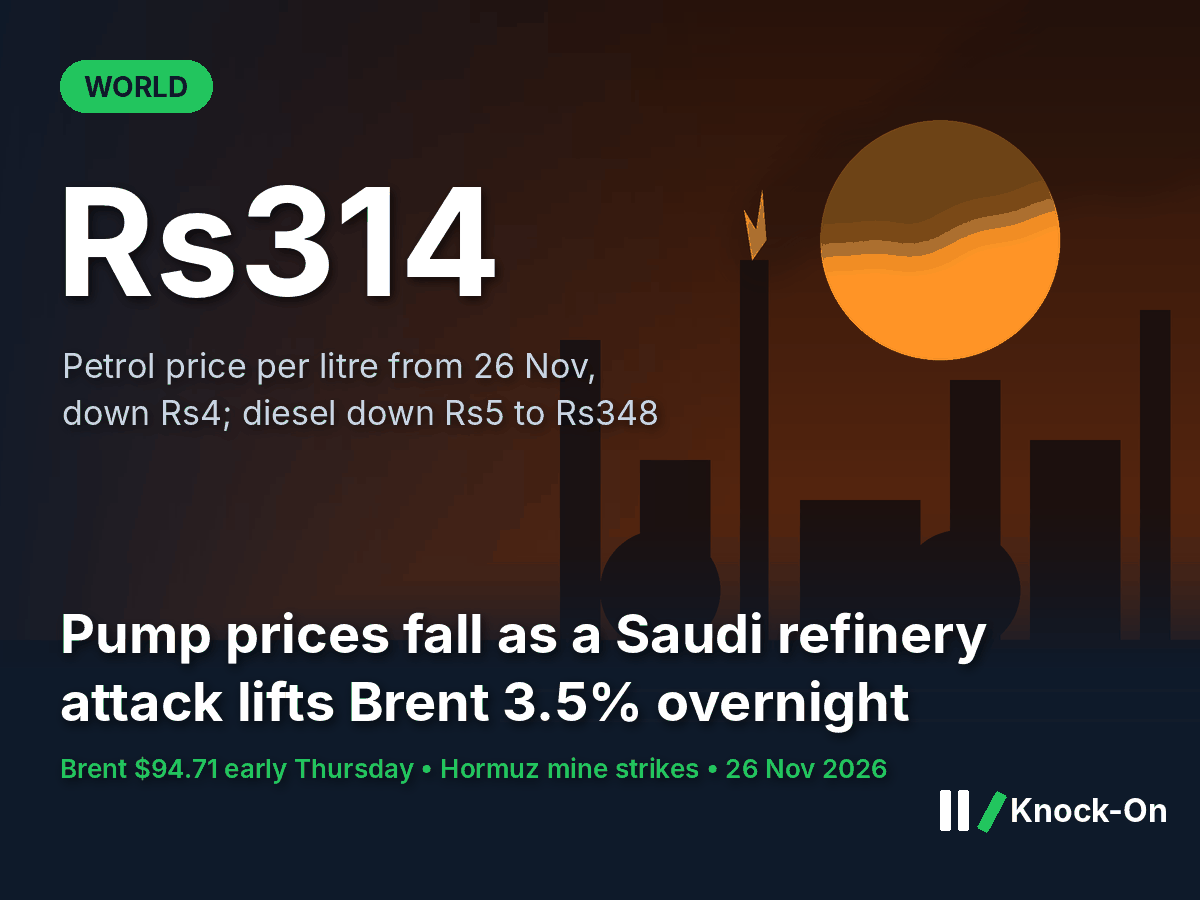
The petrol price in Pakistan fell for the third day running on Thursday, to Rs314 a litre, and diesel dropped to Rs348. But the oil market moved the other way overnight. Brent crude closed 3.5% higher on Wednesday after Yemen’s Houthis said they had attacked Saudi Arabia’s largest refinery, at Ras Tanura, and Iranian media reported tankers striking mines in the Strait of Hormuz. Because Pakistan now resets fuel prices almost daily, that rally can reach pumps, freight bills and factory costs within days.
The short version
- From 26 November petrol is Rs314 a litre (down Rs4 from Rs318) and high-speed diesel Rs348 (down Rs5 from Rs353), under Ogra’s ex-depot rates.
- Brent rose 3.5% on Wednesday and stood at $94.71 a barrel early on Thursday, up from $88.97 on Tuesday morning.
- The Houthis say they set Ras Tanura on fire; the Saudi-led coalition says it destroyed four drones there and has not said the refinery was hit.
- Today’s cuts were priced off a cheaper market, so the next revisions are where the overnight rally would show up.
What happened
Late on Wednesday the Oil and Gas Regulatory Authority notified new rates from 26 November: petrol down Rs4 to Rs314 a litre and high-speed diesel down Rs5 to Rs348, replacing the prices set a day earlier, The Nation and Dunya News reported. It was the third cut in three days: petrol was Rs319 on 24 November and Rs318 on 25 November, when diesel fell to Rs353 from Rs357.
On the same day, Houthi military spokesman Yahya Saree said the group had attacked the Ras Tanura refinery, which has capacity of 550,000 barrels a day, and that the strike “caused fires”, Reuters reported via Al-Monitor. The Saudi-led coalition said air defences had intercepted and destroyed four drones over Ras Tanura; it did not say the refinery had been struck. Satellite imagery reviewed by Reuters showed thick smoke over about 600 square kilometres. The Houthis described the attack as retaliation for Saudi strikes in Yemen, Middle East Eye reported, and warned that Saudi Red Sea ports would be targets.
Separately, Iran’s Fars agency, citing an army statement, said an oil tanker hit a naval mine and caught fire in a “restricted zone” of the Strait of Hormuz on Wednesday. Brent finished the day 3.5% higher and was at $94.71 early on Thursday, Reuters reported via Business Recorder.
Crude has risen while Pakistan’s pump prices fell
Change from 24 November to 26 November 2026, %
Why it matters
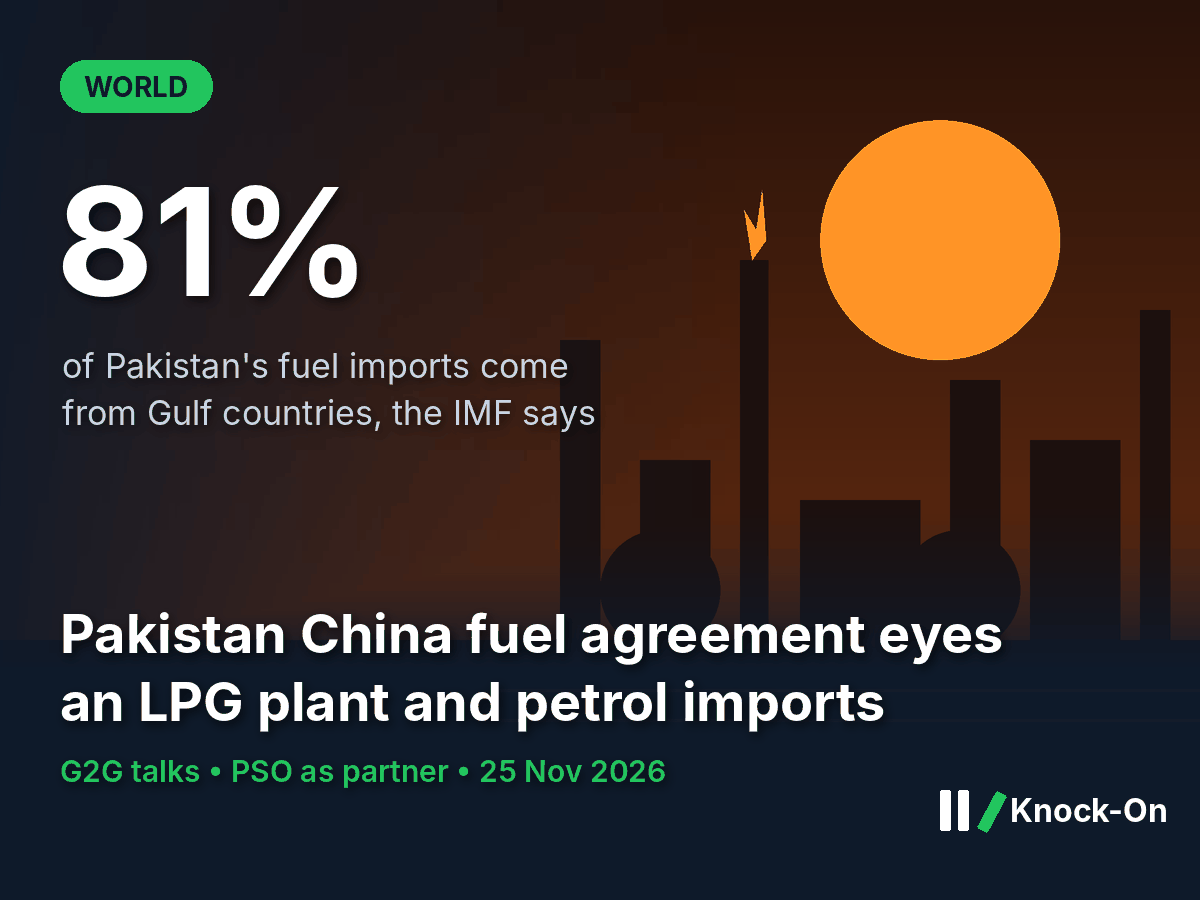
Pakistan imports most of its fuel from the Gulf; the IMF puts the GCC share at 81%, as we noted in our story on the Pakistan China fuel agreement. An attack on Saudi Arabia’s largest refinery, plus mine strikes in Hormuz, raises the risk premium on exactly the barrels Pakistan buys. The cuts that took the petrol price in Pakistan to Rs314 reflected a market that, as recently as Tuesday, was near a three-month low. ANZ analyst Daniel Hynes said the broadening of the conflict “threatens to halt the recovery in oil flows in recent weeks”.
The knock-on effects
First order: today’s relief, tomorrow’s risk
Motorists, transporters and small businesses get lower prices from today. Diesel, which moves most goods, has now fallen Rs9 in two days. If Brent holds near $95, the room for further cuts narrows quickly.
Second order: the import bill and inflation
Higher crude feeds into the oil import bill, the rupee and inflation, which the SBP watches when setting rates. Earlier this week we covered why oil is a main reason some forecasters see the SBP interest rate rising to 13%.
Third order: supply security and Gulf trade
Threats to Saudi Red Sea ports and new mine reports add to the war-risk costs already facing Pakistani cargo, described in our look at Hormuz shipping attacks and Pakistan’s Gulf trade. They also make the recent Oman and China supply deals more valuable as hedges.
Who could benefit
- Transporters and logistics firms, from today’s Rs5 diesel cut.
- Exploration and production companies, whose revenues track international crude prices.
- Suppliers outside the Gulf, as buyers look to diversify.
Who may face pressure
- Fuel importers and oil marketing companies, if replacement cargoes cost more than the price at the pump allows.
- Energy-intensive industry, if the rally reverses this week’s cuts.
- Exporters shipping via the Red Sea and Gulf, facing higher freight and insurance.
What to watch
- Any statement from Saudi Arabia or Aramco on damage at Ras Tanura.
- Ogra’s next price notices, and whether the cuts stop.
- OPEC+ meetings on 29 November on 2027 output policy.
- Further mine or tanker incidents in Hormuz, and Houthi threats to Saudi Red Sea ports.
Sources
- The Nation, Government cuts petrol price by Rs4 and diesel by Rs5 per litre, 25 Nov 2026
- Dunya News, Petrol price cut by Rs4, diesel by Rs5 per litre, 26 Nov 2026
- Business Recorder (Reuters), Oil rises on supply concerns as Iran claims mine strikes on ships, 26 Nov 2026
- Al-Monitor (Reuters), Yemen’s Houthis say they attacked Saudi Arabia’s Ras Tanura refinery, 25 Nov 2026
- Middle East Eye, Houthis say they attacked Saudi Arabia’s largest oil refinery in retaliation for deadly strikes, 25 Nov 2026
- Business Recorder (Reuters), Oil holds near three-month low as rising supply offsets Hormuz threat, 24 Nov 2026
- Dawn, Petrol price reduced by Rs3 per litre; diesel remains unchanged, 23 Nov 2026
This is analysis, not investment advice. Figures are as of 26 November 2026. Knock-On is not affiliated with any political party.
Leave a Reply