
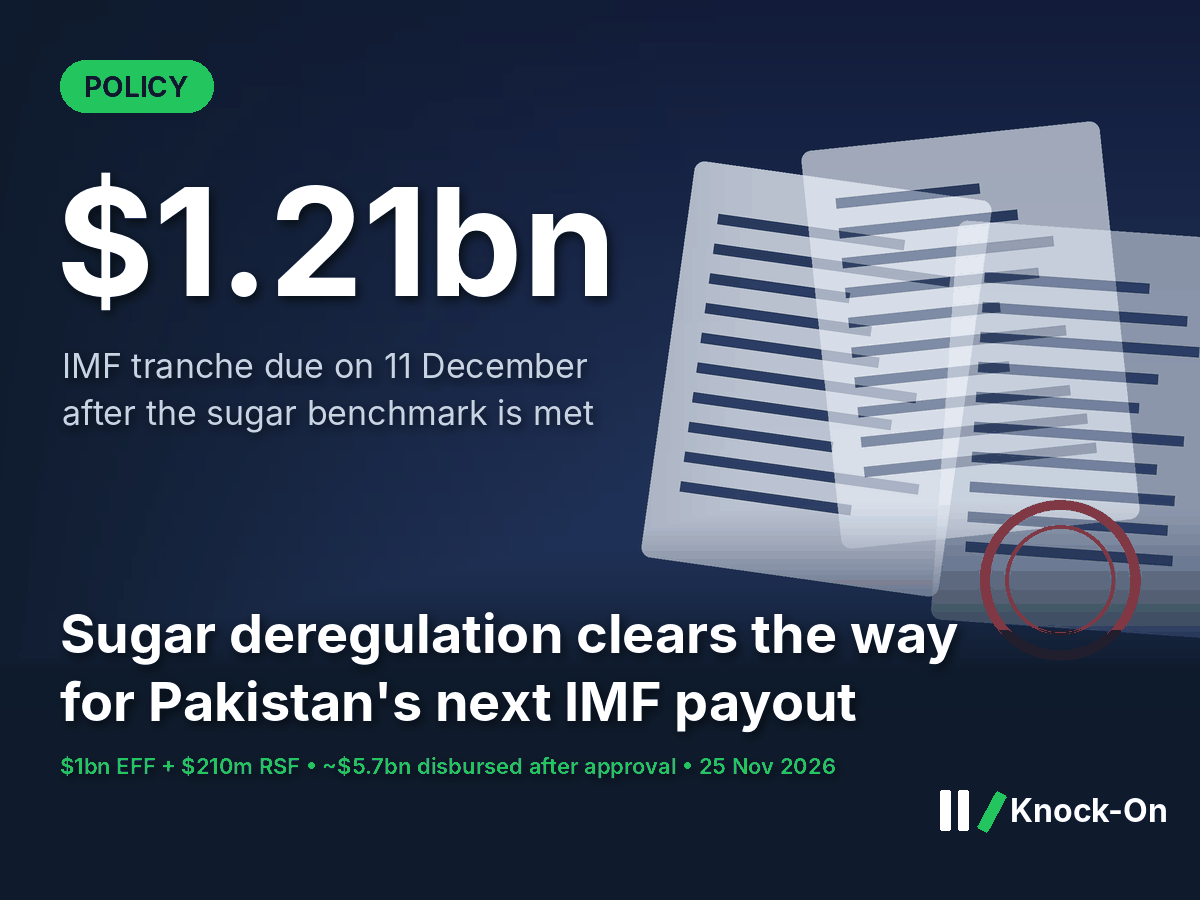
The next IMF tranche for Pakistan, worth about $1.21bn, is expected to be approved by the IMF Executive Board on 11 December, Dawn reported on Wednesday. The meeting could only be scheduled once the federal cabinet signed off a long-delayed plan to deregulate the sugar industry, a structural benchmark Pakistan had been in breach of since June. For business, the payout matters less for its size than for what it signals: the programme is on track, and one of the country’s most controlled commodity markets is about to be opened up.
The short version
- The IMF board is expected to approve about $1.21bn on 11 December: about $1bn under the $7bn Extended Fund Facility (EFF) and about $210m under the $1.4bn Resilience and Sustainability Facility (RSF).
- After approval, total disbursements under both programmes would reach about $5.7bn.
- The cabinet approved a National Policy for Deregulation of the Sugar Sector on Tuesday, ending export subsidies and curbs on moving sugar between provinces.
- Cane prices, new mills and sugar prices are to be left largely to the market, with safeguards for farmers.
What happened
Pakistan and the IMF reached a staff-level agreement in the first week of October, after a mission led by Iva Petrova held talks from 23 September to 7 October. Board approval will complete the fourth review of the EFF and the third review of the RSF, releasing about 760m SDRs (about $1bn) and 154m SDRs (about $210m). Both programmes run until September 2027, according to Dawn.
The sugar policy was the missing piece. Dawn reported that its approval was mandatory for the board meeting to be scheduled; the benchmark’s deadline was 30 June 2026. Sindh had held out until 21 November, when it cleared the plan after amendments. The policy removes zoning and variety restrictions on cane planting, leaves the cane price to the market (with a list of banned varieties), allows new mills without capacity approvals and ends price controls. Farmers get third-party checks on weighing scales and sucrose testing, and mills must pay interest on late cane dues. The government keeps a buffer stock and will encourage an ethanol blending mandate. According to sources quoted by Dawn, the prime minister recused himself from the sugar decisions because of his family’s sugar business.
After December, about two-thirds of the IMF money will have been paid
EFF + RSF combined, US$ billion, as reported 25 Nov 2026
Why it matters
An on-time IMF tranche keeps Pakistan’s other financing lines open and supports reserves, which Dawn reported at about $21.5bn gross at end-September. That matters with fuel import costs still exposed to the Gulf conflict. The IMF has also been pressing on subsidies, as we covered in its call to phase out fuel support. The sugar reform matters in its own right: it changes the rules for one of Pakistan’s largest agro-industries and for anyone who buys sugar in bulk.
The knock-on effects
First order: the IMF tranche steadies Pakistan’s dollar position
About $1.21bn adds to reserves in mid-December, and a completed review reassures commercial lenders. The IMF expects GDP growth of 3.6% for FY26, and the current account was broadly balanced, Dawn reported.
Second order: sugar moves from controls to the market
Without export subsidies or provincial movement curbs, sugar prices should follow supply and demand more closely. The government has already allowed exports of more than 400,000 tonnes, on top of 200,000 tonnes exported a few months earlier. Mills gain freedom to expand, but lose the cushion of state support.
Third order: fiscal discipline stays the price of support
The IMF’s priorities include a primary surplus of 2% of GDP through the FY27 budget. That limits room for tax relief or new subsidies, and keeps interest-rate expectations sensitive to oil, as Standard Chartered’s SBP interest rate forecast shows.
Who could benefit
- Importers and banks: a completed review supports reserves and confidence in the rupee.
- Efficient sugar mills: they can add capacity without approvals and sell across provinces.
- Cane growers: scale checks, sucrose testing and interest on late dues address long-standing complaints.
- Ethanol producers: a blending mandate, if adopted, would create new domestic demand.
Who may face pressure
- Mills that relied on export subsidies and protected provincial markets.
- Bulk sugar buyers (beverages, confectionery, bakeries), who may see more price swings once controls end.
- Households, if export demand tightens local supply; food costs are already high, as the flour price shows.
What to watch
- 11 December: the IMF Executive Board meeting and its statement on Pakistan.
- Transitional rules for the current crushing season.
- Retail sugar prices in the weekly SPI as exports proceed.
- FY27 budget talks and the 2%-of-GDP primary surplus target.
Sources
- Dawn, Pakistan eyes $1.21bn IMF disbursement next month, 25 November 2026
- Dawn, Cabinet approves deregulation of sugar sector to meet vital IMF benchmark, 25 November 2026
- IMF, Pakistan country page
This is analysis, not investment advice. Figures are as of 25 November 2026.
Leave a Reply