

Pakistan’s current account swung back into the black in October. The Pakistan current account surplus came to $39 million, according to State Bank of Pakistan (SBP) data released on Tuesday, after a deficit of $371 million in September and a deficit of $307 million in October last year. The turnaround came from workers’ remittances, not from trade: imports are still growing faster than exports. For businesses, a small surplus means less immediate pressure on the rupee and on reserves, but it is a thin cushion.
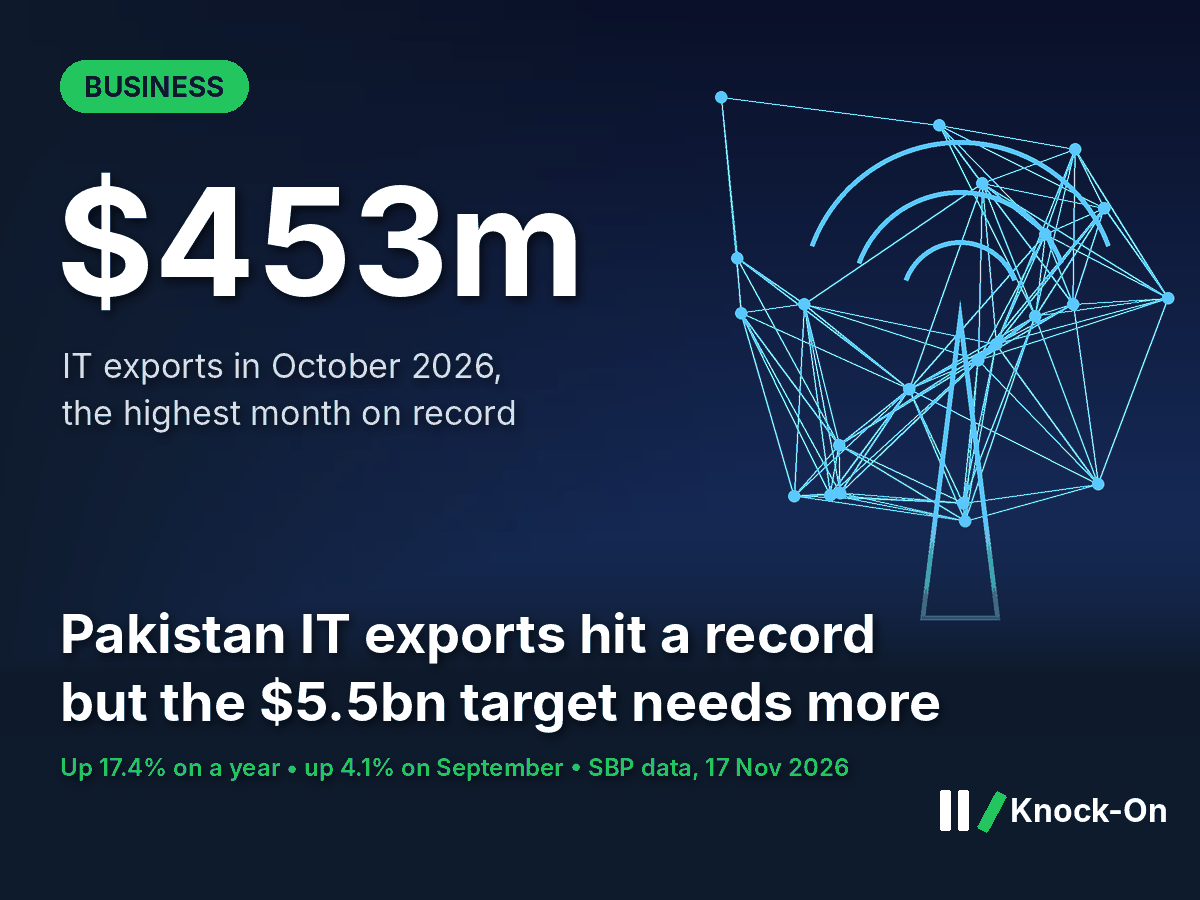
Update, 17 Nov 2026, 9:00 pm PKT: Services also helped in October. SBP data reported by Business Recorder show Pakistan IT exports hit a record $453m in October, up 17.4% on a year.
The short version
- The current account posted a $39 million surplus in October 2026, against a revised $371 million deficit in September.
- Workers’ remittances rose nearly 14% year on year to $3.89 billion, more than total exports of goods and services ($3.87 billion).
- Imports rose over 10% to $7.08 billion, so the trade gap is still widening.
- For July-October (4MFY27), the deficit is $850 million, smaller than $1,062 million a year earlier.
What happened
According to SBP data reported by Business Recorder, the current account recorded a surplus of $39 million in October 2026. September’s deficit was revised up from $356 million to $371 million. In October 2025, the account was in deficit by $307 million. Over the first four months of the fiscal year, the cumulative current account deficit was $850 million, compared with $1,062 million in the same period of FY26.
October flipped a deficit into a small surplus
Pakistan current account balance, US$ million (deficits in red)
Total exports of goods and services rose nearly 12% year on year to $3.87 billion, from $3.46 billion. Total imports rose more than 10% to $7.08 billion, from $6.41 billion. Workers’ remittances were $3.89 billion, up from $3.42 billion, an increase of nearly 14%. Knock-On reported last week that Saudi Arabia and the UAE sent $1.8 billion of October’s remittances between them.
Why it matters
The current account decides how many dollars Pakistan earns or needs from abroad each month. A surplus, even a small one, means the country did not have to borrow or draw down reserves to pay for that month’s imports and income payments. But the make-up of the October number matters as much as its sign. Remittances alone were larger than all exports of goods and services, and imports were nearly double exports. The trade side is not improving: Knock-On reported on Monday that the goods trade deficit widened 16% to $14.63 billion in July-October.
Remittances now match all exports, and imports are nearly double both
October 2026, US$ billion
The knock-on effects
First order: a Pakistan current account surplus eases dollar demand
A month without a net external financing need reduces pressure on the interbank market and on SBP reserves. Importers that need dollars for raw materials and machinery benefit from a steadier rupee when inflows cover outflows.
Second order: growth depends on remittance households
With remittances doing the heavy lifting, consumer spending in remittance-receiving areas becomes a larger driver of demand for retail, housing, motorcycles and consumer goods. That ties Pakistan’s external balance more closely to jobs and wages in the Gulf.
Third order: little room if imports keep rising
The SBP’s FY27 growth forecast already leans on remittances. If imports continue to grow at over 10% while exports grow more slowly, monthly surpluses could turn back into deficits, especially if oil prices rise again. This is a risk, not a forecast.
Who could benefit
- Importers of raw materials and machinery, from steadier dollar availability.
- Banks and exchange companies that handle remittance flows.
- Consumer-facing businesses in remittance-heavy regions, from household spending.
Who may face pressure
- Exporters, whose growth is not keeping pace with imports and who face a stronger real exchange rate as remittances support the rupee.
- Policymakers, if a widening trade gap forces tighter import controls or higher rates later in the year.
What to watch
- The SBP’s November remittance and current account data, the next test of whether the surplus holds.
- Monthly trade data for November from the Pakistan Bureau of Statistics, for signs that import growth is slowing.
- Oil prices, which drive a large share of the import bill.
- Whether the full-year deficit stays within the 0-1% of GDP range analysts cite for FY27. Sana Tawfik of Arif Habib Limited told Business Recorder she expects it to remain “manageable” within that range. That is a forecast.
Sources
- Business Recorder, Pakistan posts $39mn current account surplus in Oct 2026, 17 November 2026
- Pakistan Observer, Remittances Lift Pakistan’s Current Account to $39 Million Surplus, 17 November 2026
This is analysis, not investment advice. Figures are as of 17 November 2026.

Leave a Reply