
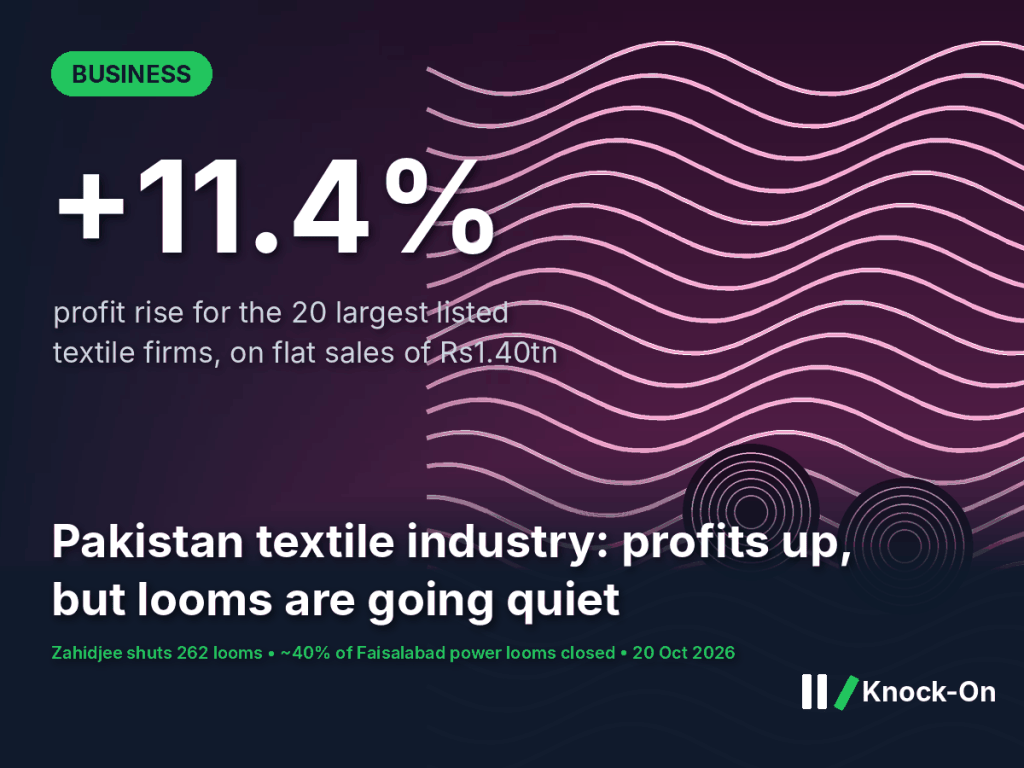
The Pakistan textile industry is splitting in two. The 20 largest listed textile companies raised their combined profit by 11.4% to Rs52.0bn in the year to June 2026, according to Topline Securities, even though their sales did not grow. On Monday, one listed mill, Zahidjee Textile Mills, told the Pakistan Stock Exchange it had shut a weaving unit of 262 looms, the latest sign that the smaller, weaving end of the trade is under heavy strain.
The short version
- Combined net income of the 20 largest listed textile firms rose to Rs52.0bn in FY26 from Rs46.7bn, Topline Securities says.
- Their combined revenue was about Rs1.40tn (about $5bn), down 0.3%, so the gain came from lower financing costs and tax changes, not more sales.
- Zahidjee Textile Mills closed a 262-loom weaving unit on 19 October, citing “operational adjustments”.
- A Dawn report cited by Profit says about 40% of power loom units in and around Faisalabad have shut.
What happened
Profit reported on 19 October that a Topline Securities report dated 13 October, by analyst Rabia Yousuf, found combined revenue of Rs1.40tn for the 20 biggest listed textile companies in the Pakistan textile industry, a marginal 0.3% fall on the previous year. Net income rose 11.4% to Rs52.0bn from Rs46.7bn. The group covers composite, spinning, weaving, woollen and apparel firms and makes up about 83% of the sector’s stock market value. Profit attributes the rise mainly to lower financing costs and tax changes rather than a broad recovery in factory profitability.
Big textile firms earned 11% more on the same sales
20 largest listed textile companies, combined net income, Rs billion, years to June
Net margin: about 3.3% in FY25 and 3.7% in FY26
Separately, Zahidjee Textile Mills, a listed exporter of value-added fabrics, made-ups and yarn, said in a stock exchange notice that it “has closed its weaving unit consisting of 262 weaving looms”. It gave no location, job numbers or financial impact. Profit, citing Dawn, reported that about 40% of power loom units in Faisalabad and nearby areas have closed, and industry representatives say more than 100,000 workers have lost their jobs. Aslam Meraj of the Textile, Power Loom and Garment Workers Union Faisalabad said local manufacturers were struggling to compete with imported yarn, grey cloth and finished goods.
Why it matters
Textiles are Pakistan’s biggest export and one of its largest employers, and the government’s new $100bn exports target for 2035 depends on them. A profit rise driven by cheaper borrowing, rather than higher sales, shows the large groups are protecting margins but not yet growing. The weaving tier that feeds them is shrinking. Operators cite high electricity tariffs, taxes and labour costs, while cheaper Chinese, largely polyester-based yarn has undercut local spinners and weavers.
The knock-on effects
First order: jobs and orders in Faisalabad
Loom closures hit wage earners, small workshop owners and the traders who supply them. Faisalabad has historically had nearly 800,000 looms, from small sheds to factories with thousands of machines, so a 40% closure rate means a large pool of idle capacity.
Second order: more imported inputs
When local weavers close, exporters lean more on imported yarn and grey cloth. That supports their costs but raises the import bill, at a time when Pakistan’s current account deficit is widening as imports outpace exports.
Third order: power demand and factory output
Fewer running looms means less industrial electricity demand, which pushes fixed grid costs onto remaining users. Factory output is already weak: large-scale manufacturing grew just 0.67% in August.
Who could benefit
- Large composite mills: lower finance costs lift earnings, and they can source cheaper imported inputs.
- Yarn importers and traders: demand for imported yarn and grey cloth rises as local weaving shrinks.
- Banks lending to top-tier mills: stronger profits improve debt servicing for the biggest borrowers.
Who may face pressure
- Power loom owners and workers: rising power costs, taxes and import competition are pushing units to close.
- Local spinners: cheaper Chinese yarn competes directly with their product.
- Faisalabad’s local economy: shops, transporters and landlords that depend on loom workers’ wages.
What to watch
- Further stock exchange notices of unit closures from listed mills.
- Monthly textile export data from the Pakistan Bureau of Statistics in early November.
- First-quarter FY27 results from listed textile companies, which will show whether lower finance costs are still lifting profits.
- Any change to industrial power tariffs or to duties on imported yarn.
Sources
- Profit, Pakistan’s 20 largest listed textile companies generate $5 billion in sales, profits rise 11%, 19 Oct 2026
- Profit, Zahidjee Textile Mills shuts 262-loom weaving unit amid mounting pressure on Pakistan’s textile industry, 19 Oct 2026
This is analysis, not investment advice. Figures are as of 20 Oct 2026.


Leave a Reply