
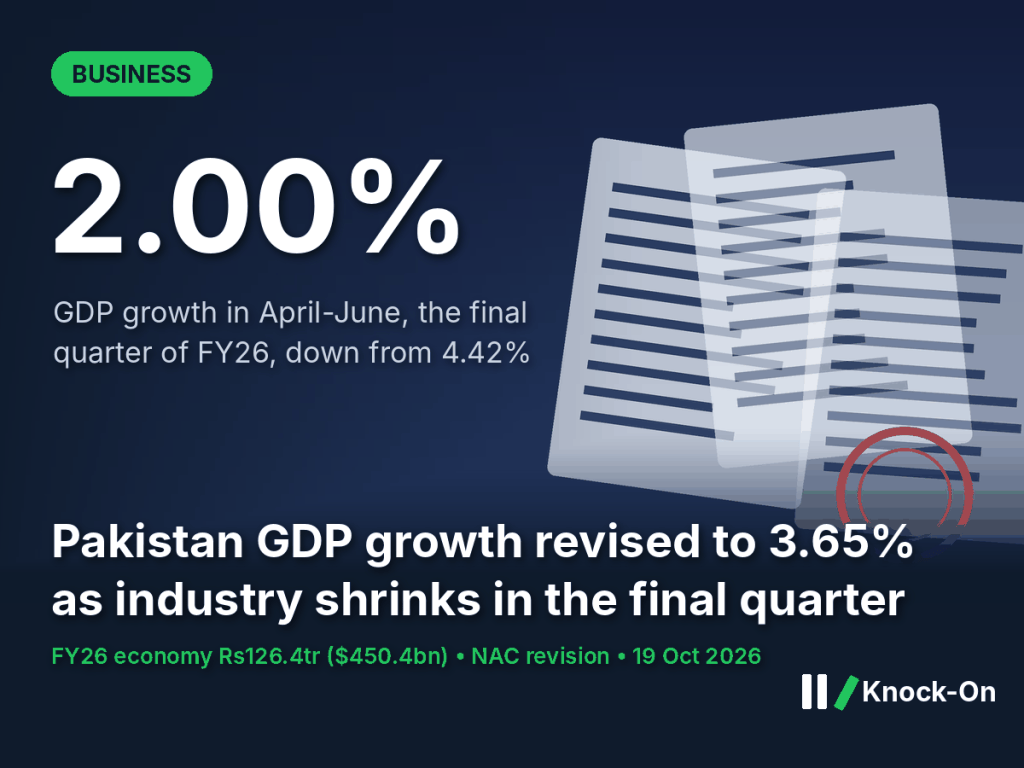
Pakistan GDP growth for the 2025-26 financial year has been revised down to 3.65% from 3.70%, the National Accounts Committee decided on Monday. The headline cut is small. The detail behind it is not: growth in the last quarter of the year, April to June 2026, slowed to 2%, and industry shrank by 4.7% in that quarter. For businesses planning for this year, the exit speed of the economy matters more than the annual average.
The short version
- FY26 GDP growth was revised to 3.65%, below the 3.70% estimate made in May and an earlier 4% estimate.
- Growth slowed to 2% in April-June, after 4.42% in January-March.
- Industry contracted 4.70% in the final quarter; agriculture was the bright spot for the year at 3.50%.
- The economy was valued at Rs126.4 trillion ($450.4bn), and income per person at $1,896.
What happened
The National Accounts Committee approved the revised figures at its 118th meeting, held at the Pakistan Bureau of Statistics (PBS) on 19 October. It also revised growth for FY25 to 3.11% from 3.18%. The IMF had forecast 3.6% for FY26, while the World Bank and the Asian Development Bank had forecast 3.7%, Dawn reported.
The quarterly path is the key change. The first three quarters were revised up or held close to earlier estimates: 3.89% in July-September, 4.31% in October-December and 4.42% in January-March. The fourth quarter came in at 2%, against 6.07% in the same quarter a year earlier. The PBS partly blamed that high base, ProPakistani reported.
Growth more than halved in the final quarter of FY26
Pakistan real GDP growth by quarter, FY2025-26, %, revised estimates of 19 Oct 2026
By sector, agriculture grew 3.50% for the year (previously 2.89%), helped by wheat, maize, pulses and tomatoes. Industry grew 3.34% (previously 3.51%) and services 3.81% (previously 4.09%). Large-scale manufacturing was revised to 5.01% from 6.11%. Within it, autos grew 57.77% while pharmaceuticals fell 8.87% and iron and steel 7.84%. In the final quarter, the electricity, gas and water sector shrank 33.19%, which ProPakistani linked to lower subsidies, a high deflator and the base effect.
Why it matters
Annual Pakistan GDP growth of 3.65% looks steady, but most of it was earned before April. The economy left FY26 growing at 2%, so FY27 starts from a weaker base than the annual number implies. The April-June quarter was also when fuel prices peaked: petrol reached Rs458.41 a litre on 3 April, according to Dawn. Our August factory output analysis showed the same split this year, with cars and apparel growing while food and pharma shrank.
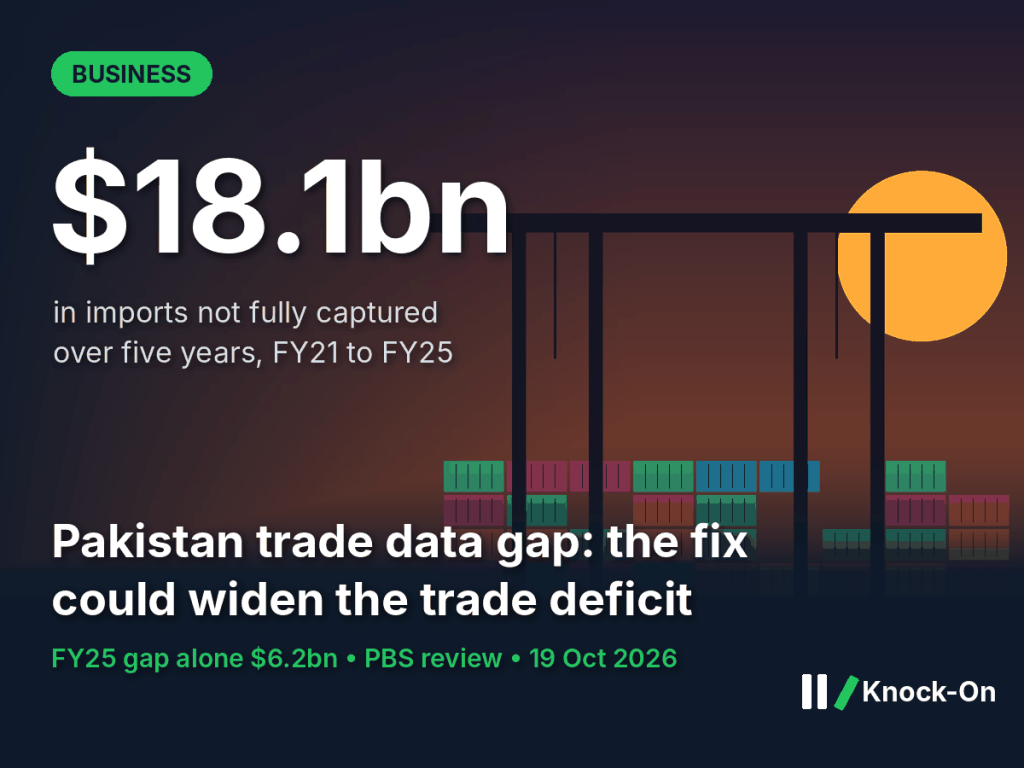
The committee also approved revised import data for FY21 to FY25, which links to the gap of about $18bn in recorded imports that we covered in our trade data story.
The knock-on effects
First order: planning numbers change
Companies, banks and lenders that build budgets on official growth will use a lower base. A 2% exit rate means demand at the start of FY27 is softer than a 3.65% average suggests, particularly for industrial suppliers.
Second order: the split economy deepens
Sectors that grew strongly, such as autos, IT and construction, can point to the data when raising finance. Pharma, steel and chemicals, which contracted, face a harder case with lenders. Wholesale and retail trade growth was cut to 2.37% from 3.71%, a sign of weaker consumer activity.
Third order: pressure on policy
A slower exit gives the government and the State Bank more reason to weigh growth support against inflation and the external account. Whether it changes policy depends on how the first quarter of FY27 turns out, which is not yet published.
Who could benefit
- Farm-linked businesses: agriculture growth was revised up to 3.50%, with crops stronger than first estimated.
- IT and telecom firms: information and communication grew 9.53%, up from an earlier 7.52%.
- Builders and suppliers: construction growth was revised up to 6.30%.
- Banks and insurers: finance and insurance growth was revised to 4.23% from 0.32%.
Who may face pressure
- Industrial suppliers: industry shrank 4.70% in April-June.
- Pharma, steel and chemicals: all three contracted over the year.
- Retailers and wholesalers: trade growth was cut to 2.37%.
- Households: income per person rose to $1,896 from $1,824, but Dawn noted high inflation means little real gain in personal incomes.
What to watch
- SBP policy meeting, 26 October: whether the slower exit features in the central bank’s view, as covered in our SBP interest rate analysis.
- Monthly LSM data: the next PBS release will show whether factory output is recovering in FY27.
- Revised import figures: how the new FY21-FY25 data change the trade and current account picture.
Sources
- Dawn, GDP growth revised down to 3.65pc as country falls short of target, 20 Oct 2026
- ProPakistani, Pakistan’s GDP Growth Revised Down to 3.65%, 19 Oct 2026
- Dawn, Govt slashes petrol price by Rs5.16 per litre, high-speed diesel rate by Rs7.69, 19 Oct 2026
This is analysis, not investment advice. Figures are as of 20 October 2026.

Leave a Reply