
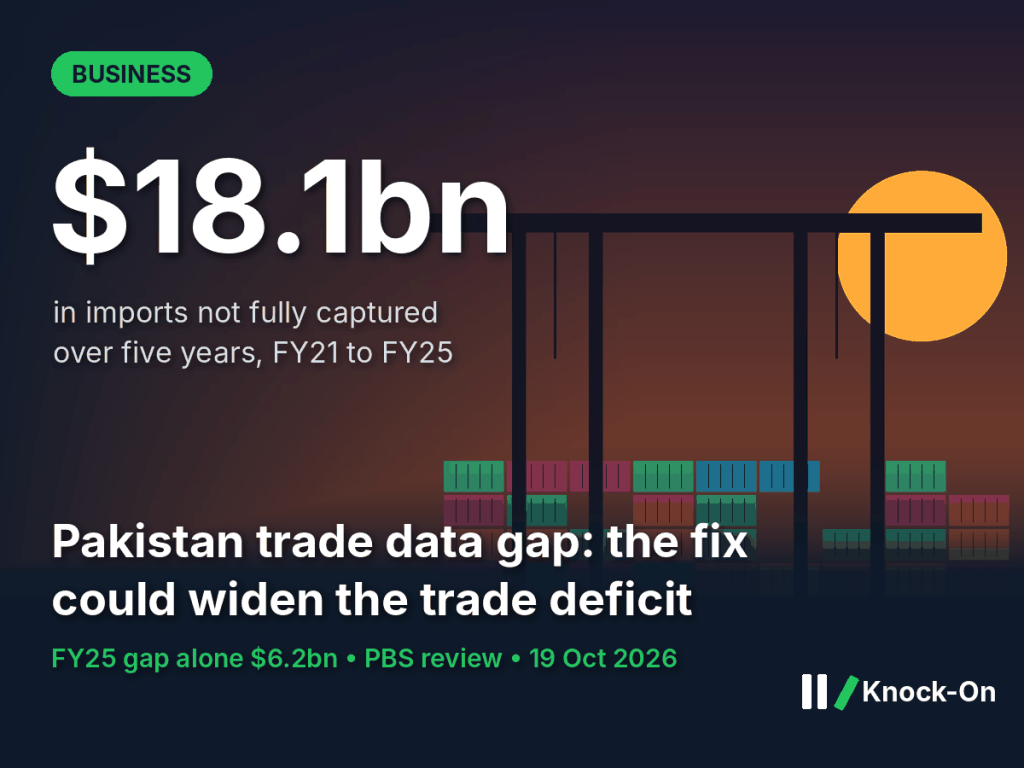
Pakistan trade data has been missing a growing slice of imports. A review by the Pakistan Bureau of Statistics found that two official import datasets differed by about $18.1bn over the five fiscal years to June 2025, with the gap widening to $6.2bn in FY25 alone, according to a report carried by Profit. The government says the discrepancies have now been identified and reconciled. The harder question is what happens next: officials have warned that switching to the more complete records would show a larger trade deficit.
The short version
- Import figures from PRAL, used for official statistics, and from Pakistan Single Window differed by about $18.1bn over FY21 to FY25.
- The gap grew from $1.4bn in FY21 to $6.2bn in FY25.
- The main cause was customs categories added after 2017 that the official dataset did not fully capture.
- The findings have been shared with the IMF, and a committee is reviewing which source to use.
What happened
The probe began in 2025 after concerns about the gap between Pakistan’s reported imports from China and China’s recorded exports to Pakistan. The Federal Board of Revenue set up an initial committee on the Prime Minister’s Office’s instructions, and the PBS prepared a detailed assessment after workshops in June and July 2025. It found that customs import data from the WeBOC system, used by the PBS and the FBR’s research directorate, had not been comprehensively updated since 2017. Pakistan Single Window data covered 15 goods declaration categories; the PRAL-based dataset used for official statistics covered seven. The largest share of the gap came from imports under facilitation schemes.
The import gap more than quadrupled in five years
Difference between PSW and PRAL import data, US$ billion, by fiscal year
The assessment went to the planning and finance ministries and then to the IMF. The finance minister has formed a committee to review the two systems and what a change of official source would mean. Recommendations include linking the PBS and the FBR’s research directorate directly to Pakistan Single Window, annual reviews of reporting procedures, and data exchange with major trading partners. The PBS has also been asked to work with Chinese authorities and the International Trade Centre so that Chinese goods shipped to Afghanistan through Pakistan are recorded correctly.
Why it matters
Trade figures feed almost every economic decision that touches business: the IMF’s financing assumptions, tariff policy and the government’s export plans. A $6.2bn gap in one year is large next to Pakistan’s roughly $30bn of annual exports, which Knock-On covered in the government’s new $100bn exports target. Officials themselves warned that moving to the fuller records would show a larger trade deficit, which is why they say the transition needs careful management while Pakistan is in an IMF programme. A wider recorded gap would come on top of already rising import pressure: the current account swung to a deficit in September as imports grew faster than exports.
The knock-on effects
First order: Pakistan trade data may be restated
A switch to Pakistan Single Window data would raise recorded imports, especially under facilitation schemes. Analysts and companies that use PBS trade figures for market sizing would need to adjust their baselines.
Second order: more scrutiny of facilitation schemes
Because the largest gap sat in imports under facilitation schemes, those schemes are likely to draw closer attention from the FBR and the IMF, and companies that rely on them should expect more questions about what they bring in.
Third order: better data, better trade talks
Cleaner data on Chinese goods moving through Pakistan to Afghanistan would sharpen talks on transit trade, a live issue since Pakistan-Afghanistan trade fell 28% with the border shut.
Who could benefit
- Local manufacturers: fuller import data can strengthen cases against under-recorded competing imports.
- Policymakers and lenders: decisions based on more complete numbers.
- Researchers and analysts: a single, reconciled import series.
Who may face pressure
- Importers using facilitation schemes: tighter checks and reporting are likely.
- The government’s trade messaging: a wider recorded deficit is harder to present, especially during an IMF programme.
What to watch
- The finance minister’s committee: whether it adopts Pakistan Single Window as the official source, and from when.
- PBS monthly trade releases: any note on revised methods or restated history.
- IMF reviews: how the revised data is treated in programme documents.
Sources
- Profit (Pakistan Today), Pakistan reconciles over $18 billion discrepancy in trade data spanning five years, 19 October 2026
This is analysis, not investment advice. Figures are as of 19 October 2026.


Leave a Reply