
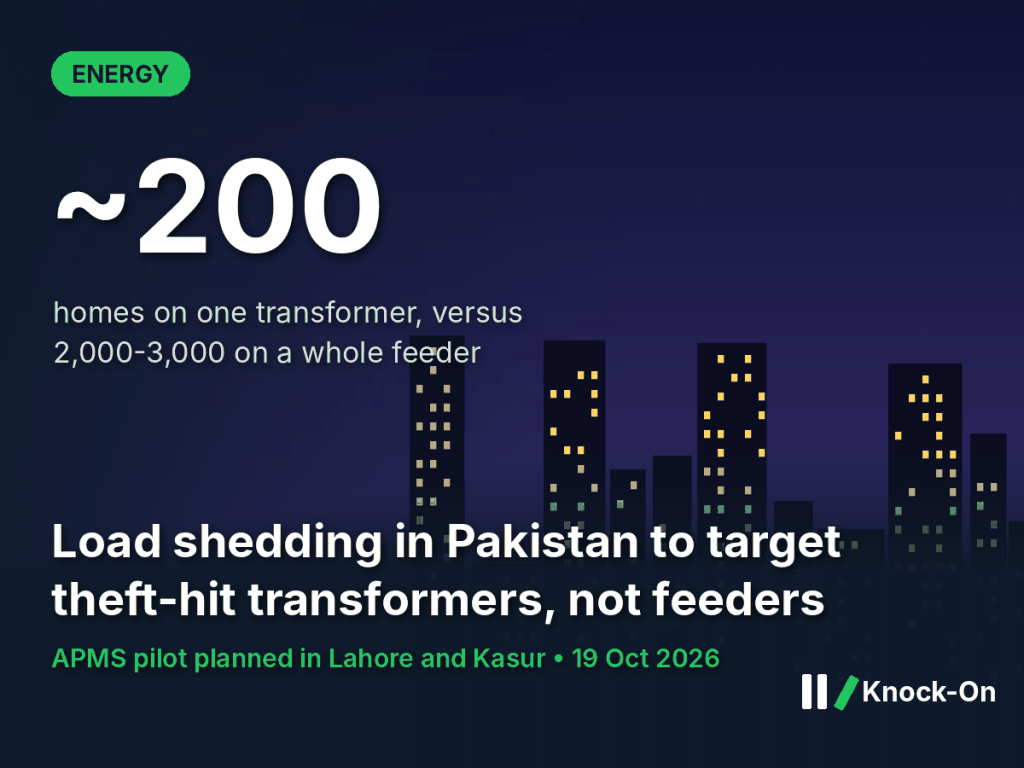
Load shedding in Pakistan is set to change shape. Energy Minister Awais Leghari said on Monday that the government will introduce, in phases, a system that identifies individual transformers in high-theft areas so power can be cut there alone, instead of across a whole feeder. Today a feeder can serve 2,000 to 3,000 consumers or more; a transformer serves about 150 to 200. For shops, workshops and small factories that pay their bills but sit on a loss-making feeder, that difference is the whole story.
The short version
- The government plans an Asset Performance Management System (APMS) to pinpoint theft at transformer level, Dawn reported.
- A pilot is planned for Lahore and Kasur, with LESCO doing the groundwork.
- Leghari was reported as saying the shift to transformer-level cuts will start from June next year.
- Until then, feeders with losses of 30% or more stay on load shedding.
What happened
Leghari announced the plan at a ceremony in Dera Ghazi Khan on 19 October, Dawn reported. APMS units, housed in an iron box at each transformer, would automatically report theft and line losses to officials. The system works alongside smart meters (Advanced Metering Infrastructure) that allow two-way communication and remote disconnection, and a tampering attempt on a smart meter would also be reported. The Power Planning and Monitoring Company, the technical arm of the Power Division, is supporting the design and roll-out. A LESCO official told Dawn that Prime Minister Shehbaz Sharif would inaugurate the pilot “soon”.
Under the current policy, load shedding applies to loss-making 11kV feeders in five categories, with longer outages for higher-loss feeders. Leghari said loadshedding will continue on feeders reporting losses of 30% or more, with no leniency for thieves or chronic defaulters. TechJuice reported him as saying the move to transformer-level load shedding would begin from June next year.
Today the whole feeder pays for its losses
Load shedding on loss-making 11kV feeders, hours by feeder category, current policy as reported 20 Oct 2026
Why it matters
Feeder-level load shedding in Pakistan punishes everyone on the line for the theft of some. Leghari put it this way: “all consumers, including those paying their bills regularly, also bear the brunt of those stealing electricity.” Narrowing cuts to a transformer would shrink the number of people affected by each outage by roughly ten to twenty times. For a business, outage hours mean generator fuel, idle staff and missed orders, at a time when electricity bills are rising again in November.
A transformer cut hits a fraction of the customers a feeder cut does
Consumers affected by one outage, by level of the grid, number of consumers
The knock-on effects
First order: fewer forced outages for paying users
If the system works as described, paying customers on a high-loss feeder would no longer lose power because of theft on another transformer. Shops and small factories in those areas could spend less on diesel and generators.
Second order: theft becomes visible and local
Data at transformer level makes it harder to hide theft in a large pool. That could raise recoveries for distribution companies, which matters as the government prepares them for sale, as covered in our DISCO privatisation analysis.
Third order: demand for meters and grid equipment
A national roll-out would need monitoring units at transformers and smart meters in place of conventional ones. That points to orders for meter makers, electrical suppliers and installers, though no budget or timeline for a full roll-out has been published.
Who could benefit
- Paying businesses on high-loss feeders: fewer outages caused by others’ theft.
- Distribution companies: better data to recover losses, starting with LESCO in the pilot.
- Meter and electrical suppliers: potential demand from smart-meter and monitoring roll-outs.
Who may face pressure
- Areas with high theft: outages would be concentrated on specific transformers.
- Chronic defaulters: Leghari said there would be no leniency.
- Generator and fuel sellers: could see lower demand where outages fall.
What to watch
- Pilot launch in Lahore and Kasur: the inauguration date has not been announced.
- June 2027: the reported start of transformer-level load shedding.
- Roll-out cost and funding: not yet published.
Sources
- Dawn, Govt unveils hi-tech system to manage loadshedding, 20 Oct 2026
- TechJuice, Load Shedding to Be Limited to Theft-Hit Transformers From June, 19 Oct 2026
This is analysis, not investment advice. Figures are as of 20 October 2026.


Leave a Reply