
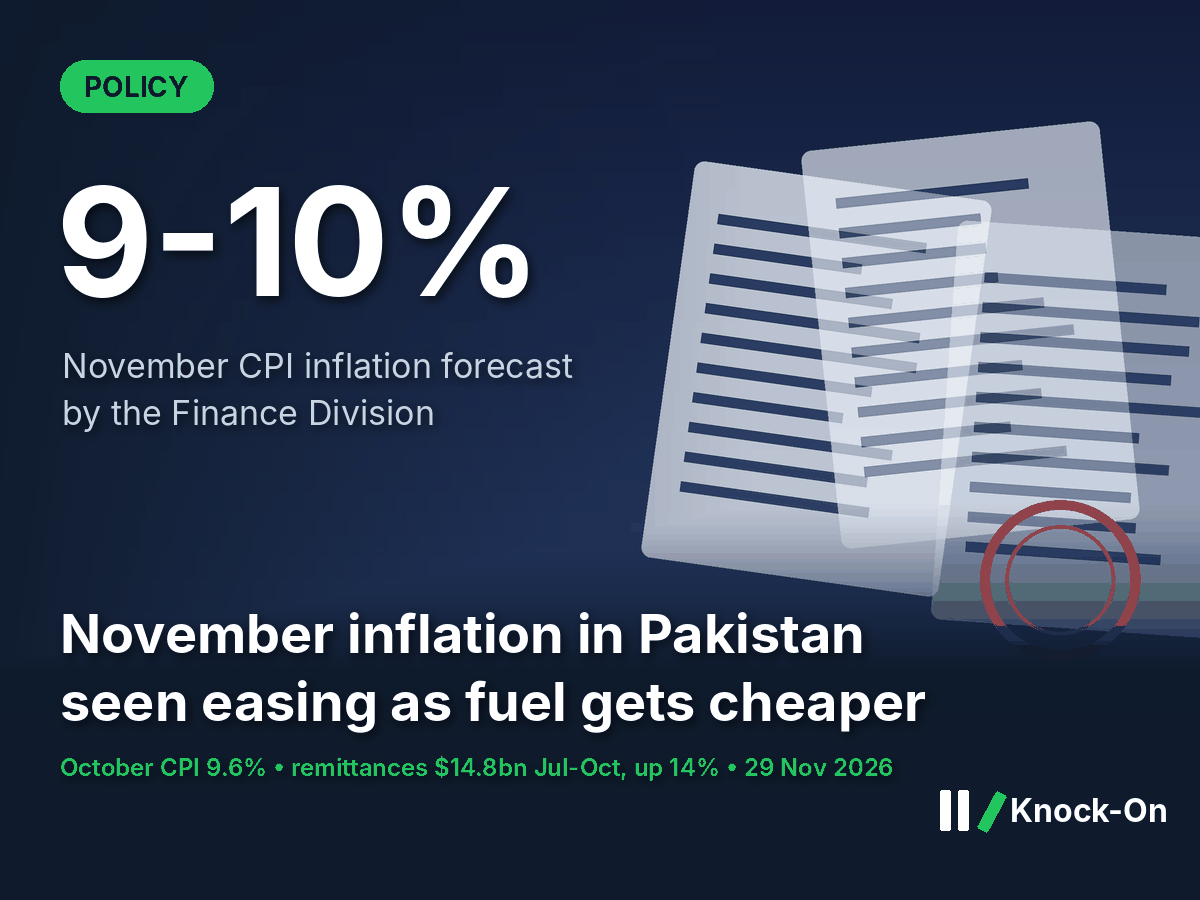
November inflation in Pakistan is expected to come in between 9% and 10%, the Finance Division said in its monthly Economic Update and Outlook, released over the weekend. That follows 9.6% in October and 10.3% in September. The report says the recent fall in crude oil and fuel prices could push November’s reading towards the lower end of the range. For businesses, the message is mixed: price pressure is easing slowly, the external accounts look healthier than a year ago, but imports are growing faster than exports again.
The short version
- The Finance Division projects November CPI inflation at 9–10%, after 9.6% in October.
- Inflation averaged 10.1% in July–October, against 4.8% a year earlier.
- Remittances rose 14% to $14.8bn in July–October; the current account deficit narrowed 20% to $850m.
- Imports rose 12.8% and exports 8.1%, widening the goods trade deficit to $12.3bn.
What happened
The Finance Division’s November 2026 outlook, reported by Business Recorder, says CPI inflation eased to 9.6% in October from 10.3% in September, though it was well above the 6.2% of October 2025. Average inflation for the first four months of FY27 was 10.1%. The division expects November inflation in the 9–10% range, with energy prices, food supplies and base effects shaping the path. Weekly data already pointed this way: SPI inflation fell back into single digits last week, though wheat flour remains expensive.
Inflation is easing from its peak but is still far above last year
CPI inflation, % year on year; November 2026 is the Finance Division’s forecast range
On the external side, workers’ remittances rose 14% to $14.8bn in July–October. Goods exports grew 8.1% to $11.4bn, but imports grew 12.8% to $23.6bn, so the goods trade deficit widened to $12.3bn from $10.5bn. The current account still posted a $39m surplus in October, and the four-month deficit fell 20% to $850m. Foreign direct investment rose 22.4% to $935.7m, and portfolio inflows of about $3.07bn came mainly from the government’s $3bn Eurobond in September. SBP’s liquid reserves stood at $21.6bn on 13 November, about $7bn higher than a year earlier.
Why it matters
The November inflation forecast matters because inflation feeds into borrowing costs, and it is still running near 10%. In the latest T-bill auction, 12-month yields were already above the policy rate. At the same time, the report shows an uneven economy: tax revenue grew 7.4% in July–September, but FBR collection for July–October was Rs94.2bn short of target, and large-scale manufacturing grew 2.5% in September. The division lists renewed Middle East tensions, climate threats to farming and tighter global financial conditions as the main downside risks.
The knock-on effects
First order: slow relief on prices
If November inflation lands near 9%, household budgets get modest relief, mostly from fuel. Food, especially flour, is the main item keeping it high.
Second order: imports test the rupee
Imports of construction materials, electrical equipment and steel are rising as activity picks up, the report says. Remittances and Eurobond money are covering the gap for now; the rupee was Rs276.5 to the dollar on 20 November against Rs280.7 a year earlier.
Third order: the oil risk
Oil is the swing factor. Lower crude prices helped since October, but a fresh Gulf supply shock, like those that pushed Brent back above $96 last week, would hit both inflation and the import bill.
Who could benefit
- Consumer businesses, if lower fuel prices free up household spending.
- Remittance-linked sectors such as housing and retail, with inflows up 14%.
- Cement and construction suppliers, with domestic cement dispatches up 5.9%.
Who may face pressure
- Borrowers hoping for quick rate cuts while inflation stays near 10%.
- Cement exporters, with export dispatches down 9.5%.
- Import-heavy firms, if the wider trade gap puts pressure on the rupee.
What to watch
- Early December: PBS releases November CPI and trade data.
- 11 December: IMF board meeting on Pakistan.
- Oil prices after the OPEC+ meetings of 29 November.
Sources
- Business Recorder, Nov inflation projected at 9-10pc: FD lists fresh downside risks to economy, 29 Nov 2026
- 24 News HD, Pakistan’s economy improving, but global risks persist: report, 29 Nov 2026
This is analysis, not investment advice. Figures are as of 29 Nov 2026.

Leave a Reply