
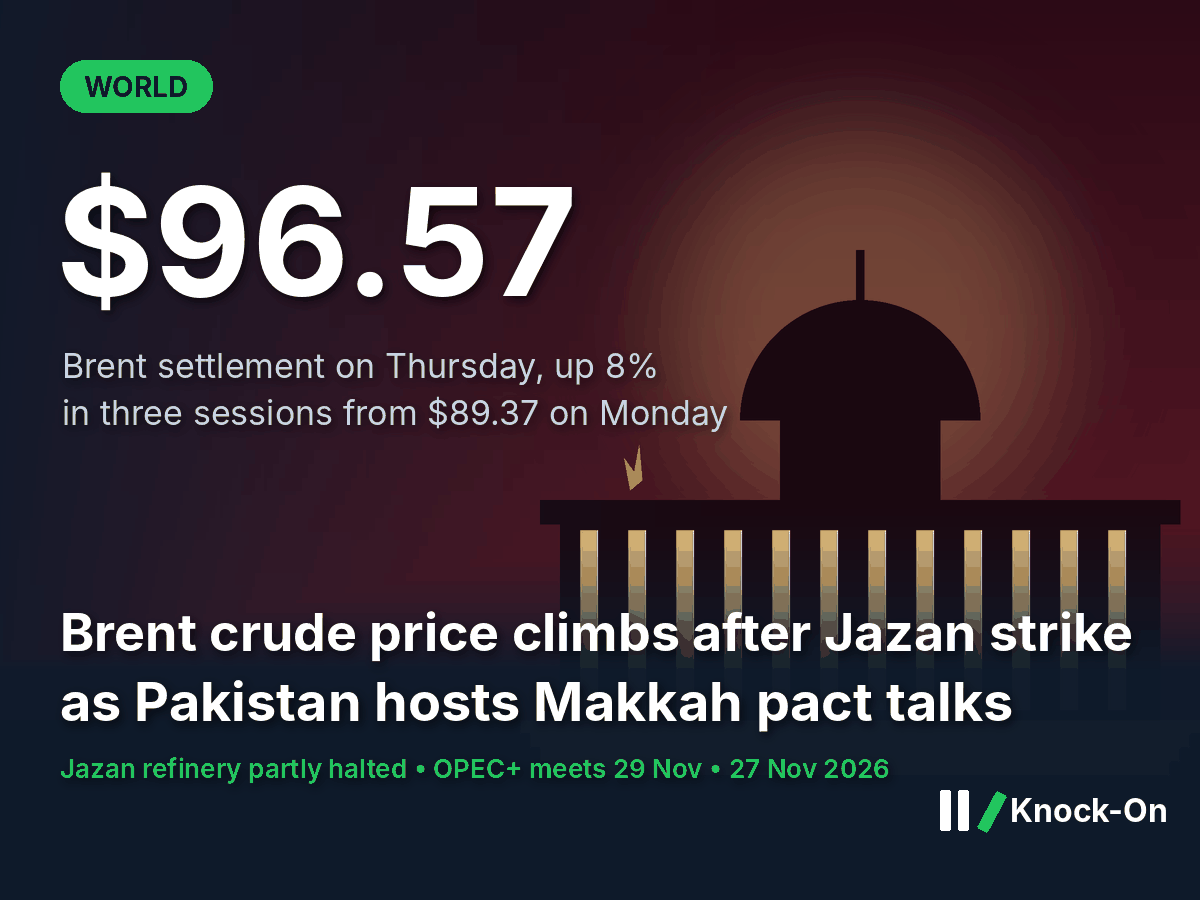
The Brent crude price settled at $96.57 a barrel on Thursday, its highest close since 6 November, after a projectile struck Saudi Aramco’s Jazan refinery on the Red Sea coast and two tankers were reported hit by mines near the Strait of Hormuz. On Friday, Pakistan hosts the foreign and defence ministers of Saudi Arabia and Türkiye in Islamabad for talks under the Makkah defence pact, with Houthi attacks on the agenda. For Pakistani businesses, the two stories meet at the fuel pump.
The short version
- Brent rose for a third straight session to settle at $96.57, about 8% above Monday’s $89.37.
- Saudi Arabia’s Energy Ministry said the Jazan refinery temporarily halted some operations after Thursday’s strike; one worker was killed.
- Pakistan, Saudi Arabia and Türkiye meet in Islamabad on 27–28 November to discuss putting their joint defence agreement into practice.
- OPEC+ meets on Sunday 29 November and is expected to keep output targets unchanged, according to people familiar with the talks.
What happened
Oil climbed through the week as attacks around Saudi Arabia piled up. On Wednesday the Houthis said they had attacked the Ras Tanura refinery and the Red Sea ports of Jeddah and Jazan; the Saudi-led coalition said it intercepted four drones near Ras Tanura and did not confirm a hit, as Knock-On reported in our analysis of the petrol price and the Saudi refinery attack. On Thursday a projectile struck the Jazan refinery itself. Saudi Arabia’s Energy Ministry said the fire was under control and that some operations were temporarily halted; one Nepalese worker was killed and several were wounded. Iran’s Revolutionary Guards also said two tankers struck sea mines near Oman’s Khasab port while trying to cross the Strait of Hormuz.
Brent gained $1.96, or 2.07%, on Thursday. Early on Friday it was trading at $96.19, down 38 cents. US markets were closed for Thanksgiving, so trading was thin.
Brent added $7.20 a barrel in three sessions
Brent crude, US$ a barrel, 23–27 November 2026
In Islamabad, the Strategic Political and Defence Committee of the Makkah pact holds its third meeting, after Istanbul on 31 August and Riyadh on 5 October. Deputy Prime Minister and Foreign Minister Ishaq Dar is to chair it, according to The Nation, with Saudi Foreign Minister Prince Faisal bin Farhan and Turkish Foreign Minister Hakan Fidan among the delegates. Defence Minister Khawaja Asif told AFP the conflict between Saudi Arabia and the Houthis would be discussed. The pact, signed on 7 August, treats an armed attack on one member as an attack on all; Türkiye’s parliament ratified it earlier this month, as covered in our report on the Makkah defence pact vote. Islamabad declared a local holiday on Friday for the meeting.
Why it matters
Pakistan imports most of its oil, so a higher Brent crude price feeds straight into the import bill, the rupee and inflation. Pump prices now move closely with Gulf benchmarks, as explained in our piece on daily fuel pricing, which means this week’s rally can reach consumers quickly after a run of cuts that took petrol to Rs314 a litre. The SBP’s own reserves stood at $21.59bn in the week to 20 November, a cushion, but one that a sustained rise in oil would test.
The knock-on effects
First order: the Brent crude price and the pump
An 8% rise in crude in three days narrows the room for further petrol and diesel cuts. Transporters, farmers buying diesel and power producers using furnace oil feel it first.
Second order: inflation and interest rates
Fuel costs pass into freight and food prices. Standard Chartered has said high oil prices, not demand, are what could push the SBP interest rate higher, so a lasting rally would weigh on hopes for cheaper credit.
Third order: Gulf security and Saudi ties
Saudi Arabia is a key source of oil, financing and jobs for Pakistani workers. Any decision in Islamabad on how the three members support each other could shape that relationship, though officials have not said what, if anything, the meeting will decide. Khawaja Asif said the agreement remains in its early stages.
Who could benefit
- Oil and gas producers: exploration companies earn more when crude rises.
- Refiners with stock on hand: inventory bought at lower prices can gain in value.
Who may face pressure
- Transport, logistics and airlines, where fuel is the largest variable cost.
- Energy-intensive manufacturers and exporters competing on thin margins.
- Households, if the recent run of fuel price cuts stops.
What to watch
- 27–28 November: any joint statement from the Makkah pact meeting in Islamabad.
- 29 November: OPEC+ ministerial meeting; sources expect output targets to be kept at least through the first quarter of 2027.
- Saudi updates on how long Jazan operations stay reduced, and further reports of mines in Hormuz.
- The next Pakistani fuel price notification, to see whether the rally reaches the pump.
Sources
- GSM Global News (Reuters), Brent Settles at $96.57 as Houthi Attacks on Saudi Refineries and Hormuz Mine Reports Stoke Supply Fears, 26 November 2026
- PiQ Markets, Brent holds near month high after strike halts Jazan refinery operations, 27 November 2026
- The Nation (Thailand), Brent gains 2.07% on 26 Nov as OPEC+ weighs 2027 quotas, 27 November 2026
- The Nation, Pakistan, KSA, Türkiye to discuss Houthi attacks in Islamabad meeting today, 27 November 2026
- Al-Monitor (Reuters), Pakistan, Saudi, Turkey to hold Mecca alliance meeting in Islamabad Nov 27-28, sources say, 26 November 2026
- Express Tribune, Makkah pact trio to meet in Islamabad, 26 November 2026
- Nukta, Islamabad declares Nov 27 holiday ahead of Makkah Defense Pact meeting, 26 November 2026
- Dawn, SBP reserves up $8m, 27 November 2026
This is analysis, not investment advice. Figures are as of 27 November 2026. Knock-On is not affiliated with any political party.

Leave a Reply