
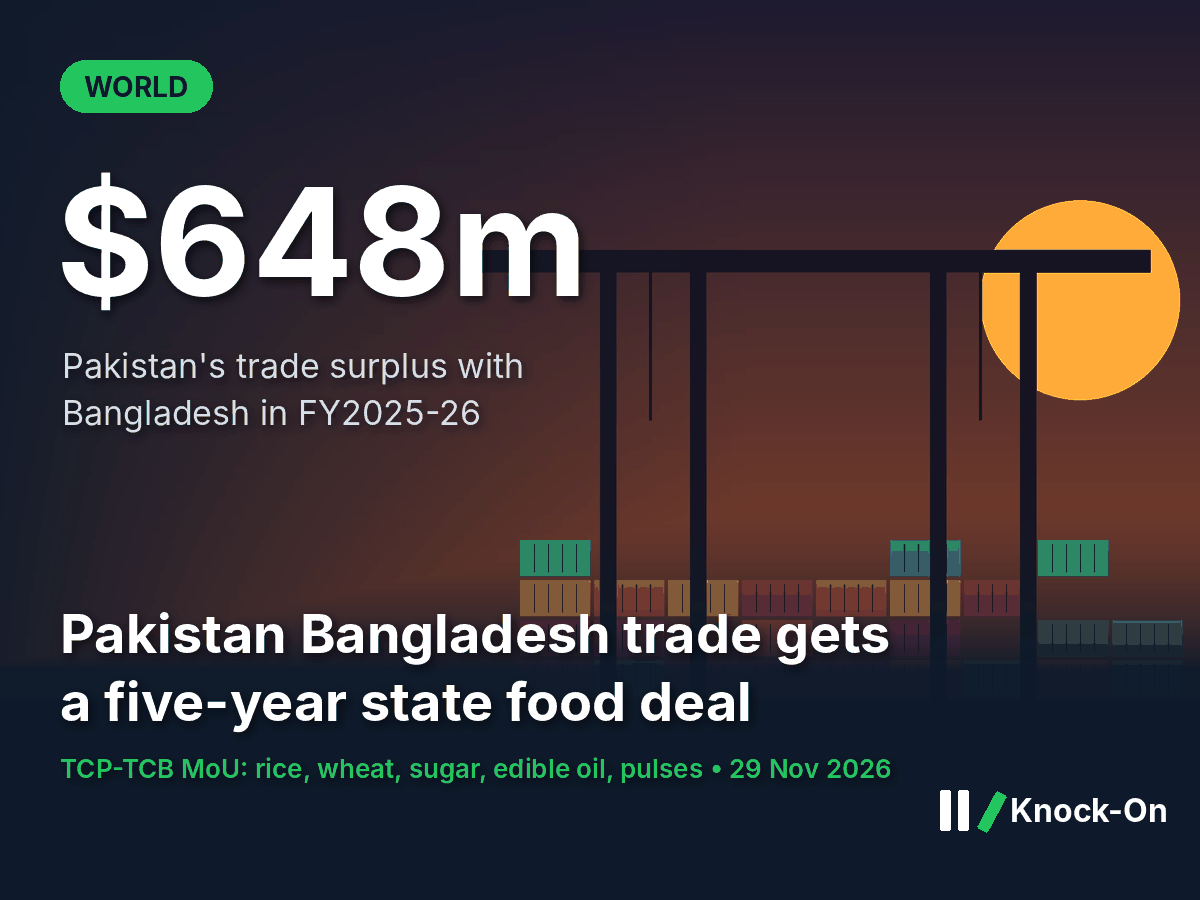
Pakistan Bangladesh trade now has a direct state-to-state channel for food. On 29 November the Trading Corporation of Bangladesh (TCB) and the Trading Corporation of Pakistan (TCP) signed a five-year memorandum of understanding to buy and sell essential commodities, from rice, wheat and sugar to edible oils and pulses, according to Bangladesh’s Daily Star. For Pakistani exporters the deal opens a government buyer in a market where sales have been falling; for Pakistan’s own food planners it adds another possible source as wheat and flour prices climb at home.
The short version
- TCP and TCB signed a five-year MoU in Dhaka on 29 November to trade essential goods in both directions.
- The list covers rice, wheat, sugar, edible oils, pulses, onions, potatoes, tea, fruit and fertiliser.
- Pakistan’s exports to Bangladesh fell 9.3% to $715.6m in FY26; imports were $67.2m.
- No volumes or prices have been announced; the first trade Joint Working Group meets in Islamabad on 1–2 December.
What happened
The MoU was signed at the Secretariat in Dhaka by TCB chairman Brigadier General Mohammad Foyshol Azad and Pakistan’s high commissioner to Bangladesh, Imran Haider, the Daily Star reported, citing Bangladesh’s commerce ministry. Under it, the two state trading bodies can buy and sell by mutual agreement “according to their respective needs”. Covered products include all types of rice and wheat, raw and refined sugar, canola, soybean, sunflower, rice bran and palm olein oils, sesame, red lentils, chickpeas, potatoes, onions, tea, pineapples, jackfruit, dates and fertiliser.
Bangladesh’s commerce secretary, Sharf Uddin Ahmed Choudhury, said the MoU would create direct, structured commercial ties between the two state bodies. Haider said Pakistan has surplus basmati rice, onions, potatoes and spices to supply. He also said Pakistan had withdrawn an anti-dumping duty on Bangladeshi hydrogen peroxide and keeps a duty-free quota for 10,000 tonnes of Bangladeshi tea a year. Azad said the two bodies would work to identify products, set competitive prices and ensure timely delivery.
Why it matters
Pakistan Bangladesh trade is small and lopsided, and it has been shrinking. State Bank figures reported by Profit and Dawn show Pakistan’s exports to Bangladesh fell to $715.6m in FY26 from $789.0m, while imports fell to $67.2m from $78.3m. Bangladesh’s Financial Express put Pakistan’s surplus at about $648.4m.
Pakistan sells Bangladesh about ten times what it buys
Pakistan’s goods trade with Bangladesh, US$ million, FY25 vs FY26
A government buyer could help reverse the export decline, but the MoU sets no volumes, so its value depends on actual tenders. It also matters at home: TCP is the agency Islamabad uses for strategic imports, and it is already preparing for wheat imports of up to 2.5m tonnes. The deal lets it trade with Bangladesh in either direction, depending on which side has a surplus.
The knock-on effects
First order: a new route for Pakistan Bangladesh trade in food
Rice millers, onion and potato traders and spice exporters gain a state buyer that can place bulk orders, alongside private buyers.
Second order: pressure to open the other way
With a surplus of roughly $648m, Pakistan faces requests to buy more. The Financial Express reported that Dhaka plans to press Islamabad on trade barriers at the first Joint Working Group meeting. The hydrogen peroxide duty withdrawal and tea quota show where concessions have come so far.
Third order: regional diversification
Pakistan is trying to widen its trade partners, from seeking zero tariffs from China to its narrowing Gulf deficit. A working South Asian food channel adds to that, and gives both governments an extra source when harvests fail.
Who could benefit
- Basmati and rice exporters: named by the high commissioner as a surplus product.
- Vegetable and spice traders: onions, potatoes and spices are on Pakistan’s offer list.
- Bangladeshi fruit and tea sellers: pineapples already reach Karachi, and Pakistan keeps a 10,000-tonne duty-free tea quota.
Who may face pressure
- Local producers of goods where Pakistan offers Bangladesh lower duties or wider quotas.
- Private importers who may face competition from TCP for some commodities.
What to watch
- The first Pakistan–Bangladesh trade Joint Working Group in Islamabad, 1–2 December.
- The first TCP or TCB tender under the MoU, and whether it names volumes and prices.
- Monthly SBP and PBS trade data for any recovery in exports to Bangladesh.
Sources
- The Daily Star, Bangladesh, Pakistan agree to trade essential goods, 29 Nov 2026
- The Financial Express, Dhaka to press Islamabad on trade barriers, Nov 2026
- Profit, Pakistan’s trade deficit with nine neighbouring nations widens 30% to $15.93 billion in FY26, 22 Jul 2026
- Dawn, Regional trade deficit widens to $16bn, 22 Jul 2026
This is analysis, not investment advice. Figures are as of 29 November 2026. Knock-On is not affiliated with any political party.


Leave a Reply