
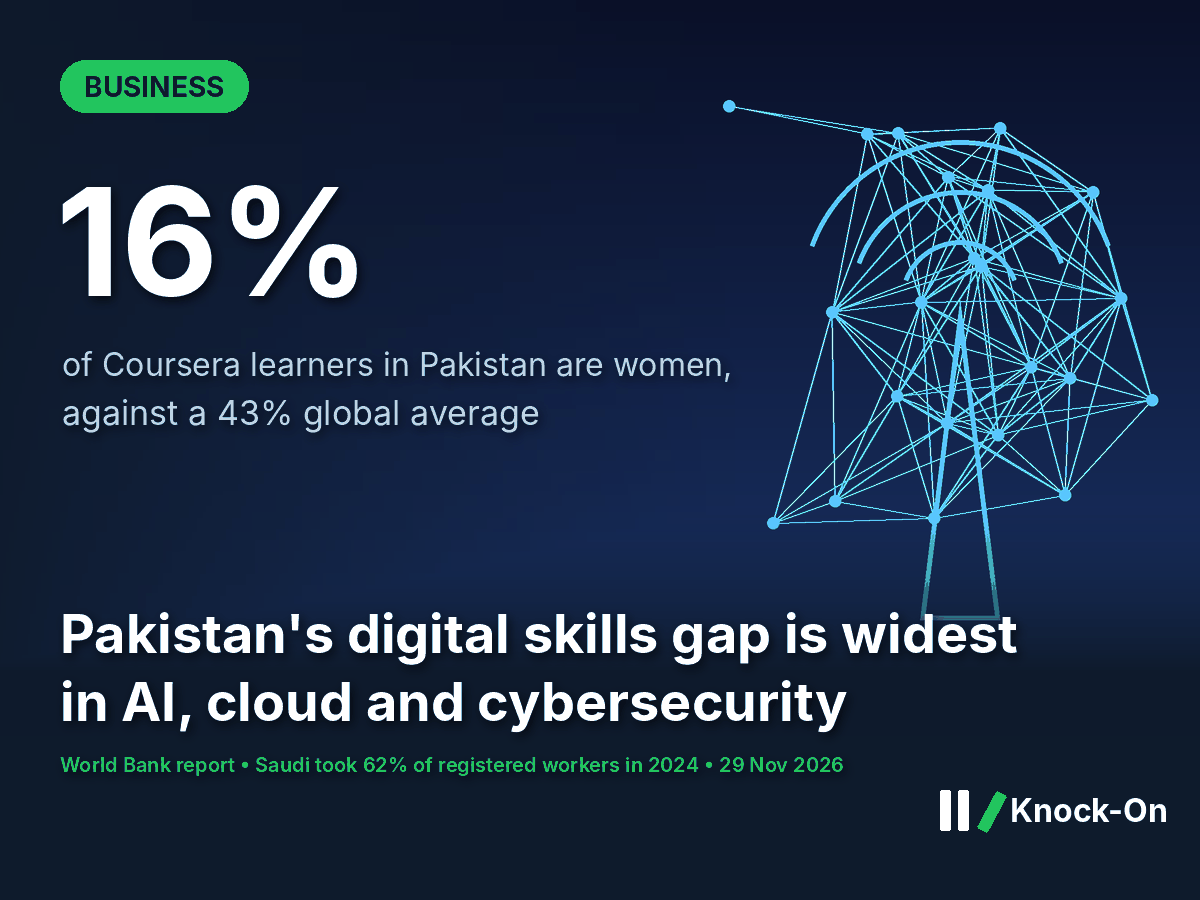
The digital skills gap in Pakistan is widest in the skills employers now pay most for: artificial intelligence, cloud computing, cybersecurity, data engineering and platform engineering. That is the finding of a new World Bank report on digital and AI skills in the Middle East, North Africa, Afghanistan and Pakistan, reported by Dawn on Sunday. For IT exporters trying to move up the value chain, and for the Gulf labour market that absorbs most Pakistani workers abroad, the shortfall is a business problem, not only an education one.
The short version
- The World Bank says Pakistan’s tech talent pipeline is weakest in AI, cloud, cybersecurity, data engineering and platform engineering.
- Women are 16% of Coursera learners in Pakistan, against a global average of 43%.
- Saudi Arabia took 62% of registered Pakistani overseas workers in 2024, and Pakistanis were 11.9% of its high-skilled labour inflows.
- The report calls for one national framework for curricula, training standards and certification.
What happened
The World Bank report, Digital and AI Skills for Jobs in the Middle East, North Africa, Afghanistan and Pakistan, says many Pakistani university courses focus on foundational concepts with limited hands-on exposure to frontier technologies. Weak links between universities and industry leave a substantial share of tech graduates without industry-aligned jobs in their first year after graduating, according to Dawn’s account of the report. Responsibility for digital skills is split between federal ministries, provincial governments, universities, vocational authorities and industry bodies, with no single framework that industry has validated.
The gender gap is stark. Women make up 16% of Coursera learners in Pakistan, the report says, compared with 43% worldwide.
Pakistani women are far behind in online tech learning
Women as a share of Coursera learners, %, as cited in the World Bank report (Nov 2026)
The report also looks at demand in the Gulf. Online job postings in Saudi Arabia rose 43% between 2021 and 2023, according to Lightcast data cited in the report, then fell 25% in 2024 while staying above 2021 levels; mid-2025 data point to sustained demand. Pakistanis accounted for 11.9% of Saudi Arabia’s high-skilled labour inflows, and the kingdom received 62% of all registered Pakistani overseas workers in 2024.
Why it matters
Pakistan’s digital skills gap sits where growth is. IT services firms that want higher-margin work in AI, cloud and security need exactly the engineers the report says are in short supply, and Saudi Arabia, which already takes most registered Pakistani workers abroad, has seen online job postings stay above 2021 levels. Saudi Arabia also shapes Pakistan’s trade balance with the Gulf, and the report suggests the type of worker Pakistan sends abroad will matter as much as the number. The report warns that “the critical test will be whether implementation can move with the speed and coordination that the labour market requires”.
The knock-on effects
First order: the digital skills gap raises hiring costs for tech firms
Where AI, cloud and cybersecurity specialists are scarce, local IT firms compete for the same small pool, and graduates without applied training need longer in-house training before they can bill clients. That is Knock-On’s reading of the report’s findings, not a figure the World Bank published.
Second order: remittances depend on the skill mix
With most registered overseas workers going to Saudi Arabia, a shift in Saudi demand toward digital roles could change who gets hired from Pakistan. Better-trained workers would tend to earn more and send more home; workers without those skills face more competition.
Third order: export ambitions need a talent base
Islamabad’s export push, including its bid for zero-tariff access to China, leans on services as well as goods. The report’s recommendation of centres of excellence to help IT services move up the global value chain points to where the next round of public and donor money could go, much as development lenders such as the ADB with its farm loans target specific sectors.
Who could benefit
- Training providers and universities that offer applied, industry-certified AI, cloud and security courses.
- IT firms with internship pipelines, which the report says should be expanded and tied to employability.
- Women in tech and rural learners, if flexible delivery models recommended by the report are funded.
Who may face pressure
- IT exporters competing for scarce senior engineers in AI, cloud and cybersecurity.
- Graduates of programmes with little applied training, who face slower entry into industry jobs.
- Overseas employment promoters reliant on lower-skilled placements, if Gulf demand keeps shifting.
What to watch
- Whether the federal government responds with a unified digital skills framework, as the report recommends.
- Monthly IT export data from the State Bank in early December, for signs of higher-value services growth.
- Saudi hiring trends in 2026–27 and Bureau of Emigration placement figures.
Sources
- Dawn, Pakistan’s digital talent falls short of rising demand: World Bank, 29 Nov 2026
- World Bank, Digital and AI Skills for Jobs in the Middle East, North Africa, Afghanistan and Pakistan (report page), Nov 2026
This is analysis, not investment advice. Figures are as of 29 Nov 2026.
Leave a Reply