
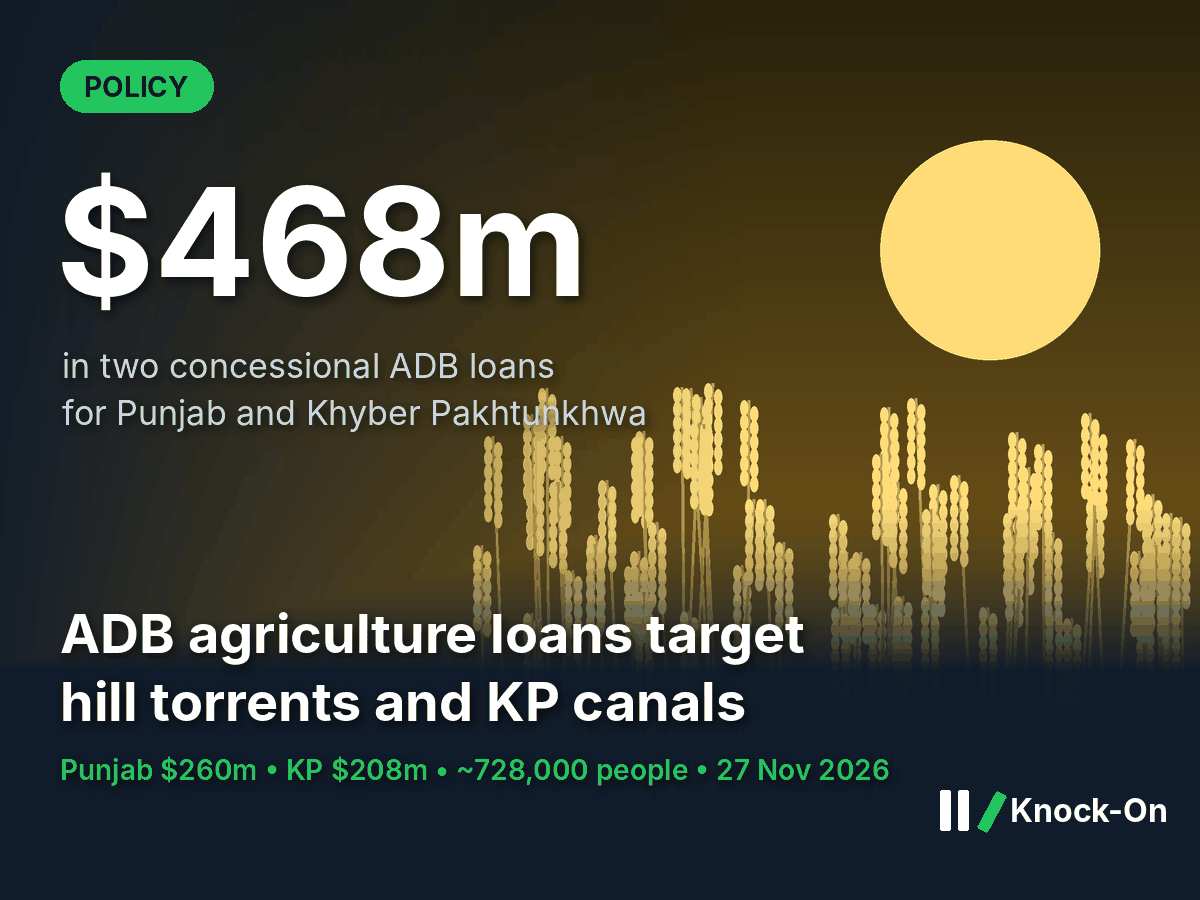
New ADB agriculture loans worth $468 million will pay for irrigation canals in Khyber Pakhtunkhwa and flash-flood defences in Punjab’s hill-torrent belt, the Asian Development Bank said on Friday, 27 November. The two concessional loans are aimed at farm productivity and flood resilience, and ADB says about 728,000 people should benefit. With wheat imports now allowed up to 2.5m tonnes as flour prices climb, money for farm water is landing at a sensitive moment for food costs.
The short version
- ADB approved two concessional loans totalling $468m on 27 November.
- $260m goes to Punjab’s Integrated Hill Torrent Management Project; $208m to a Khyber Pakhtunkhwa irrigated agriculture project.
- About 728,000 people are expected to benefit, according to ADB.
- Contractors, farm-input suppliers and smallholders in five named districts are first in line; loan terms have not been published.
What happened
In a statement on Friday, ADB said it had approved the ADB agriculture loans for irrigation infrastructure, agricultural productivity and flood resilience in Punjab and Khyber Pakhtunkhwa, Profit and APP reported. The larger loan, $260m, funds Punjab’s Integrated Hill Torrent Management Project, which tackles flash-flood risk and floodwater harvesting in hilly areas through water retention, drainage and flood-protection works and promotes spate irrigation, the practice of diverting seasonal floodwater onto fields. Pakistan Observer and Minute Mirror report that the project covers Dera Ghazi Khan and Rajanpur.
The $208m Khyber Pakhtunkhwa Resilient Irrigated Agriculture Livelihoods Development Project targets smallholder farmers in Nowshera, Swabi and Upper Chitral. It will build and rehabilitate irrigation systems, improve water management and introduce modern farm technology, with livelihood training for women and support for their role in water governance. Pakistan Observer reports that the works include rehabilitating the Pehur Main Canal, extending the Pehur High Level Canal and building the Mulkhow irrigation distribution system.
Punjab gets more than half of the $468m
ADB concessional loans approved 27 Nov 2026, US$ million (share of total)
Why it matters
Water, not land, is the binding constraint for many small farms, and flash floods in the hill-torrent belt can wipe out a season’s crop and the roads that carry it to market. ADB Country Director for Pakistan Emma Fan said the projects will contribute to strengthening food security, and that resilient water management and sustainable farming are “vital for the economic potential of rural communities in these two provinces.” For business, the loans are also a pipeline of civil works paid in foreign currency on concessional terms. They add to recent ADB lending, including a $500m results-based pension loan and $500m of contingent disaster financing.
The knock-on effects
First order: contracts for canals and flood works
The first money is likely to flow to engineering and construction: canal rehabilitation in KP, and retention, drainage and protection structures in Punjab. That means demand for cement, steel, pipes and earth-moving equipment in districts that rarely see large projects, once procurement begins.
Second order: steadier water, higher yields
ADB expects higher yields, jobs and more reliable water for farms and communities. If canals deliver water more reliably, farmers can spend more on seed, fertiliser and machinery with less risk, which matters for input sellers and rural lenders.
Third order: food prices and fewer flood losses
Over several years, better-protected farmland could reduce crop and infrastructure losses after floods and add to domestic food supply. That is a slow channel; it will not ease this winter’s flour prices, but it bears on how often Pakistan needs to import staples in bad years.
Who could benefit
- Smallholder farmers in Nowshera, Swabi and Upper Chitral, and in the Punjab hill-torrent districts.
- Construction and engineering firms that bid for canal and flood-protection works.
- Building-material suppliers, including cement and steel, near the project sites.
- Farm-input and machinery sellers, if water supply becomes more reliable.
- Women in farm households, through livelihood training and a role in water governance in KP.
Who may face pressure
- Provincial governments, which must run procurement and keep the works on schedule.
- The federal budget, which carries the repayments; concessional terms lower but do not remove the cost.
- Farmers outside the named districts, who face the same water and flood risks without new funding.
What to watch
- Signing of the loan agreements and publication of loan terms and timelines (dates not announced).
- The first tenders for canal and hill-torrent works in KP and Punjab.
- The IMF board meeting on Pakistan’s next tranche, set for 11 December.
- Wheat import tenders and flour prices this winter, the near-term test of food security.
Sources
- Profit by Pakistan Today, ADB approves $468m for Pakistan water, agriculture projects, 27 Nov 2026
- APP, ADB approves $468 million financing for resilient agriculture in Pakistan’s provinces, 27 Nov 2026
- Pakistan Observer, Pakistan secures $468 million ADB financing for KP irrigation, Punjab hill torrent projects, 27 Nov 2026
- Minute Mirror, ADB approves $468m for projects in Punjab, KP, 28 Nov 2026
- ARY News, ADB approves $468 million in loans for Pakistan, 27 Nov 2026
This is analysis, not investment advice. Figures are as of 28 November 2026.
Leave a Reply