
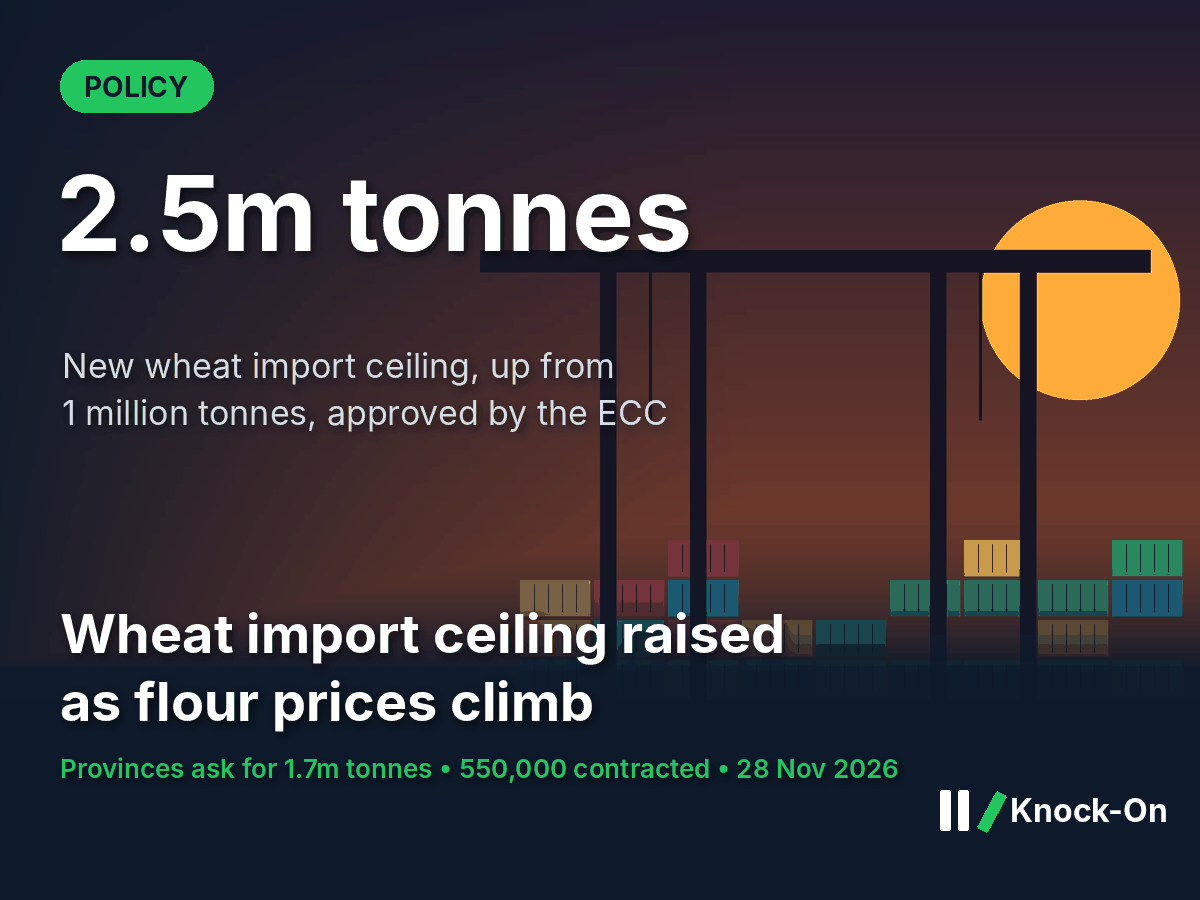
The ceiling for wheat import in Pakistan has been raised from 1 million to 2.5 million tonnes for the 2026-27 food year, after the Economic Coordination Committee (ECC) of the cabinet approved the change in principle on Friday. Profit reported that the decision was taken “as flour prices climb” and that provinces now want about 1.7 million tonnes of foreign wheat before the next harvest. The provinces will carry the entire cost. For flour mills, bakers and food companies, the size of the new limit shows how much supply the government wants room to bring in before the new crop.
The short version
- The ECC, chaired by Finance Minister Muhammad Aurangzeb, raised the wheat import ceiling to 2.5 million tonnes, from 1 million. The federal cabinet still has to ratify it.
- Provinces have asked for about 1.7 million tonnes: Punjab 950,000, Sindh 450,000 (subject to confirmation) and Khyber Pakhtunkhwa 300,000.
- About 550,000 tonnes are already contracted; a third tender for up to 800,000 tonnes closes on 30 November.
- Provinces must pay for procurement, freight, insurance, port charges and duties in advance.
What happened
The ECC met virtually after a summary from the Ministry of National Food Security and Research, according to Profit. It said the higher limit is meant to keep wheat available, stabilise the market and meet provincial needs until the coming harvest, and that it gives room to cover extra demand without repeat approvals. Actual purchases will depend on confirmed provincial requirements and market conditions. The committee also approved priority berthing for wheat ships at the ports.
Provincial demand has moved sharply. The first assessment was 750,000 tonnes, later cut to 550,000 tonnes, before the latest estimate of about 1.7 million tonnes. Balochistan’s needs are to be met from PASSCO stocks. A day earlier, a steering committee on wheat imports chaired by Deputy Prime Minister Ishaq Dar discussed the plan, Profit reported.
The new ceiling is well above what provinces have asked for
Wheat imports for food year 2026-27, million tonnes, as of 28 Nov 2026
Imports run through the Trading Corporation of Pakistan (TCP). Its first tender bought 365,000 tonnes at an average of $348.83 a tonne. The third tender, issued on 23 November, seeks up to 800,000 tonnes of 2026-crop wheat delivered in bulk to Karachi or Gwadar, with a minimum offer of 150,000 tonnes. About 200,000 tonnes of earlier purchases are close to arriving. We covered the first ships in our report on the wheat import landing at Karachi.
Why it matters
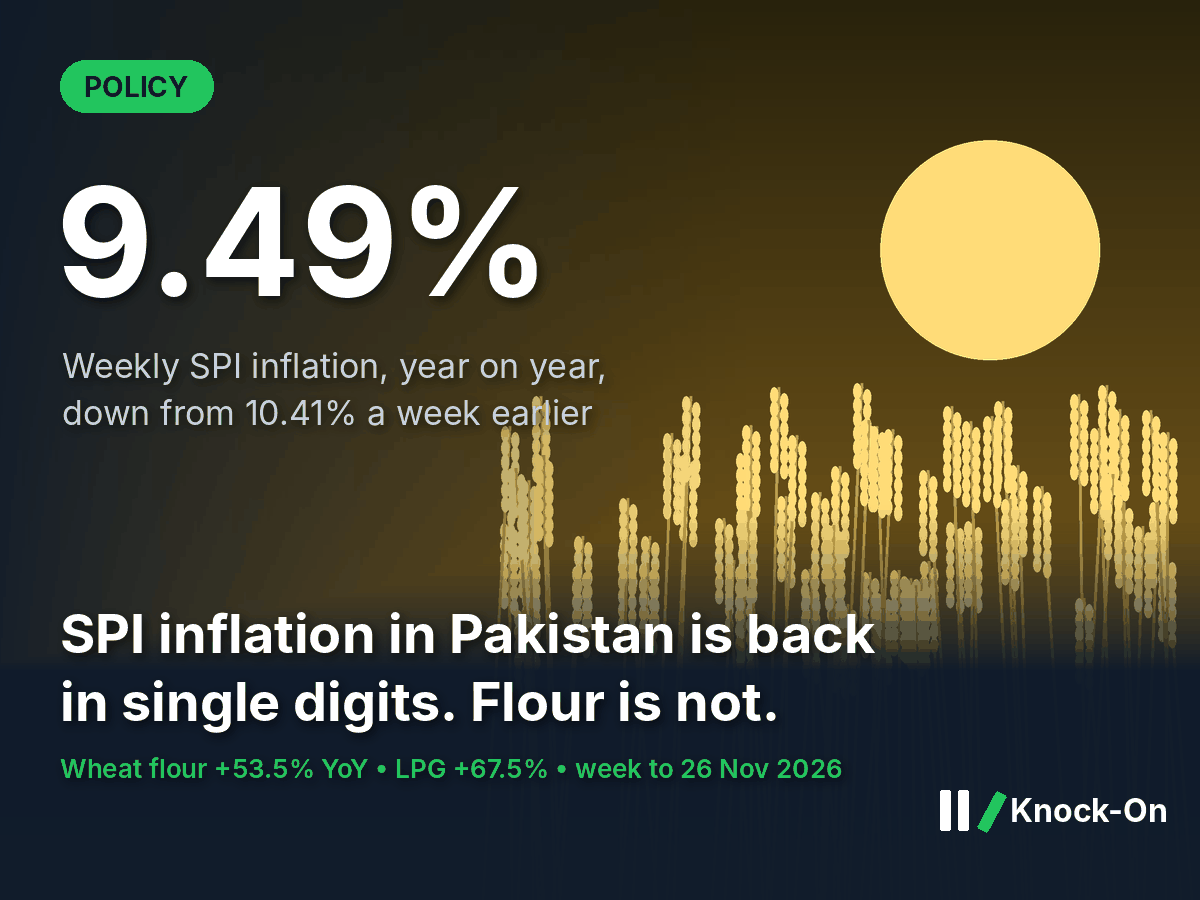
Flour is one of the heaviest pressures on household budgets. Wheat flour was up 53.5% year on year in the latest weekly SPI, as we noted in our SPI inflation analysis, even as fuel became cheaper. Earlier, Punjab fixed wheat at Rs4,500 for mills, which we discussed in our flour price story. More imported grain is the government’s main lever to cool that. It also adds to the import bill: at the first tender’s average price, 1.7 million tonnes would cost about $593 million, and the full 2.5 million about $872 million (Knock-On calculation; actual prices will differ).
The knock-on effects
First order: more wheat import for Pakistan’s mills
Flour mills in Punjab, Sindh and KP should get more grain released from provincial stocks once ships arrive. Priority berthing could shorten the gap between purchase and supply.
Second order: pressure on provincial budgets
Because provinces must pay in advance, Punjab’s 950,000 tonnes alone would be roughly $331 million at the first tender’s price (Knock-On calculation). That money has to come from provincial budgets or bank borrowing, which competes with development spending.
Third order: dollars and next season’s farmers
Large food imports draw on foreign exchange at a time when the rupee depends on remittances and IMF inflows. Imported wheat arriving close to the next harvest could also weigh on prices farmers receive, a balance Dar asked officials to protect, according to Profit.
Who could benefit
- Flour mills and bakeries, if steadier grain supply eases input costs.
- Port, shipping and bulk-handling firms in Karachi and Gwadar, from more cargoes.
- Households, if flour prices stop rising.
Who may face pressure
- Provincial finance departments, which must fund purchases upfront.
- Wheat growers, if imports are still arriving when the new crop comes in.
- The external account, through a larger food import bill.
What to watch
- 30 November: bids close in TCP’s third tender; the winning price per tonne.
- Federal cabinet ratification of the 2.5 million tonne ceiling.
- Sindh’s written confirmation of its 450,000 tonne request.
- Early December: November CPI, and weekly SPI readings for wheat flour.
Sources
- Profit by Pakistan Today, As flour prices climb, ECC raises wheat import ceiling to 2.5 million tonnes, 28 Nov 2026
- Profit by Pakistan Today, Govt considers additional 500,000 tonnes of wheat imports, 27 Nov 2026
- Dawn, weekly SPI report, 27 Nov 2026 (wheat flour year-on-year change)
This is analysis, not investment advice. Figures are as of 28 November 2026.
Leave a Reply