
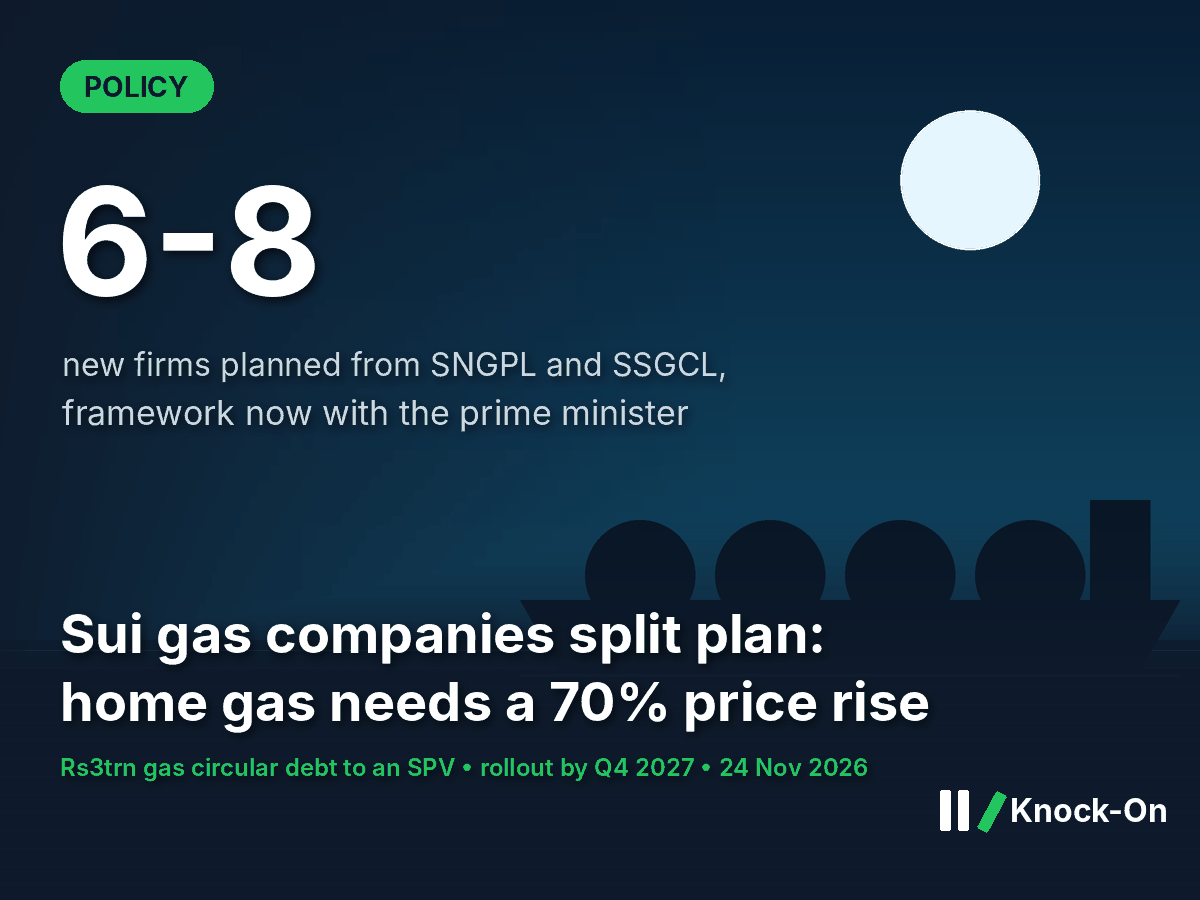
A plan to split the Sui gas companies has reached Prime Minister Shehbaz Sharif’s desk. The framework would break Sui Northern Gas Pipelines (SNGPL) and Sui Southern Gas Company (SSGCL) into six to eight separate entities, move more than Rs3 trillion of gas circular debt off their books, and open gas supply to competition. Its numbers show who has been paying for what: households pay far below cost, while industry and commerce pay slightly above it. For Pakistani businesses, that is the most important line in the plan.
The short version
- SNGPL and SSGCL would be unbundled into six to eight firms, separating transmission, distribution and sales.
- Over Rs3trn of gas circular debt would go to a special purpose vehicle, serviced through a surcharge in tariffs.
- SNGPL’s household tariff averages Rs1,268 against a break-even of Rs2,152, a 69.8% gap; commercial and industrial users pay above break-even.
- Officials aim to move to implementation by the fourth quarter of 2027.
What happened
According to a summary seen by Dawn, the petroleum division has sent the PM a reform framework for in-principle clearance. Sources said it was prepared with technical support from the World Bank, KPMG and Wood Mackenzie, and that the IMF is on board. Transaction advisers need the PM’s authorisation, and the remaining legal steps would take five to six months. “We will be rolling out the transformation plan into the implementation stage by the fourth quarter of 2027,” an official told the paper.
The split of the Sui gas companies would create at least four sales entities: two competitive suppliers for commercial and industrial customers, and two regulated suppliers for households. The Sui companies would have to release 20% of their supply and customer portfolios in the first year and 10% in each of the next two years, with price regulation ending once 60% has been offloaded. The circular debt would be parked in a vehicle modelled on the Power Holding Company used for electricity.
Households pay well below cost; industry pays above it
Average gas tariff vs break-even, Rs per MCF as reported, Nov 2026
Why it matters
The plan to split the Sui gas companies puts numbers on a long-running cross-subsidy. SNGPL’s household tariff would need to rise 69.8% to break even, and SSGCL’s 82.7%; without that, a Rs150bn subsidy is needed. Commercial and industrial users already pay above cost, leaving room for cuts of 5.4% on SNGPL’s network and 7.4% on SSGCL’s. SNGPL’s household segment lost Rs158bn, against profits of Rs24bn from transport and Rs36bn from commercial sales. Like the Delta Energy gas pipeline plan, this is a framework, not yet a decision.
The knock-on effects
First order: a new price path for gas
The framework proposes gradual price rises, cutting household billing slabs from 12 to one, delivering subsidies through the social safety net, and a multi-year tariff on a regulated asset base, as K-Electric has.
Second order: choice for industrial gas buyers
Competitive suppliers for commercial and industrial users could give textile mills, fertiliser plants and food processors a choice of supplier, and possibly lower prices, once portfolios open up.
Third order: investment and governance
SNGPL plans Rs736bn of capital spending from FY2027 to FY2032 and SSGCL Rs390bn. Separate, ring-fenced firms could find that money easier to raise. A recent corruption risk assessment of federal bodies showed how far utility governance still has to go.
Who could benefit
- Industrial and commercial gas users, who pay above cost today.
- Private gas traders and LNG importers, who could compete for released portfolios.
- The government’s books, if circular debt stops growing.
Who may face pressure
- Household consumers, facing much higher bills if subsidies are narrowed.
- All gas users, who would carry a debt-servicing surcharge.
- SNGPL and SSGCL shareholders, until the asset split and valuations are clear.
What to watch
- The PM’s in-principle decision and the hiring of transaction advisers.
- Any IMF reference to the plan in its next review.
- Ogra’s next gas price notification and any change to household slabs.
- The implementation target: the fourth quarter of 2027.
Sources
- Dawn, Plan to split gas firms lands on PM’s table, 24 Nov 2026
This is analysis, not investment advice. Figures are as of 24 November 2026.

Leave a Reply