
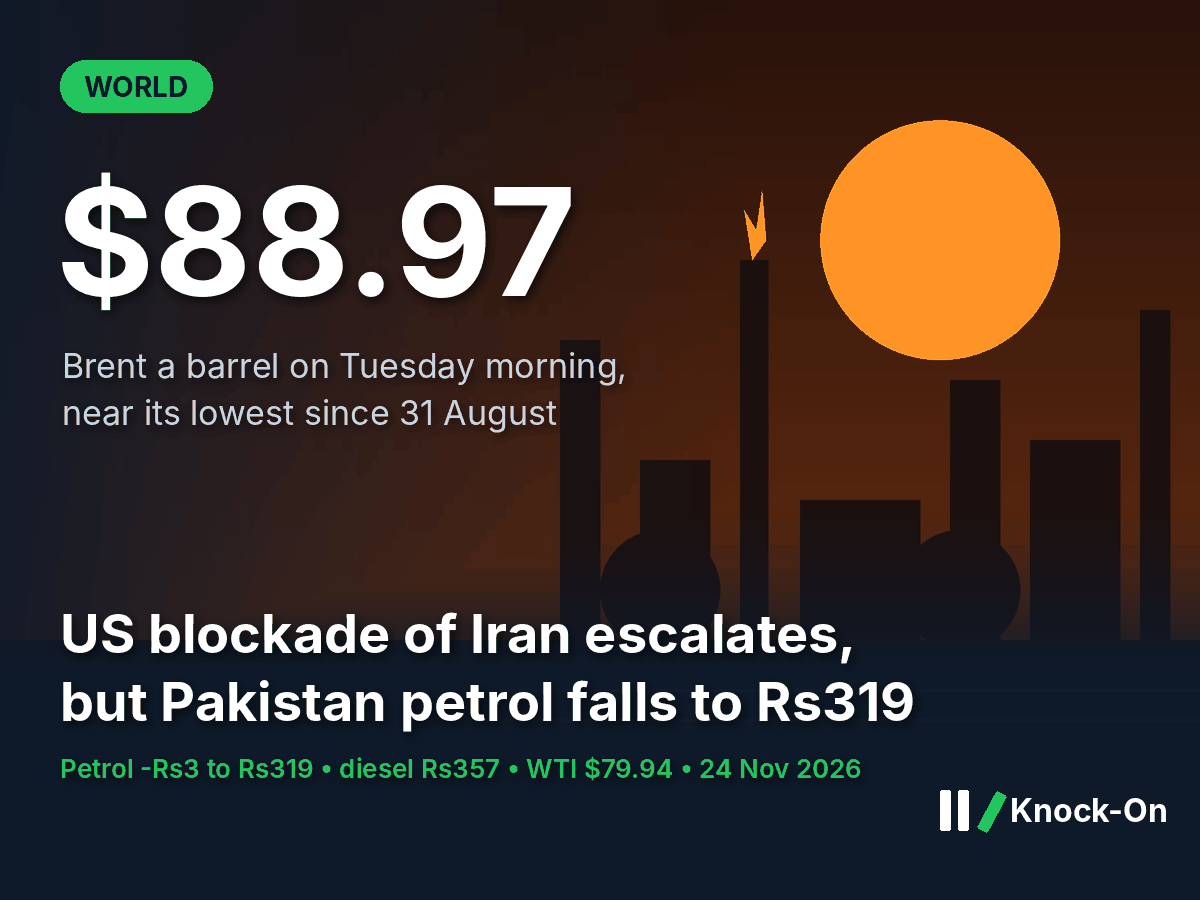
The US blockade of Iran entered a sharper phase this week. President Donald Trump warned that Iranian ships trying to break it would go “to the bottom of the sea”, and Tehran said it would use “every means” to counter it. Yet the oil market barely flinched: Brent slipped to $88.97 a barrel on Tuesday morning, close to a three-month low, and Pakistan cut its petrol price by Rs3 to Rs319 a litre. For Pakistani businesses, the gap between the war headlines and the price of fuel is the story that matters.
The short version
- Iran called the US naval blockade of its ports “military aggression” on Monday; Mr Trump said on Sunday that ships trying to break it would be sunk.
- Brent fell 40 cents to $88.97 early on Tuesday after its lowest close since 31 August, as rising supply outweighed the Hormuz risk.
- Pakistan’s petrol price is Rs319 a litre from 24 November; diesel is unchanged at Rs357.
- Iran’s conditions for reopening Hormuz include implementing the Pakistan-mediated “Islamabad MoU”, which Mr Trump has called “null and void”.
What happened
According to CBS News, the US imposed a counter-blockade of Iranian ports in response to Iran’s push to close the Strait of Hormuz, and later added economic sanctions and a task force to disrupt land routes into Iran. On Sunday Mr Trump said of Iranian vessels: “I hope they do it; they’ll all go down to the bottom of the sea.” On Monday Iran’s foreign ministry spokesman, Esmaeil Baghaei, said Iran “will use every means to counter US aggression”, Euronews reported.
Foreign Minister Abbas Araghchi said Hormuz could reopen quickly once Iran’s conditions are met: the lifting of US sanctions, an end to the naval blockade, and implementation of US commitments under the Islamabad memorandum of understanding, which Pakistan mediated and witnessed in June. Mr Trump has described the MoU as “null and void”. Qatar’s prime minister was expected to meet US Secretary of State Marco Rubio on Monday.
Markets read it differently. Reuters, via Business Recorder, reported Brent at $88.97 and US crude at $79.94 early on Tuesday, citing Libya’s reopened Sharara pipeline and a Deutsche Bank estimate that global inventories rose 52 million barrels in October. Late on Monday, Ogra notified a Rs3 cut in petrol to Rs319 a litre, Dawn reported.
Pakistan’s petrol price has given back most of its war spike
Petrol price, Rs per litre, March to November 2026
Why it matters
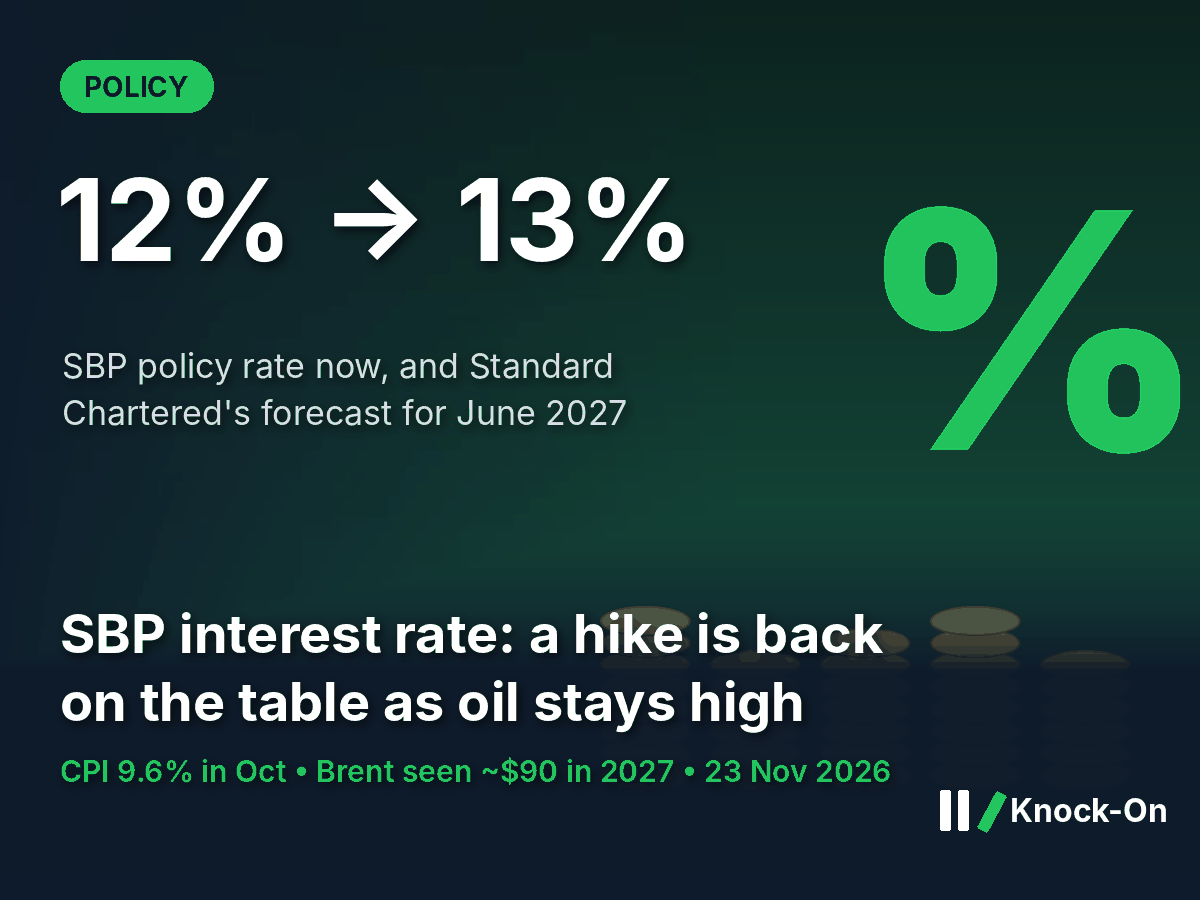
Pakistan now sets fuel prices almost daily in line with international markets, so the US blockade of Iran reaches Pakistani businesses through the oil price within days, in either direction. Petrol is Rs139 a litre below its April peak, which eases transport, logistics and input costs. But the government still collects Rs114 a litre in taxes and duties on petrol and Rs100 on diesel, and diesel, which moves most goods, has not fallen this time. Oil is also one of the main reasons forecasters see the SBP interest rate rising further, so cheaper crude matters for borrowing costs too.
The knock-on effects
First order: fuel costs ease, slowly
A lower petrol price helps households, ride-hailing, two-wheeler deliveries and small traders straight away. Freight operators gain only when diesel follows, and it was left at Rs357.
Second order: the import bill and the rupee
Every dollar off Brent trims Pakistan’s oil import bill and eases pressure on reserves. That relief is fragile: ANZ’s Daniel Hynes said the market “remains under severe strain” and that “inventory buffers are thin”. As we noted in our look at Hormuz shipping attacks and Pakistan’s Gulf trade, freight and insurance costs for Gulf-bound cargo stay high even when crude falls.
Third order: Pakistan’s diplomatic stake
Because Iran ties any reopening of Hormuz to the Islamabad MoU, Pakistan’s role as mediator stays in play. A revived deal would likely lower risk premiums on Gulf shipping; a collapse could bring back the price spikes seen in the spring.
Who could benefit
- Motorists and small businesses that run on petrol, from delivery riders to rickshaw fleets.
- Airlines and logistics firms, if lower crude feeds through to jet fuel and diesel.
- The external account, through a smaller oil import bill while Brent stays below $90.
Who may face pressure
- Petrol pump dealers, who say daily price changes are draining their working capital and have threatened a strike within 15 days (Dawn, 24 Nov).
- Exporters shipping to the Gulf, who still face war-risk freight and insurance.
- Fuel importers and refiners, holding stock bought at higher prices as the market falls.
What to watch
- Any Iranian attempt to run the blockade, and the US response.
- The outcome of the Qatar–US talks and whether the Islamabad MoU is revived.
- Ogra’s daily price notices, especially whether diesel moves below Rs357.
- The petroleum dealers’ 15-day deadline for a 30-day pricing mechanism, falling around 8 December.
Sources
- Euronews, Iran vows ‘every means’ to counter US blockade of Hormuz after Trump threat, 23 Nov 2026
- CBS News, Iran says it will use all means to end U.S. blockade as Trump plays down escalating attacks, 23 Nov 2026
- Business Recorder (Reuters), Oil holds near three-month low as rising supply offsets Hormuz threat, 24 Nov 2026
- Dawn, Petrol price reduced by Rs3 per litre; diesel remains unchanged, 23 Nov 2026
- Dawn, Petroleum dealers warn of another strike over unmet demands, 24 Nov 2026
- Express Tribune, PM Shehbaz signs ‘Islamabad MoU’ as mediator between US and Iran, 18 Jun 2026
This is analysis, not investment advice. Figures are as of 24 November 2026. Knock-On is not affiliated with any political party.

Leave a Reply