
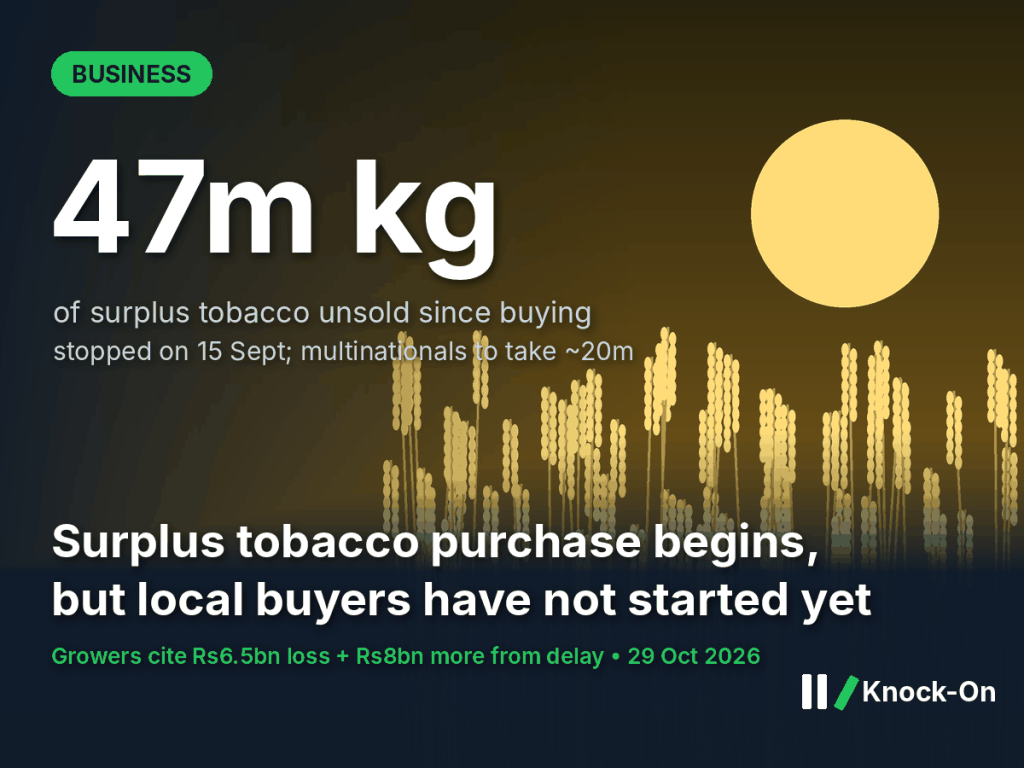
The purchase of surplus tobacco in Pakistan has restarted after a six-week pause, but only two buyers have turned up so far. Philip Morris International began buying on Tuesday and Pakistan Tobacco Company on Wednesday, Dawn reported from Swabi, while Pakistani companies have yet to start. Of a 47 million kilogram surplus, the two multinationals are expected to take about 20 million kg. Growers in Khyber Pakhtunkhwa say they have already lost billions of rupees this season.
The short version
- Buying of the 47m kg tobacco surplus resumed on 27–28 October, after companies stopped purchases on 15 September.
- Philip Morris International and Pakistan Tobacco Company are to buy about 20m kg; the rest, roughly 27m kg, is left to Pakistani firms that have not yet started.
- A growers’ leader says farmers lost Rs6.5bn this year on low prices and face a further Rs8bn loss from the late purchase.
- Growers want next year’s quotas announced early, written contracts and payment through banks.
What happened
Tobacco companies stopped buying leaf on 15 September, leaving growers holding a surplus crop. According to Dawn, the Pakistan Tobacco Board (PTB) failed to agree a strategy for the surplus over the following 40 days. A meeting at the PTB’s head office in Peshawar last week finally settled on a restart. Nasir Khan, general secretary of the Kashthkar Coordination Council, told Dawn that the gathering had “unanimously decided” purchases would begin on 26 or 27 October, “but minor hiccups delayed the process by a day.”
The surplus tobacco purchase in Pakistan is split by quota. The two multinationals will take about 20m kg, and the remainder is meant to be bought by Pakistani companies, which had not begun buying “due to unknown reasons”, the newspaper said. Purchases are guided by minimum indicative prices set by the Ministry of National Food Security, including Rs545 per kg for flue-cured Virginia grown in the plains and Rs615.90 per kg in mountainous areas.
More than half the surplus waits on buyers who have not started
Surplus tobacco in Pakistan, million kg, 2026 crop, as of 29 Oct 2026
Why it matters
For growers in Swabi and the rest of the tobacco belt, a delayed sale means cash arrives late for the next sowing, for debts and for household spending. Iqbal Shewa, patron-in-chief of the Kashthkar Ittehad Association, told Dawn: “Growers have already lost Rs6.5 billion this year due to low prices. And now they will have to bear a further loss of Rs8bn because of the late purchase.” Taken together, that is a claimed Rs14.5bn hit (Knock-On calculation of the growers’ figures). Rural incomes in Khyber Pakhtunkhwa are also squeezed by fuel costs, with the diesel price in Pakistan near Rs400 a litre, and by dearer borrowing after the SBP interest rate hike to 12%.
The knock-on effects
First order: surplus tobacco cash reaches some growers, not all
Farmers selling to the two multinationals should now be paid, but those whose leaf is expected to go to Pakistani buyers remain unpaid until those firms start. Stored leaf can lose quality and weight over time, which is one reason growers link the delay to further losses.
Second order: weaker rural spending in tobacco districts
Late or reduced payments usually show up in local markets: fewer purchases of fertiliser, seed, motorcycles and consumer goods, and more borrowing from informal lenders. Traders and input dealers in the tobacco belt are likely to feel this first.
Third order: pressure to change how the crop is contracted
Growers’ four demands, as set out by Nasir Khan, are that companies announce next year’s quota, all companies sign and honour agreements with growers, farmers are paid through banks, and a tobacco expo is held in growing areas rather than Karachi. If adopted, written contracts and bank payments would make the crop more predictable and more visible to lenders. Muhammad Ali Dagiwal of the Pakhtunkhwa Kashthkar Jirga said the PTB’s representatives “always toe the companies’ line”; the board’s response was not reported.
Who could benefit
- Growers with multinational quotas: they can now sell and get cash before the next season.
- Cigarette makers buying now: they secure leaf at the official minimum indicative prices.
- Banks: if payments move through bank accounts, as growers want, deposits and farm lending data in the region could grow.
Who may face pressure
- Growers waiting on Pakistani buyers: roughly 27m kg has no confirmed start date.
- Local traders and input dealers: slower farm cash means slower sales and more credit requests.
- The Pakistan Tobacco Board: growers’ groups are publicly questioning its handling of the surplus.
What to watch
- Whether Pakistani companies start buying their share in the coming days, and at what prices.
- Any PTB or Ministry of National Food Security statement on the surplus and on next year’s quotas.
- Whether growers’ groups escalate if buying stalls; food costs and rural incomes also feed into the government’s broader push on supply, including the wheat import now landing at Karachi.
Sources
- Dawn, Multinationals begin buying surplus tobacco, 29 October 2026
This is analysis, not investment advice. Figures are as of 29 October 2026.

Leave a Reply