
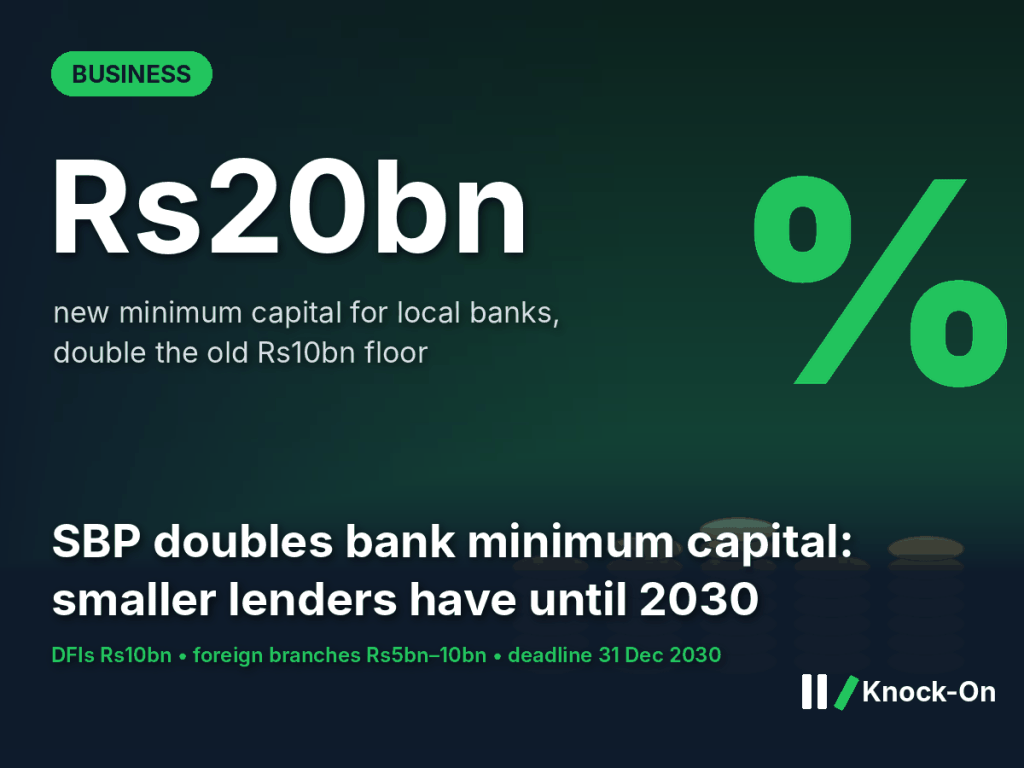
The State Bank of Pakistan has doubled the bank minimum capital requirement for locally incorporated banks to Rs20 billion from Rs10 billion, giving existing banks until 31 December 2030 to comply. Analysts expect little immediate impact on the large listed banks, whose capital and reserves already exceed the new floor. The real question is what the rule means for Pakistan’s smaller lenders, and whether it nudges the industry towards fresh capital raising or consolidation.
The short version
- Local banks, including Islamic banking subsidiaries, must hold at least Rs20bn in capital, double the previous Rs10bn.
- Development finance institutions (DFIs) need Rs10bn; foreign bank branches need Rs5bn (up to five branches) or Rs10bn (six to 50 branches).
- Existing banks and DFIs have until 31 December 2030; statutory reserves can now count towards the requirement.
- Most large banks already comply; a few smaller institutions may need to raise capital.
What happened
In a circular issued this week, the State Bank of Pakistan revised the minimum capital requirement (MCR) for banks and DFIs. The central bank said the change reflects the higher cost of setting up and running financial institutions sustainably. The new bank minimum capital requirement updates earlier SBP directives from 2008, 2009 and 2014; all other minimum capital instructions are unchanged.
Banks can now count statutory reserves held under Section 21 of the Banking Companies Ordinance, 1962, towards the requirement, in addition to the capital items already allowed. Reserves counted this way cannot be withdrawn without the SBP’s prior approval. There is a single deadline, 31 December 2030, with no interim steps described.
Local banks now need twice as much capital
Minimum capital requirement, Rs billion, SBP circular, October 2026 (deadline 31 Dec 2030)
Why it matters
A higher capital floor makes each bank a bigger buffer against losses, which matters at a time of high interest rates and an economy hit by the oil shock. The SBP raised its policy rate to 12% this month, as covered in Knock-On’s report on the SBP interest rate hike. Banks have also been putting their cash into government paper rather than private loans, as the latest T-bill auction in Pakistan showed. A stronger capital base gives banks more room to lend, but it does not by itself make them lend more to businesses.
For the big listed lenders, the rule is mostly a formality. Analysts quoted by Nukta said the banks they cover should already exceed Rs20bn in eligible capital and reserves, and that only a few institutions may need further assessment. Mid-sized banks with strong profits, such as the Bank of Punjab, whose profit rose 22% in nine months, are building reserves that count towards the requirement.
The knock-on effects
First order: smaller banks must plan for capital
Banks below the new bank minimum capital requirement will need to close the gap by 2030. The usual routes are retaining more profit, issuing new shares or merging with a stronger partner. The long deadline gives them five years to choose.
Second order: dividends and deal-making
A bank that needs to build capital may pay out less of its profit as dividends. Others may look for buyers or partners, which could bring more mergers and acquisitions to the banking sector over the next few years.
Third order: a higher entry barrier
A Rs20bn floor raises the cost of starting a new local bank, and foreign banks face tiered requirements linked to their branch networks. This could favour larger, established groups, while digital-first entrants may need deeper-pocketed backers.
Who could benefit
- Depositors: better-capitalised banks offer a larger cushion against losses.
- Large, well-capitalised banks: they already comply and may find acquisition opportunities.
- Advisers and investment banks: any capital raising or mergers would create advisory work.
Who may face pressure
- Smaller banks: those below Rs20bn must raise capital or find a partner by 2030.
- Shareholders of smaller banks: possible rights issues or lower dividends while capital is built.
- Foreign bank branches with small networks: they must hold Rs5bn or Rs10bn of assigned capital, net of losses.
- New entrants: a higher cost of obtaining a banking licence.
What to watch
- Coming weeks: bank statements to the PSX on how each institution plans to meet the new floor.
- Quarterly results: dividend payout ratios at smaller listed banks.
- Any merger announcements: early signs of consolidation in the sector.
- 31 December 2030: the compliance deadline for existing banks and DFIs.
Sources
- Dawn, Rs20 billion capital limit set for banks, 29 Oct 2026
- Nukta, SBP doubles minimum capital requirement for banks to PKR 20 billion, 28 Oct 2026
This is analysis, not investment advice. Figures are as of 29 October 2026.



Leave a Reply