
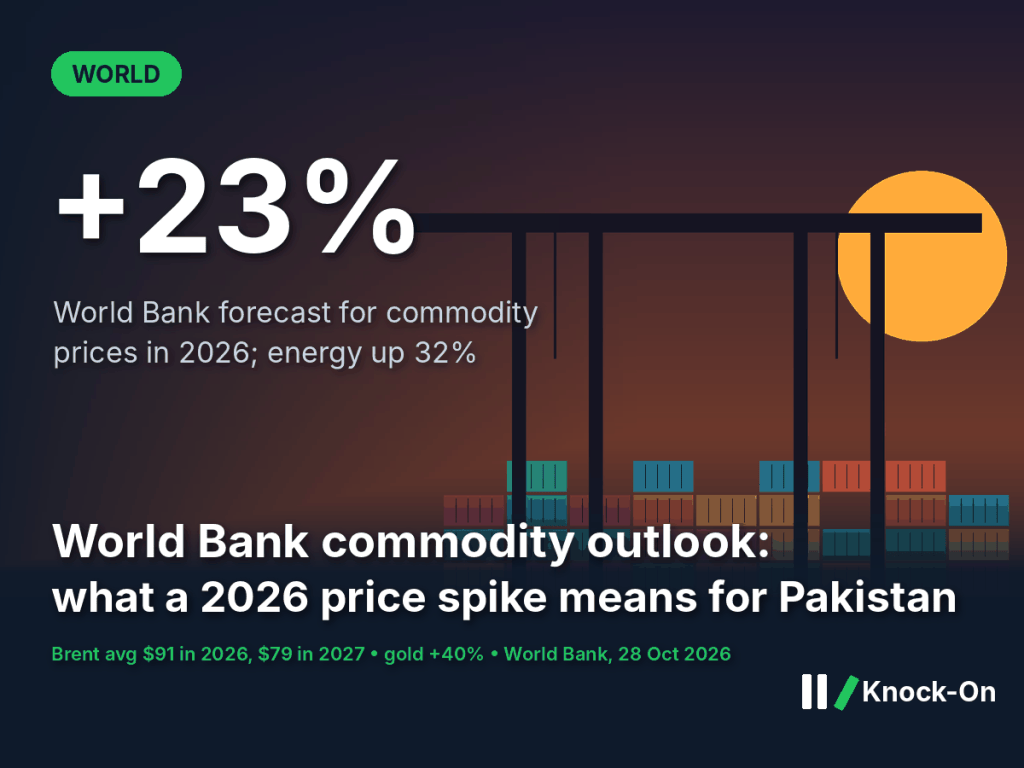
The World Bank commodity outlook, published on 28 October, expects global commodity prices to rise 23% in 2026, with energy up 32% and gold and other precious metals up 40%. For Pakistan, which imports most of the oil and edible oil it uses, the forecast matters more than the headline number suggests: it says the war-driven price shock is not a short spike but a cost base that will ease only slowly in 2027.
The short version
- The World Bank forecasts commodity prices up 23% in 2026 and down 7% in 2027.
- Brent crude is forecast to average $91 a barrel in 2026, up from $69 in 2025, and $79 in 2027. On 28 October it traded at $113.72.
- Food prices are expected to rise about 10% this year and another 7% next year; fertiliser is up 14% in 2026.
- For Pakistan, the outlook points to a longer period of costly fuel, imported inflation and pressure on the import bill.
What happened
In its October Commodity Markets Outlook, the World Bank said energy prices will rise 32% in 2026, reversing three years of declines. It expects global oil supply to fall 5.2% this year, the largest drop in more than four decades outside the 2020 recession, while oil consumption falls 2.5%. Because production is still below consumption, stocks will keep being drawn down.
Metals are forecast to rise 25% in 2026, with record highs for aluminium, copper and tin. Fertiliser prices are expected to rise 14% after an early-year spike in urea, before returning to 2025 levels in 2027. Food prices are forecast to climb about 10% in 2026 and about 7% in 2027, a cumulative 18%. “Commodity markets are being hit by several major shocks at once,” said Ayhan Kose, the World Bank’s deputy chief economist.
Energy leads the World Bank’s 2026 price surge
Forecast change in prices in 2026, %, World Bank Commodity Markets Outlook, 28 Oct 2026
Why it matters
Pakistan pays for the energy line in that chart directly. Under daily fuel pricing, high-speed diesel reached Rs399.82 a litre and petrol Rs377.91 on 28 October, as Knock-On reported in its look at the diesel price in Pakistan. The World Bank’s $91 average for 2026 sits well below the $113.72 Brent traded at on 28 October, which shows how much of this year’s damage came in recent months. Its $79 forecast for 2027 offers relief, but the World Bank’s own adverse scenario puts Brent at $105 next year. That range matches the caution in Knock-On’s earlier report on the oil price forecast for Pakistan.
Today’s oil price is far above the World Bank’s averages
Brent crude, US$ a barrel: annual averages and forecasts vs the 28 Oct 2026 price
The knock-on effects
First order: a costlier import bill
Higher oil, edible oil and fertiliser prices raise the dollar cost of the same volume of imports. That increases demand for dollars and puts pressure on the rupee and the current account, even if import volumes stay flat.
Second order: inflation and interest rates
Fuel feeds into freight, farm and factory costs, and food is the largest part of the household budget. The State Bank has already cited oil above $100 and wheat prices in its SBP interest rate rise to 12%. A slow fall in commodity prices would make it harder to justify cuts soon.
Third order: farm costs and the next harvest
If urea and imported fertiliser stay expensive into the sowing season, farmers may use less of it, which can affect yields and, later, food prices and import needs. The World Bank also flags a strong El Niño and attacks on Black Sea grain shipments as risks to food supply.
Who could benefit
- Oil and gas producers: companies whose output is priced off international oil benefit from higher benchmark prices.
- Gold holders: a 40% forecast rise in precious metals supports local gold prices, which stood at Rs425,636 a tola on 29 October.
- Exporters of food and minerals: sellers with spare output can earn more per tonne abroad.
Who may face pressure
- Transport and logistics firms: diesel near Rs400 a litre squeezes margins.
- Farmers: higher fertiliser and fuel costs before the wheat sowing season.
- Manufacturers using imported metals: record aluminium and copper prices raise costs for engineering, cable and auto-parts makers.
- Households: food prices forecast to rise about 18% over two years globally.
What to watch
- 1 November: the OPEC+ meeting on supply levels.
- Early November: Pakistan’s October CPI inflation data from the Pakistan Bureau of Statistics.
- Daily: fuel price changes under Pakistan’s daily pricing system.
- Ongoing: Middle East peace talks; the World Bank lists an escalation of the conflict among the main upside risks to its price forecasts.
Sources
- World Bank, Commodity Prices Set to Increase by 23% in 2026 as Global Shocks Mount, 28 Oct 2026
- Dawn, Commodity prices to surge 23pc, warns WB, 29 Oct 2026
- Dawn, Oil prices fall $2 on peace hopes, 28 Oct 2026
- Dawn, Diesel price nears Rs400 as govt adds over a rupee to petrol, HSD rates, 28 Oct 2026
- Daily Pakistan, Gold unchanged at Rs425,636 per tola, silver falls by Rs86, 29 Oct 2026
This is analysis, not investment advice. Figures are as of 29 October 2026. Knock-On is not affiliated with any political party.

Leave a Reply