
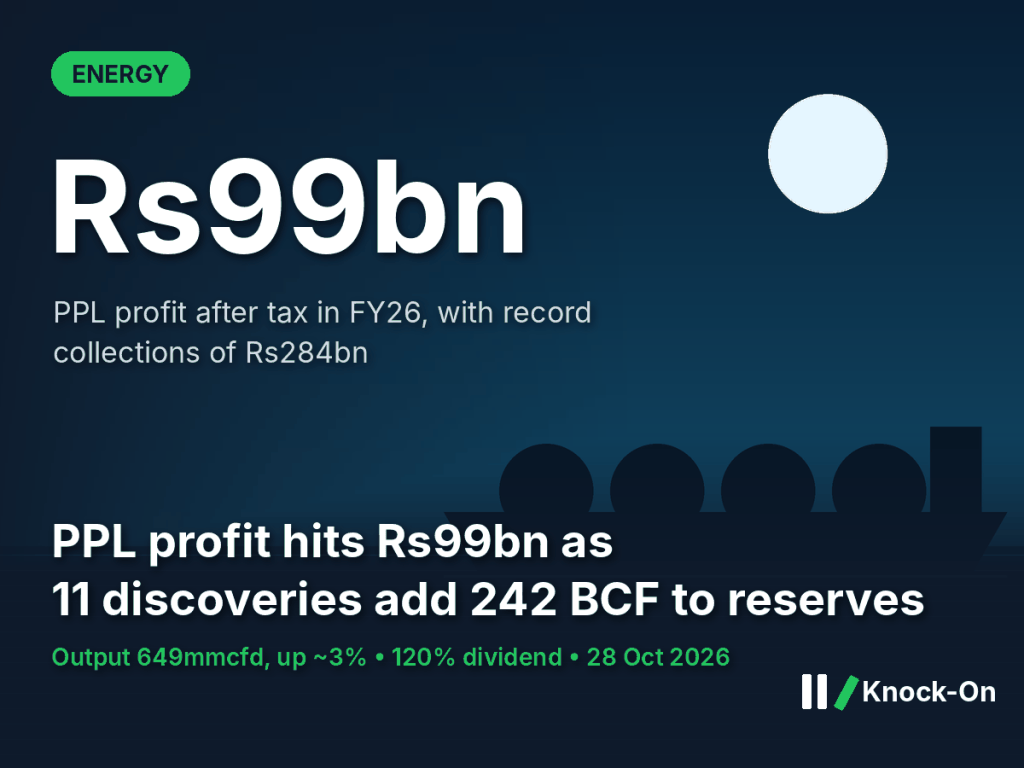
PPL profit after tax came to Rs99 billion in the 2025–26 financial year, Pakistan Petroleum Ltd told shareholders at its 75th annual general meeting on Tuesday, Dawn reported. The company also said it achieved its highest-ever collections, Rs284bn, and made 11 discoveries that added 242 billion cubic feet (BCF) to its proven and probable (2P) reserves. For a country importing costly LNG and fuel during a Gulf war, domestic gas output and the cash to drill for more matter well beyond PPL’s own shareholders.
The short version
- PPL earned Rs99bn after tax in FY26 and collected a record Rs284bn from customers.
- It paid a final cash dividend of 60%, taking the year’s total to 120%.
- Average production was 649 million cubic feet a day (mmcfd), about 3% higher than a year earlier despite gas curtailment.
- Of 11 discoveries, two were in PPL-operated blocks and nine in partner-operated assets.
What happened
According to Dawn’s report of the AGM, PPL drilled seven exploration wells and four development wells during FY26. It secured eight blocks in Pakistan’s Offshore Bidding Round 2025, two as operator and six as a partner, and signed a farm-out agreement with Turkish Petroleum Overseas Company for the Eastern Offshore Indus Block C. Abroad, development of Offshore Block 5 in Abu Dhabi continued through its subsidiary Pakistan International Oil Ltd. The company has also set up PPL Minerals as a separate business unit, with the BLZ project in its execution phase and mineral exploration expanded in Chagai.
Managing director and chief executive Khalid Abdul Rehman said that despite geopolitical uncertainty, volatile energy markets, gas curtailment, declining mature fields, security challenges and mounting circular debt, PPL “had demonstrated resilience”, Dawn reported.
PPL collected almost three times what it kept as profit
Pakistan Petroleum Ltd, FY26, Rs billion
Where the 11 discoveries were made
Why it matters
Record collections are the most telling number in PPL’s results. Gas producers in Pakistan have for years booked profits they could not fully collect, because the circular debt of unpaid bills between gas utilities, power producers and the government left them holding receivables. A record Rs284bn collected suggests more of PPL’s profit turned into cash in FY26, which funds drilling and dividends. Higher output, even by about 3%, also matters when every extra unit of domestic gas replaces imported LNG priced off a Gulf market disrupted by war; Knock-On has covered the search for new supply, including US LNG for Pakistan.
The knock-on effects
First order: PPL profit flows to shareholders and the state
A 120% total cash dividend returns money to shareholders, and the government, as a major shareholder in PPL, is among the recipients. For a budget working to IMF-backed targets, dividends from state energy companies are a useful non-tax income source.
Second order: reserves that depend on partners
Nine of the 11 discoveries came from partner-operated assets. That spreads risk, but it also means the pace at which new gas reaches the network depends partly on other operators’ development plans. The eight offshore blocks and the Turkish farm-out are long-term bets; offshore exploration typically takes years before any production.
Third order: a test for energy stocks on the PSX
Exploration and production companies are among the heavyweights of the KSE-100, which has been recovering on results season. Strong cash flow at PPL, alongside the jump in PSO profit, supports the case that high oil prices are lifting parts of the energy chain even as they hurt fuel users.
Who could benefit
- Shareholders: a 120% total cash dividend for the year.
- The government: dividend income and, over time, more domestic gas to reduce import bills.
- Gas-using industry: any new domestic supply eases dependence on imported LNG.
Who may face pressure
- PPL itself: its chief executive names declining mature fields, gas curtailment, security challenges and circular debt as continuing risks.
- Gas utilities: record collections by producers mean less room to delay payments.
- Exploration in insecure areas: security costs remain a drag on drilling plans.
What to watch
- PPL’s next quarterly results, which will show whether collections and output held up after the oil-price spike.
- Work programmes on the eight new offshore blocks and the Eastern Offshore Indus Block C farm-out.
- Progress on the BLZ minerals project and in Chagai.
- Government steps on gas-sector circular debt, which decide how much of producers’ profit becomes cash.
Sources
- Dawn, Pakistan Petroleum Ltd earns Rs99bn profit, makes 11 discoveries, 28 October 2026
This is analysis, not investment advice. Figures are as of 28 October 2026.

Leave a Reply