
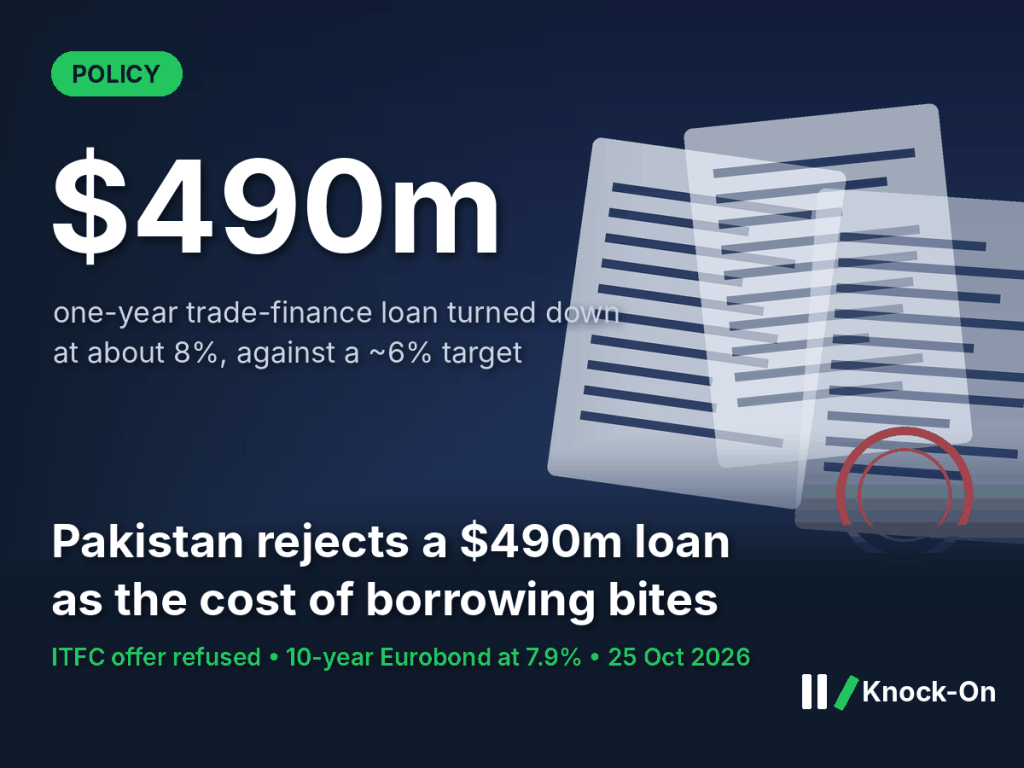
Pakistan rejects $490m loan offer on cost grounds, the Express Tribune reported on 25 October. According to government officials quoted by the paper, the finance ministry turned down a one-year, $490 million commercial loan from the International Islamic Trade Finance Corporation (ITFC), part of the Islamic Development Bank Group, because its all-in cost of about 8% was too high. The Debt Management Office (DMO) had hoped to pay about 6%. Turning down dollars while large repayments fall due shows how much borrowing costs now shape the government’s financing choices.
The short version
- The ITFC offered $490m for one year at an all-in cost of about 8%; the DMO wanted about 6%.
- A Pakistani dollar bond maturing in December 2027 was trading at about 6.1%, the Tribune says.
- The Economic Affairs Division has been asked to find a cheaper facility from the ITFC or another lender.
- Gross financing needs for FY27 are Rs28.647trn, about 20% of GDP, under the finance ministry’s plan.
What happened
According to government officials quoted anonymously by the Express Tribune, the decision was taken last week by the DMO, which has had no permanent director general since January 2026. The finance ministry spokesperson did not respond to the paper’s request for comment. The ministry has asked the Economic Affairs Division to look for a new facility at competitive rates.
The report sets the offer against Pakistan’s recent market borrowing. In September 2026 Pakistan raised $3bn through Eurobonds: $1.75bn over five and a half years at a 7.5% coupon and $1.25bn over 10 years at 7.9%. In August it took a $300m loan from United Bank Limited, sourced from Bahrain and Dubai, and waived income tax on the bank’s profit from it, with the cost paid from the budget.
The ITFC offer cost more than a 10-year Eurobond
Cost of Pakistan’s dollar borrowing, % a year, as reported on 25 Oct 2026
Why it matters
The rejected $490m loan was short-term trade finance, the kind of money Pakistan often uses to pay for oil and other imports. Turning it down signals that the finance ministry is trying to hold a line on price rather than accept any dollars on offer. That discipline has a cost of its own: the gap has to be filled from elsewhere. The finance ministry’s FY27 plan puts gross financing needs at Rs28.647trn, made up of a federal deficit of Rs7trn and more than Rs21trn of maturing domestic and external debt. Net external financing is projected at Rs813bn (about $2.8bn), with $1.6bn net from multilateral lenders.
The IMF’s latest report projects a current account deficit of about 1% of GDP, nearly $4.5bn, at least $1.5bn more than the $2.5bn-3bn range Pakistani officials cited in recent talks, the Tribune reports. The Fund has also warned that the Iran war impact on Pakistan could deepen if oil climbs further.
The knock-on effects
First order: a $490m hole in short-term funding
Until a replacement is found, the government has less ready dollar funding for imports, which puts more weight on reserves and on the timing of other inflows.
Second order: a price signal to lenders
By pointing to its own bond trading near 6.1%, the DMO is telling commercial lenders what it considers a fair rate. If cheaper money arrives, other banks may price closer to that level; if it does not, the government may have to accept more expensive terms later.
Third order: domestic rates and the rupee
Any shortfall in external money tends to be met by more domestic borrowing or slower reserve growth. That feeds into today’s SBP interest rate decision and into pressure on the rupee, at a time when profit repatriation already exceeds net FDI.
Who could benefit
- Taxpayers: a cheaper replacement loan would lower the interest bill paid from the budget.
- Competing lenders: banks or multilaterals able to offer rates nearer 6% now have an opening.
- Holders of Pakistani bonds: a government guarding its borrowing costs supports confidence in its debt management.
Who may face pressure
- Importers of oil and raw materials: trade finance is what pays for cargoes while Brent trades well above $100.
- The Debt Management Office: it must find a replacement without a permanent head.
- Domestic borrowers: more government borrowing at home would compete with business for bank credit.
What to watch
- 26 October: the State Bank’s monetary policy decision.
- Coming weeks: whether the Economic Affairs Division secures a replacement facility, and at what rate.
- Monthly: SBP reserve data and external inflows from multilateral lenders.
Sources
- The Express Tribune, Govt rejects $490m loan over cost, 25 October 2026
This is analysis, not investment advice. Figures are as of 25 October 2026.


Leave a Reply