
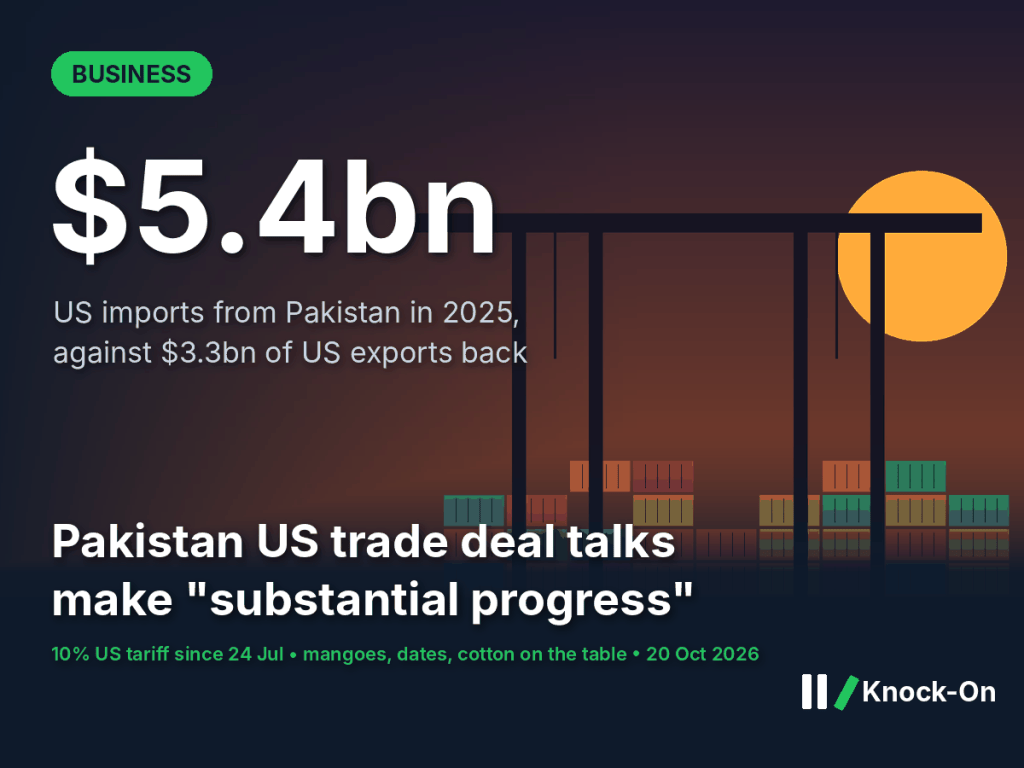
The Pakistan US trade deal is close but not done. Commerce Secretary Jawad Paul told a meeting with a US delegation in Islamabad that “substantial progress” had been made on several important provisions of the proposed reciprocal trade agreement, but that “a few technical points” still need to be settled with the Office of the US Trade Representative (USTR), Business Recorder reported on Tuesday. For exporters, the stakes are a market that bought $5.4bn of Pakistani goods last year and now charges a 10% tariff on them.
The short version
- Pakistan says talks on a reciprocal trade agreement with the US have made substantial progress, with a few technical points left; no completion date was given.
- Pakistan wants faster US inspections for mango exports and progress on market access for dates; the US wants to sell more cotton and soybeans.
- USTR figures show the US imported $5.4bn of goods from Pakistan in 2025 and exported $3.3bn, up 56.6%.
- A 10% US tariff on Pakistani goods has applied since 24 July, under Section 301.
What happened
Commerce Minister Jam Kamal Khan hosted a US delegation that included US Chargé d’Affaires Natalie A. Baker, according to Business Recorder. Jawad Paul asked for expedited visits by US inspection teams so that mango export arrangements can be made, saying wider access to the US market would create valuable export opportunities, particularly for growers and businesses in Balochistan. Pakistan also sought progress on the pending US market-access process for its dates. The US side welcomed the discussion and said it would follow up with the relevant US authorities.
In return, both sides discussed higher US exports of cotton and soybeans to Pakistan, with Jawad Paul stressing competitive pricing and trade financing. Jam Kamal invited US companies to invest in farm machinery, food processing, cold-chain infrastructure and value-added farm products, and to attend the FoodAg 2026 exhibition in Karachi on 23 to 26 November.
US sales to Pakistan are growing faster than Pakistan’s sales to the US
US-Pakistan goods trade, US$ billion, calendar years
Why it matters
The US is one of the largest buyers of Pakistani goods, and textiles and apparel make up the overwhelming majority of what it buys, Pakistan Today reported in July. Since 24 July those goods have faced a 10% tariff imposed by USTR under Section 301, after an investigation into forced-labour import rules covering about 60 trading partners. Analysts quoted by Pakistan Today estimated the tariff could cut textile exports by about $564m, and by more than $2bn if US buyers shift orders to cheaper suppliers. A Pakistan US trade deal that lowers that rate would directly help an industry where big mills are profitable but smaller weavers are shutting looms.
The deal also has a price. Pakistan’s surplus with the US narrowed to about $2.1bn in 2025 from roughly $3.0bn a year earlier (Knock-On calculation), as US exports jumped. Buying more US cotton and soybeans would narrow it further, which is part of what Washington wants from reciprocal deals.
The knock-on effects
First order: exporters’ pricing in the US
Any cut to the 10% tariff would improve margins for apparel, home-textile and other exporters selling to US retailers, and make Pakistani goods more competitive against Bangladesh, India, Vietnam and China.
Second order: cheaper inputs, more imports
More US cotton could help spinners when local cotton quality is weak, and US soybeans feed the poultry and edible-oil chains. But both add to the import bill at a time when Pakistan’s current account deficit hit $356m in September.
Third order: new farm exports
US approval for mangoes and dates would open a premium market for fruit growers, especially in Balochistan and Sindh, and support investment in cold chains and processing. It would be a small but useful step toward the $100bn exports target.
Who could benefit
- Textile and apparel exporters: the biggest winners if the US tariff on Pakistani goods is reduced.
- Mango and date growers: new US market access would add a higher-priced outlet.
- Cold-chain and food-processing firms: exports of fresh fruit need storage, treatment and packing capacity.
- Spinners and feed millers: could gain from steadier supplies of US cotton and soybeans.
Who may face pressure
- Local cotton growers: more imported US cotton competes with domestic crops.
- Exporters in the meantime: until a deal is signed, the 10% tariff stays and US buyers can move orders elsewhere.
- The trade balance: larger US imports reduce Pakistan’s surplus with its key export market.
What to watch
- Talks with USTR on the remaining technical points; no date has been announced.
- Dates for US inspection visits for mango exports.
- FoodAg 2026 in Karachi, 23 to 26 November, and whether US firms take part.
- Monthly export data to the US for signs that the 10% tariff is moving orders away.
Sources
- Business Recorder, Pakistan, US make substantial progress on reciprocal trade deal, 20 Oct 2026
- Pakistan Today, Pakistan pushes textiles in US after new tariff, 31 Jul 2026
- Pakistan TV, Pakistan, US see ‘significant progress’ in Reciprocal Trade Agreement talks, 11 Jul 2026
This is analysis, not investment advice. Figures are as of 20 Oct 2026.


Leave a Reply