
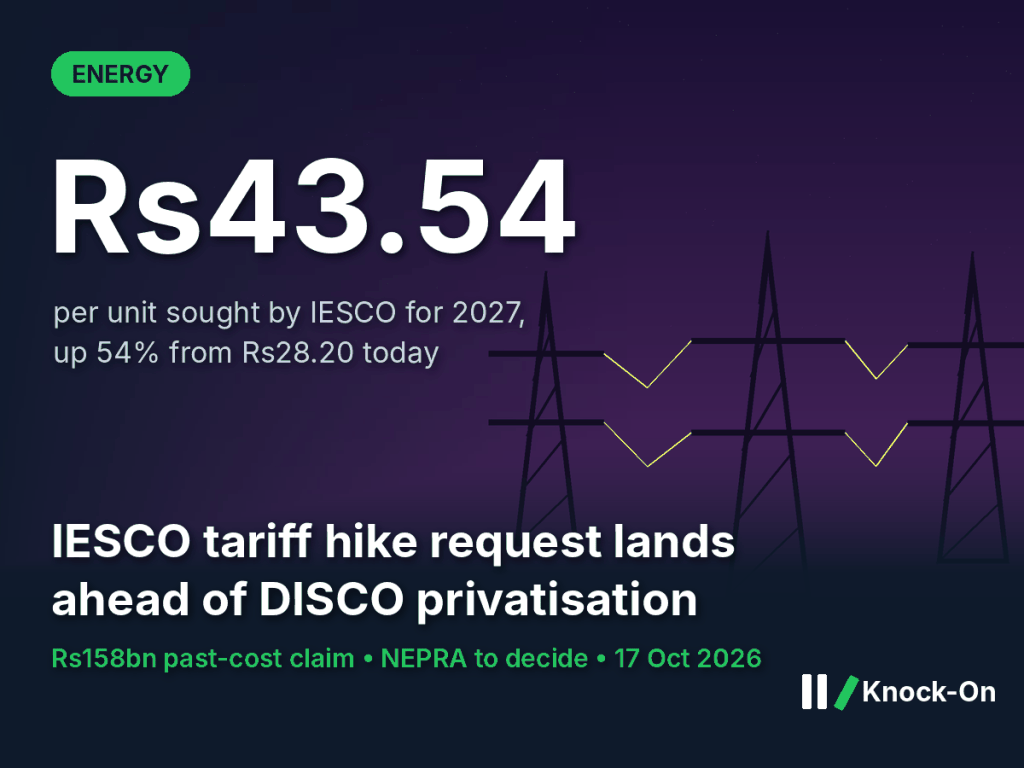
The IESCO tariff hike request would raise the average electricity rate charged by the Islamabad Electric Supply Company by more than 54%, from Rs28.20 to Rs43.54 per unit, from January 2027. The company, which serves Islamabad, Rawalpindi and nearby districts and is in the first group of power distributors lined up for privatisation, put its case to the regulator this week. Most of the increase comes from a single item: Rs157.9bn of past costs it wants to recover in one year. Nothing changes on bills yet, but the request shows how much cleaning up the government’s sell-off plan may require.
The short version
- IESCO has asked NEPRA for an average tariff of Rs43.54 a unit for calendar year 2027, up from Rs28.20.
- The request includes a Rs157.9bn prior year adjustment, partly linked to cheap power supplied to Azad Jammu and Kashmir.
- A NEPRA member questioned recovering the whole amount in one step rather than in phases.
- The regulator decides first; the federal government then notifies the final consumer tariff.
What happened
IESCO’s chief executive presented the petition at a public hearing of the National Electric Power Regulatory Authority (NEPRA), Business Recorder reported on 16 October. According to the company’s filing, dated 11 September, it wants a revenue requirement of Rs530.2bn for 2027 on expected sales of 12,176 million units, which works out to the Rs43.54 average. Its own distribution and supply margin is Rs78.1bn, or Rs6.42 a unit.
IESCO wants its average tariff up by more than half
Average tariff, rupees per unit (kWh)
The company reported losses in 2025-26 and says its balance sheet must be adjusted before the Privatisation Commission offers it to investors. The Rs157.9bn prior year adjustment is the biggest driver. Part of it relates to supplying cheap electricity to Azad Jammu and Kashmir, which takes about 17% of IESCO’s power. NEPRA member Amina Ahmed asked why the whole sum should be cleared at once rather than in phases. The regulator also questioned IESCO’s smart-meter rollout, which started in urban Rawalpindi and Islamabad rather than in areas where theft is highest.
Other distributors were heard in the same round. Sukkur’s SEPCO was criticised for recovering only 36% of its bills in 2025-26, against about 95% for the Punjab-based companies, and a NEPRA member said it would struggle to find a buyer in its current state.
Why it matters
The government says it wants to sell loss-making distributors to stop a drain on public money, as we explained in our piece on DISCO privatisation and the Rs850bn yearly loss. The IESCO tariff hike request shows the other side of that plan: before a company can be sold, someone has to absorb its past losses. If NEPRA allows the full adjustment, users pay more. If it spreads it out or rejects part of it, the gap stays on the books or falls on the budget.
Bill recovery shows why some DISCOs are harder to sell
Share of bills recovered, 2025-26 (%)
The knock-on effects
First order: the IESCO tariff hike and the national rate
Pakistan generally applies a uniform national tariff, with the government covering differences between companies through subsidies or adjustments. A higher IESCO revenue requirement therefore does not translate one-for-one into Islamabad bills, but it raises the total cost the system must recover. That adds to pressures already on bills, such as the Rs2.56 a unit fuel charge increase proposed for November.
Second order: privatisation pricing
Buyers will price IESCO on what NEPRA allows it to earn and recover. A clean opening balance sheet could attract better bids; an unresolved adjustment would likely lower them. NEPRA’s remarks on SEPCO suggest companies with weak recovery may need deeper restructuring before any sale.
Third order: industry’s energy costs
Exporters already cite power tariffs as a main reason they struggle to compete. Any rise in grid costs, combined with expected winter gas cuts for industry, would push more firms to look at solar, captive power or efficiency upgrades.
Who could benefit
- Prospective DISCO buyers if past losses are cleared before the sale.
- Solar and efficiency suppliers as businesses look for ways to cut grid use.
- Smart-meter vendors if NEPRA pushes metering towards high-theft areas.
Who may face pressure
- Electricity users if the adjustment is passed through in full.
- The federal budget if any shortfall is absorbed through subsidies.
- Weak-recovery DISCOs such as SEPCO, whose sale prospects NEPRA questioned.
What to watch
- NEPRA’s written decisions on the 2027 petitions from IESCO and the other nine state-owned distributors.
- Whether the Rs157.9bn adjustment is allowed in full, phased or cut.
- The federal government’s notification of consumer tariffs for January 2027.
- Privatisation Commission timelines for the first group of DISCOs.
Sources
- Business Recorder, Loss-making Disco on sell-off list: IESCO seeks over 54pc hike in tariff for CY27, 16 Oct 2026
- NEPRA, IESCO petition: annual adjustment and indexation (admission notice), 11 Sep 2026
This is analysis, not investment advice. Figures are as of 17 Oct 2026.

Leave a Reply