
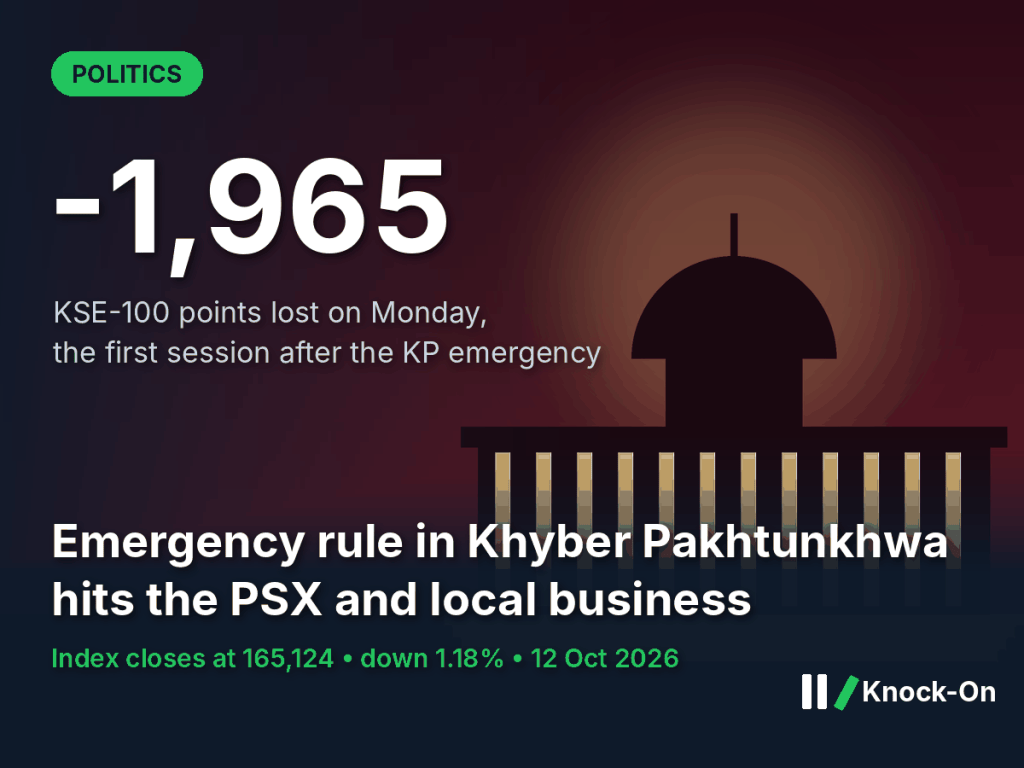
The first trading session after the federal government imposed emergency and governor’s rule in Khyber Pakhtunkhwa (KP) cost the stock market almost 2,000 points. The KSE-100 closed on Monday at 165,124.41, down 1,964.86 points or 1.18%, a bigger fall in one day than in the whole of last week. Beyond the market, businesses in the province are dealing with internet disruption, road blockades and closed schools, and nobody yet knows how long the measures will last.
Update, 14 Oct 2026, 9:00 pm PKT: The Senate has also approved the resolution endorsing the KP emergency and governor’s rule, completing the parliamentary approval required under Article 232 after the National Assembly’s vote earlier in the day. Parliamentary Affairs Minister Tariq Fazal Chaudhry moved the resolution. Opposition senators, including PTI’s Syed Ali Zafar and JUI members, challenged its constitutional basis; Quetta Voice reported that opposition members tore up copies and walked out, and Senate Chairman Yousaf Raza Gillani then declared it passed. The PTI says it rejects the emergency, while the government cites security grounds. Petitions remain before the Peshawar High Court (sources: 24 News HD; Quetta Voice, 14 Oct 2026).
Update, 14 Oct 2026, 5:00 pm PKT: The National Assembly on Wednesday passed a resolution endorsing the KP emergency and governor’s rule by majority vote after a debate of more than four hours, Minute Mirror reported. Law Minister Azam Nazeer Tarar said Article 232 requires approval within 10 days; the PTI called the move undemocratic and said it would challenge it in court. The Senate has yet to vote. The KSE-100 rose 641.07 points (0.39%) to 165,417.51, its first gain since the emergency was imposed, Business Recorder reported. Read our analysis of the KSE-100 today and the KP vote.
Update, 14 Oct 2026, 1:05 pm PKT: Parliament is moving to ratify the KP emergency this week. The National Assembly was scheduled to take up a government resolution at 11am today and the Senate at 4pm, with a joint sitting summoned for Thursday, 24 News reported. The PPP has decided to vote for the government resolution, Aaj News reported, citing party sources. Prime Minister Shehbaz Sharif told allied parties on Tuesday that the measures were taken under Articles 232 and 234 after cabinet consultations, and said the federal government had provided over Rs800bn to KP under the NFC framework for counterterrorism, according to a PMO statement carried by Business Recorder. PTI Senator Ali Zafar told the Senate the party is united in the resolve to defeat terrorism but that the fight should not put the Constitution aside. The Peshawar High Court petition seeks suspension of the governor’s rule notification; no hearing date has been reported. For a related policy risk, see the World Bank KP loan that comes up for approval under governor’s rule.
Update, 13 Oct 2026, 5:00 pm PKT: The KSE-100 fell for a second session on Tuesday, closing at 164,776.44, down 347.97 points (0.21%), after an early rebound of more than 900 points faded, according to Business Recorder. The index is now about 2,313 points below Friday’s close. The same day, Law Minister Azam Nazeer Tarar and Information Minister Attaullah Tarar told foreign media the emergency was driven by security concerns and the lack of a joint counterterrorism strategy with the provincial government, while the PTI has said it wants a policy agreed jointly by the federal and provincial governments. Read our full analysis of the KSE-100 today and why the rebound faded.
Update, 13 Oct 2026, 7:55 am PKT: The KP emergency and governor’s rule have been challenged in the Peshawar High Court. A writ petition filed on Monday by lawyer Salman Khan, naming the president, the prime minister and the KP governor as respondents, calls the measures “unconstitutional and illegal”, says road closures stopped people reaching the courts, and asks the court to suspend the proclamation until it decides the case, ARY News reported. No hearing date has been reported. Federal Minister for Parliamentary Affairs Tariq Fazal Chaudhry said the PTI could go to court if it had reservations and that Parliament would examine the emergency’s constitutional validity. Markets reopen today with the KSE-100 at 165,124.41.
The short version
- President Asif Ali Zardari signed the proclamation on Sunday 11 October on the advice of Prime Minister Shehbaz Sharif, under Articles 232 and 234 of the Constitution.
- The KSE-100 fell 1,964.86 points (1.18%) on Monday, with banks, energy, cement and autos all lower.
- Internet services were disrupted in parts of KP, and containers blocked motorway entry points around Peshawar.
- Both houses of Parliament must approve the emergency by 21 October; PTI says it will challenge it in court.
What happened
According to Dawn, the federal cabinet recommended the move citing the provincial government’s “deliberate disengagement from the fight against terrorism”, and the President approved it on Sunday. Al Jazeera reports that Governor Faisal Karim Kundi takes over provincial government functions, assisted by an 11-member advisory council, while Parliament takes over the powers of the provincial assembly, where PTI holds a majority. The army has been authorised to deploy in aid of civil power. Minister of State for Interior Talal Chaudhry said on Monday that Chief Minister Sohail Afridi had been detained.
Government ministers say the grounds are security. Law Minister Azam Nazeer Tarar said the “fundamental grounds for imposition of emergency are law and order, fight against terrorism.” Dawn reports that the Prime Minister told the cabinet he would not let PTI destabilise the economy. PTI chairman Gohar Ali Khan called the decision an “extremely alarming and grave political mistake” and said the party would challenge it in the courts and the assemblies. He also asked why governor’s rule covers the whole province if the security problem is in 12 districts.
On the Pakistan Stock Exchange, the index touched 166,988.32 early on Monday before selling took hold. Business Recorder reported selling in automobile assemblers, cement, commercial banks, oil and gas exploration, oil marketing and power generation, with index-heavy stocks such as HUBCO, OGDC, PSO, MCB and UBL closing lower. Blue chips fell harder than the wider market: the KSE-30 lost 1.68%. The fall extends last week’s swings, when even the IMF deal could not lift the PSX.
One Monday cost the market more than all of last week
KSE-100 points lost, week to 9 Oct vs Monday 12 Oct 2026
Why it matters
Markets can usually price a known risk. What they struggle with is an open-ended one. The emergency has no fixed end date once Parliament approves it, and governor’s rule can run in two-month extensions for up to six months, according to Al Jazeera. Saad Hanif of Ismail Iqbal Securities told Business Recorder the political backdrop had “added to an already cautious mood”, with investors “staying on the sidelines”.
The timing is also awkward for economic policy. Fawad Basir of KTrade told The Express Tribune that high commodity prices are keeping inflation elevated, which could weigh on the State Bank’s rate decision later this month. Political strain makes the IMF programme and the $1.2 billion tranche the Prime Minister hopes to unlock harder to keep on track.
The knock-on effects
First order: business in the province
Pakistan Observer reported that mobile data, Wi-Fi and some fixed-line services were disrupted in parts of KP from late Sunday, hitting businesses that rely on online orders and digital payments. Services in Peshawar were reported restored by Monday, but networks in Swabi were still suspended. Schools and colleges in Peshawar, Mardan, Swabi and Nowshera were closed.
Second order: freight and supply
Containers at motorway entry points slow the movement of goods between KP, Punjab and the capital. Transporters were already losing days to the blockades around the PTI march (see what the march has already cost business), and longer disruption adds to delivery times and costs for distributors serving the north.
Third order: the cost of capital
A lasting rise in political risk tends to show up in higher risk premiums, making it harder for companies to raise equity and for the government to attract investment it is courting through privatisation.
Who could benefit
- Patient buyers: some investors look for lower entry prices after sharp falls, though the direction depends on how the situation develops.
- Businesses with backup connectivity and inventory: firms that can operate offline or hold extra stock are better placed if disruption continues.
Who may face pressure
- Online sellers, freelancers and digital-payment users in KP, wherever internet services stay down.
- Transporters and distributors moving goods through Peshawar and the motorways.
- Index-heavy banks and energy stocks, which led Monday’s decline.
What to watch
- 14 October: National Assembly (11am) and Senate (4pm) sessions on resolutions endorsing the emergency.
- 15 October: joint sitting of Parliament summoned to ratify the measures.
- 21 October: deadline for both houses of Parliament to approve it.
- Court petitions: the Peshawar High Court petition seeking suspension of governor’s rule; no hearing date reported yet.
- Later in October: the State Bank’s monetary policy decision.
- Connectivity: whether internet services in Swabi and other districts are restored.
Sources
- 24 News, National Assembly, Senate pass resolution endorsing Centre’s imposition of emergency in KP, 14 October 2026
- Quetta Voice, Senate approves emergency in KP as opposition walks out, 14 October 2026
- Minute Mirror, National Assembly approves imposition of emergency in Khyber Pakhtunkhwa, 14 October 2026
- Business Recorder, PSX: bulls dominate, KSE-100 ends with over 600 points gain, 14 October 2026
- 24 News, NA, Senate sessions today to ratify imposition of governor’s rule in KP, 14 October 2026
- Business Recorder, Imposition of emergency, governor’s rule challenged in PHC, 14 October 2026
- Business Recorder, PM Shehbaz briefs allied parties on KP situation, defends ‘constitutional measures’, 13 October 2026
- Aaj News, PPP to back govt resolution on governor’s rule in KP, 13 October 2026
- Business Recorder, PSX: KSE-100 down 347.97 points, 13 October 2026
- Business Recorder, Govt says Khyber Pakhtunkhwa emergency aimed at unified counterterrorism policy, 13 October 2026
- ARY News, PHC moved against emergency, governor’s rule in KP, 12 October 2026
- Business Recorder, PSX: selling pressure at bourse, KSE-100 sheds nearly 2,000 points amid political volatility, 12 October 2026
- The Express Tribune, K-P emergency fuels PSX sell-off as index drops over 700 points, 12 October 2026
- Dawn, Emergency, governor’s rule imposed in KP as president approves cabinet decision, 11 October 2026
- Al Jazeera, What do emergency and governor rule in Pakistan’s Khyber Pakhtunkhwa mean?, 12 October 2026
- Arab News Pakistan, Pakistan imposes emergency in opposition-ruled Khyber Pakhtunkhwa province, 11 October 2026
- Pakistan Observer, Internet services remain disrupted in Peshawar, Swabi amid KP emergency, 12 October 2026
This is analysis, not investment advice. Knock-On is not affiliated with any political party. Figures are as of the market close on 12 October 2026.






Leave a Reply