
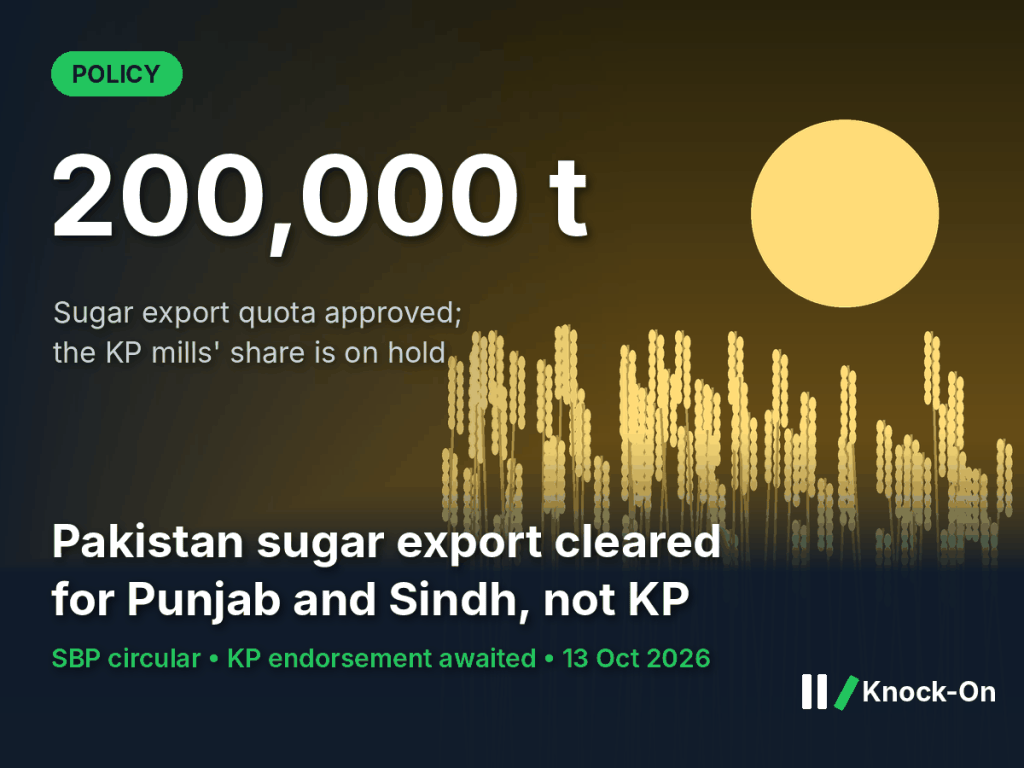
Pakistan’s 200,000-tonne sugar export can now go ahead for mills in Punjab and Sindh, but not for those in Khyber Pakhtunkhwa. In a circular on Tuesday, the State Bank of Pakistan told banks to hold export transactions by KP mills until the provincial government endorses their revised quotas. The sugar export is small next to what mills say they hold in surplus, but for KP’s millers and the cane growers who supply them, the delay comes as the province is run under governor’s rule.
The short version
- Banks may process sugar exports by eligible Punjab and Sindh mills, whose provincial governments have endorsed revised quotas.
- KP mills must wait until the food security ministry confirms the province’s endorsement. The circular gives no reason for the delay.
- Exports must be paid by sight letter of credit or in advance, and shipped by sea. No shipment deadline is set.
- The sugar industry had asked to export at least 1 million tonnes, five times the approved amount.
What happened
The SBP’s circular, titled “Revised Instructions – Export of 200,000 MT of Sugar”, followed revised province-wise and mill-wise quotas that the Ministry of National Food Security and Research shared on 9 October, based on data from the Pakistan Sugar Mills Association (PSMA), Business Recorder reported. “The endorsement from the Government of Khyber Pakhtunkhwa (KP) is still awaited,” the SBP said. Allocations among mills are based on provincial quotas set by verified crushing capacity or performance.
The Economic Coordination Committee approved the export on 14 September, with what Dawn described as safeguards to keep domestic prices stable, and the cabinet ratified the decision. On 29 September a cabinet committee chaired by Deputy Prime Minister Ishaq Dar finalised the modalities and set up a committee to monitor sugar prices, Radio Pakistan reported.
The approved quota is a fraction of the surplus that the industry and officials each estimate.
The approved sugar export is a fraction of the estimated surplus
Sugar, tonnes
Why it matters
The PSMA said stocks stood at over 2.6 million tonnes on 31 August, against average monthly consumption of 560,096 tonnes, and estimated that exporting the surplus could earn $600 million to $700 million at current international prices. It rejected the 200,000-tonne quota as inadequate. Officials, for their part, are wary of prices. The Express Tribune reported that last year’s 790,000-tonne export, combined with a fall in output, helped push sugar to Rs220 a kg, after which the government approved imports of 500,000 tonnes. The average price in early September was Rs148 a kg, about 18% lower than a year earlier.
The hold on KP mills comes days after the federal government imposed governor’s rule and an emergency in Khyber Pakhtunkhwa. The government says the move is aimed at a unified counterterrorism policy. PTI senator Ali Zafar called it a political crisis disguised as a security solution, Dawn reported. The SBP circular does not link the pending endorsement to these events.
The knock-on effects
First order: KP mills lose time on the sugar export
Punjab and Sindh mills can start lining up buyers and letters of credit now. KP mills cannot, and every week of delay means they compete later for the same overseas buyers.
Second order: cash flow for mills and growers
Export earnings help mills free up cash tied in stock before the new crushing season, which affects how promptly they can pay cane growers. Mills that cannot export carry those stocks longer.
Third order: prices and policy credibility
A small, controlled export limits the risk of a repeat of last year’s price spike, which matters for food inflation already visible in flour prices. But the IMF has asked for a policy to fully liberalise the sugar sector, and quota-by-quota approvals are the opposite of that.
Who could benefit
- Punjab and Sindh mills, which can start exporting now.
- Banks handling export trade, through letters of credit and advance payments.
- Household and industrial sugar buyers, if the limited quota keeps local prices stable.
Who may face pressure
- KP sugar mills, until the provincial endorsement arrives.
- Cane growers in KP, if mills’ cash flow tightens.
- Mills with large stocks nationwide, given a quota far below their request.
What to watch
- The KP government’s endorsement of mill quotas and the ministry’s confirmation to the SBP.
- Weekly export reports, which banks must file with the SBP every Friday.
- Retail sugar prices, tracked by the new price monitoring committee.
- Any further export approval once the 2026-27 crushing season begins.
Sources
- Business Recorder, SBP directs banks to put on hold sugar exports by mills located in Khyber Pakhtunkhwa, 13 October 2026
- Business Recorder, SBP revises instructions for sugar exports, 14 October 2026
- Dawn, Economic Coordination Committee allows 0.2m tonnes of sugar export, 15 September 2026
- Radio Pakistan, Cabinet Committee finalizes modalities for export 200,000 metric tons of sugar, 29 September 2026
- The Express Tribune, Govt allows 200,000 tonnes more sugar export, 9 September 2026
- ChiniMandi, Pakistan sugar mills reject 200,000-tonne sugar export quota, seek 1 million tonnes, 15 September 2026
- Business Recorder, Govt says Khyber Pakhtunkhwa emergency aimed at unified counterterrorism policy, 13 October 2026
- Dawn, PTI’s Ali Zafar terms governor’s rule in KP ‘political crisis disguised as security solution’; ministers defend move, 13 October 2026
This is analysis, not investment advice. Figures are as of 14 October 2026. Knock-On is not affiliated with any political party.





Leave a Reply