
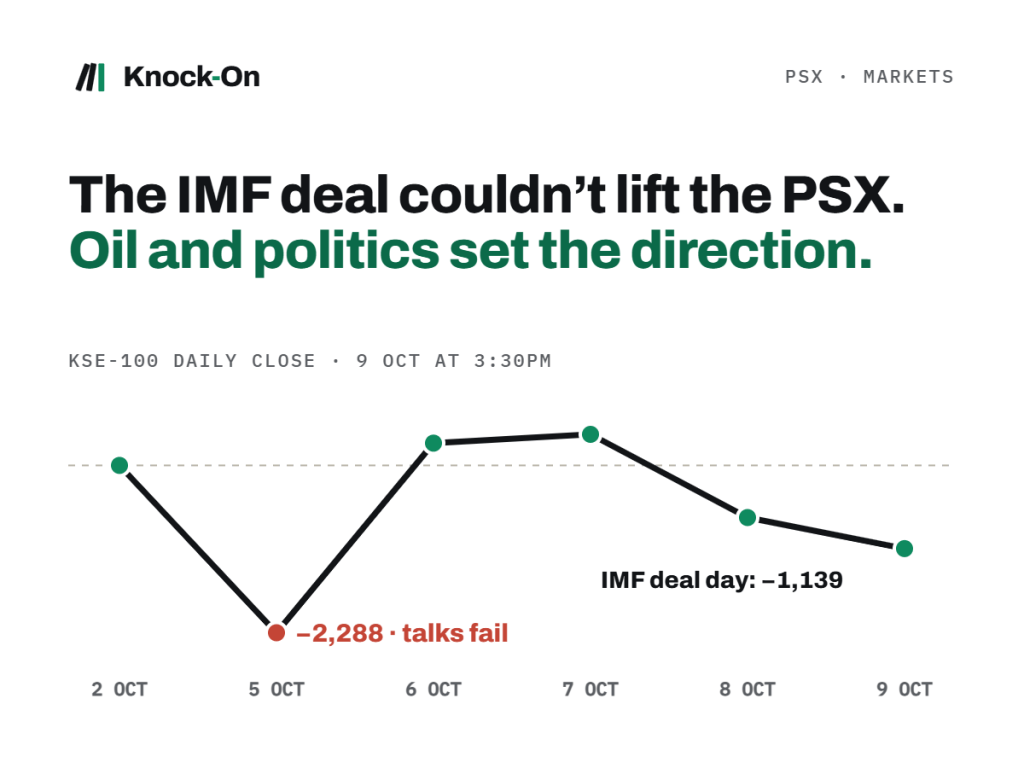
Pakistan secured its IMF staff-level agreement this week, normally the kind of news that lifts the stock market. Instead the KSE-100 spent the week swinging with oil prices and the political standoff, and on Friday afternoon it was trading below where it started the week.
The short version
- The KSE-100 closed last week at 168,155. It fell 2,288 points on Monday, recovered on Tuesday, and was trading near 167,000 late on Friday.
- The IMF agreement, announced on 8 October, lifted the index early that day but it closed 1,138 points lower.
- Brent crude rose above $104 a barrel on Thursday on supply fears around the Strait of Hormuz.
- The index is almost 13% below its 52-week high of 191,033.
What happened
Daily closes this week, from Business Recorder (Tuesday’s figure is derived from Wednesday’s reported change):
- Friday 2 October: 168,155 (last week’s close)
- Monday 5 October: 165,867, down 2,288 points, after government–PTI talks failed and the long march began
- Tuesday 6 October: about 168,460, a recovery of roughly 2,590 points
- Wednesday 7 October: 168,580, up 120 points
- Thursday 8 October: 167,442, down 1,139 points, despite the IMF agreement
- Friday 9 October: about 167,018 at 3:30pm, down about 424 points
On Thursday the index reached 169,487 in the morning after the IMF news, then sold off through the day. Of 496 companies traded, 130 rose and 324 fell. On Friday early gains of about 600 points faded the same way.
Why it matters
The pattern shows what investors are pricing. Much of the IMF news had been anticipated, and markets tend to move on expectations rather than confirmation. What is not settled is the cost of oil and the political outlook.
Oil matters because Pakistan imports most of its fuel. Higher crude prices widen the import bill, add to inflation and reduce the room for the State Bank to cut interest rates. Consumer inflation was 10.26% in September. Ahmed Sheraz of KASB KTrade said sentiment was likely to stay cautious until there was more clarity on geopolitics and oil, and that a sustained fall in energy prices could help equities.
Politics matters because a prolonged standoff raises the risk of disruption to business and to policy.
The knock-on effects
First order: sectors move differently
Banks, fertiliser companies and oil and gas stocks led Thursday’s losses. Exploration companies can benefit from higher oil prices, but they were sold along with the rest of the market.
Second order: interest rates
If oil keeps inflation high, the State Bank is less likely to cut rates at its next meeting on 26 October. That affects bank profits and the appeal of shares relative to fixed income.
Third order: the cost of capital
A weaker market makes it harder and more expensive for companies to raise equity, and lowers the value of holdings for investors and pension funds.
Who could benefit
- Investors with cash, if they see current levels as an entry point. This is not a recommendation.
- Exporters, as a stable rupee near 277 to the dollar supports planning.
Who may face pressure
- Leveraged traders, in a market moving 1,000 to 2,000 points a day.
- Companies planning share sales, while sentiment is weak.
What to watch
- Brent crude, especially any easing of supply concerns in the Gulf.
- The long march, and any return to talks.
- The IMF Executive Board date for approving the tranche of about $1.2 billion.
- The SBP policy decision on 26 October.
Sources
- Business Recorder, KSE-100 settles nearly 2,300 points lower on political uncertainty, higher oil prices, 5 October 2026
- Business Recorder, KSE-100 sheds over 1,100 points on selling pressure, 8 October 2026
- Express Tribune, PSX reverses early gains as KSE-100 sheds over 600 points, 8 October 2026
- Business Recorder, KSE-100 sheds over 400 points after early gains fade, 9 October 2026
- Express Tribune, PSX below 170k on weak sentiment, 4 October 2026
- Pakera, KSE-100 falls 2,288 points on 5 October 2026 (52-week high)
This is analysis, not investment advice. Figures are as of 3:30pm on 9 October 2026.


Leave a Reply