
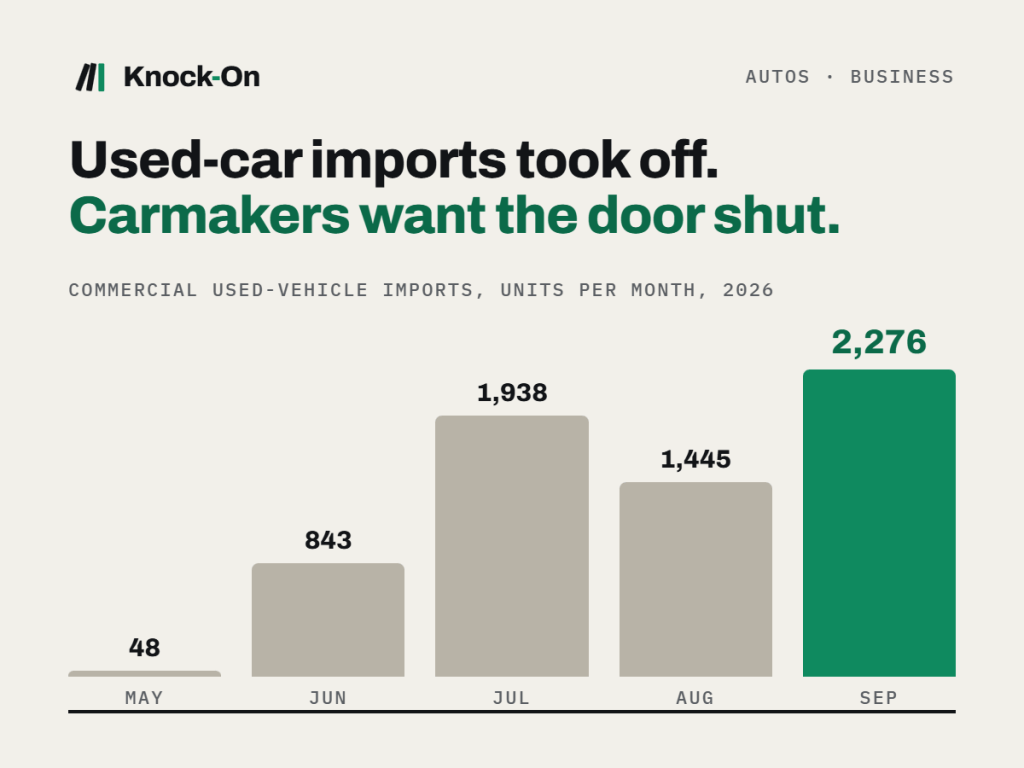
Pakistan’s car market is being reshaped by imports rather than by new models. Commercial imports of used vehicles have climbed from a handful in May to more than 2,000 a month, and the rules have just been relaxed further. Local assemblers and parts makers are pushing back before the government finalises a new auto policy.
The short version
- Commercial used-vehicle imports rose from 48 units in May 2026 to 2,276 in September, according to Ministry of Commerce data cited by PAMA.
- A 30 September notification from the Engineering Development Board (EDB) removed the minimum capital and after-sales service requirements for commercial importers.
- PAMA estimates losses of more than Rs50 billion for local industry if last year’s import volumes return, and has asked for the notification to be suspended.
- The government says the cabinet may approve a new auto policy within about two weeks.
What happened
The EDB’s new notification applies only to used vehicles. The 2025 version also covered new imported cars. It drops the requirement that commercial importers have a minimum level of capital and adequate after-sales service, and it moves pre- and post-shipment inspection from the EDB to the Pakistan Standards and Quality Control Authority (PSQCA).
The Pakistan Automotive Manufacturers Association (PAMA) wrote to Haroon Akhtar Khan, the prime minister’s adviser on industries, calling the change a dilution of safeguards. It says imported used cars benefit from depreciation allowances of up to 36% while local manufacturers carry investment, localisation, tax and compliance obligations.
Separately, Haroon Akhtar Khan told a Senate committee on 7 October that the new policy would restrict imports of fully built cars through tariffs, support local parts production, and cut duties and other costs on electric and plug-in hybrid vehicles. It would also allow one-time imports of low-cost EVs.
Why it matters
Monthly commercial imports of used vehicles, per PAMA:
- May 2026: 48
- June: 843
- July: 1,938
- August: 1,445
- September: 2,276
That is a large flow for a market of Pakistan’s size, and it competes directly with locally assembled cars in the same price bands. The parts industry says 50 to 60% of the components in locally assembled vehicles are made in Pakistan, so lost assembly volume also means lost orders for vendors. Senators at the committee hearing cited concerns that about 2.2 million jobs depend on the sector.
The knock-on effects
First order: more choice for buyers
Buyers get more imported options, often better equipped than local models at similar prices. Car dealers and importers gain business.
Second order: pressure on assemblers and vendors
Lower local sales mean fewer production shifts and smaller orders for parts makers. Vendors with high fixed costs are the most exposed.
Third order: the trade bill
More imported cars mean more demand for dollars. Policymakers will weigh that against the need for competition in a protected market.
Who could benefit
- Car buyers, through wider choice and price competition.
- Commercial importers and dealers, now facing fewer entry requirements.
- EV buyers, if the proposed duty cuts go ahead.
Who may face pressure
- Local assemblers, especially in the segments where used imports compete.
- Auto-parts manufacturers and their workers.
- Buyers of imported cars, if after-sales support weakens with the requirement removed.
What to watch
- Cabinet approval of the auto policy, and the tariff rates it sets on fully built imports.
- Whether the EDB notification is suspended, as PAMA has requested.
- Monthly import and local sales data for October.
Sources
- Business Recorder, Used cars’ import: PAMA voices its concerns over EDB notification, 8 October 2026
- Business Recorder, Cabinet may approve new auto policy within next two weeks: Haroon, 8 October 2026
This is analysis, not investment advice. Figures are as of 9 October 2026.


Leave a Reply