
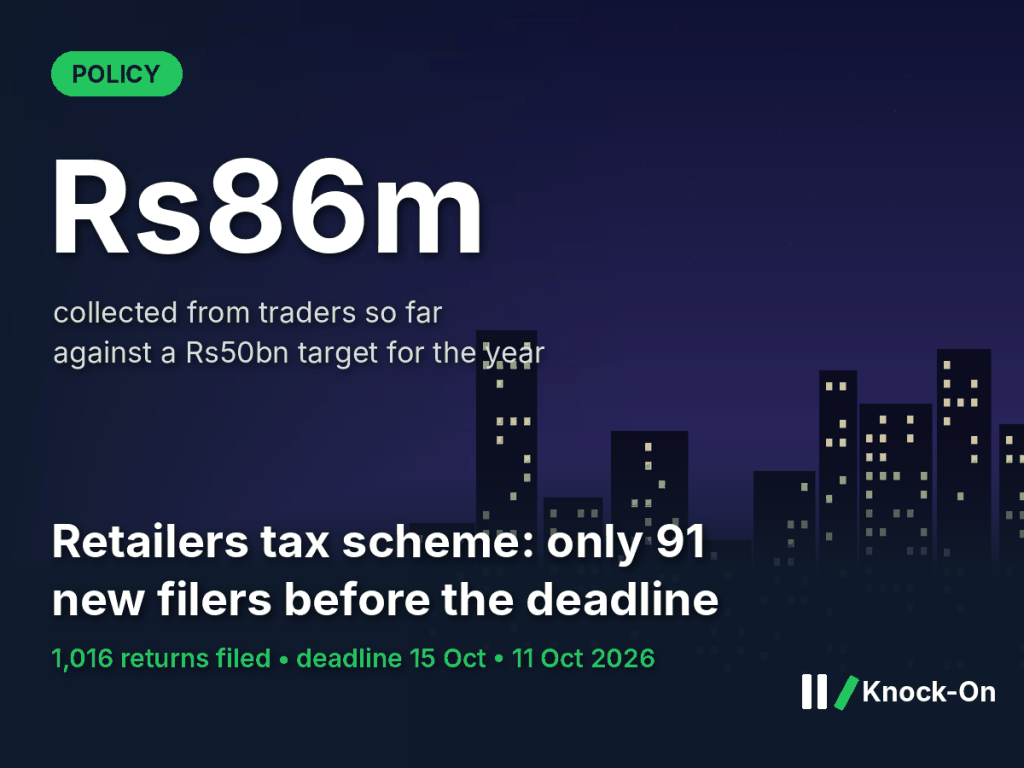
Pakistan’s latest attempt to bring shopkeepers into the tax system is struggling. The Federal Board of Revenue (FBR) told the IMF that only 1,016 retailers have filed returns under its fixed tax scheme, and just 91 of them are new to the tax roll. Against a target of Rs50 billion for this fiscal year, Rs86 million has been collected. On Friday, Finance Minister Muhammad Aurangzeb reviewed the scheme and said it should be treated as a long-term route into the tax system, not a one-year arrangement.
Update, 13 Oct 2026, 9:00 pm PKT: The 15 October filing date is now under pressure: the Pakistan Tax Advisers Association has asked the FBR chairman to extend the income tax return deadline to 15 November, citing a slow IRIS portal and new return columns (Business Recorder). The FBR had not announced an extension at the time of writing. See our analysis of the income tax return deadline.
The short version
- Only 91 of the 1,016 retailers who filed under the fixed tax scheme are new taxpayers, according to figures the FBR shared with the IMF.
- Rs86 million has been collected against a Rs50 billion target, about 0.17% of the goal.
- The return deadline is 15 October. After that, staged penalties of Rs10,000, Rs25,000 and Rs50,000 apply.
- The finance minister says the scheme will continue beyond 2026, which signals enforcement rather than retreat.
What happened
The Retailers’ Tax Scheme is meant to bring small traders into the tax net through simpler registration and a fixed payment. Within two months, 10,338 retailers registered through the FBR’s app, of whom 2,337 were new, according to an FBR briefing to the Senate Standing Committee on Finance reported by ProPakistani on 1 October. Very few went on to file returns.
By early October, the FBR told the IMF mission conducting the fourth review of Pakistan’s $7 billion loan programme that 1,016 retailers had filed returns under the scheme, of whom 91 were new. FBR Chairman Rashid Mahmood Langrial told senators that traders had “defeated the good faith” of the government and that app glitches were “merely an excuse” for not filing. Minister of State for Finance Bilal Azhar Kayani acknowledged technical problems for first-time filers.
Thousands registered. Fewer than a hundred new filers.
Retailers at each stage of the fixed tax scheme, number, as reported 1 to 7 October 2026
On 9 October, Mr Aurangzeb met Mr Kayani and the FBR chairman to review registrations and returns. Dawn reported that the meeting took place “at a time when the response from the traders was below expectations”. The minister called for a balanced approach combining facilitation with targeted measures, and said the scheme “should not be seen as a one-year arrangement limited to 2026”. The FBR also reported on mapping unregistered retailers using available data.
Why it matters
The scheme is one of the few tools the government has to widen a narrow tax base, and the IMF is watching it. About 3.7 million traders are outside the system, according to the FBR, which aims to bring in 500,000 to one million. If retailers stay out, the revenue gap tends to be filled by those already paying: salaried workers, manufacturers and formal businesses. The chairman told senators that a successful scheme could raise more than Rs100 billion from traders.
The knock-on effects
First order: penalties and field visits
Once the 15 October deadline passes, non-filing retailers face staged fines. FBR officials say all non-filers will be pursued and that teams will go into markets. Mr Kayani said that if fines are not enough, “strong enforcement measures would have to be taken”.
Second order: friction in the supply chain
Distributors and manufacturers that sell to small shops could feel the pressure first if enforcement relies on data trails such as invoices and bank records. Business groups are already sensitive to this: at the Lahore Chamber on Friday, the prime minister’s adviser on industries, Haroon Akhtar Khan, said FIRs and account freezes should be avoided in business matters.
Third order: the budget and the IMF
A shortfall from traders leaves a hole that the government must fill elsewhere or explain to the IMF, which has just agreed its latest review of Pakistan’s loan programme. That raises the risk of extra measures on sectors that are easier to tax, such as the FBR’s plan to tax creators on every social media platform, a pattern Pakistani businesses have seen before.
Who could benefit
- Formal retailers already filing, if enforcement narrows the cost gap with undocumented competitors.
- Tax advisers and digital filing services, as first-time filers seek help before and after the deadline.
- Documented manufacturers, whose tax burden depends partly on whether the base widens.
Who may face pressure
- Unregistered shopkeepers facing staged fines after 15 October.
- Wholesalers and distributors whose customer records may be used to map retailers.
- Salaried taxpayers and formal firms, if the shortfall is made up through other measures.
What to watch
- 15 October: extended deadline for income tax returns, including for retailers.
- Whether trader bodies call for another extension, and how the FBR responds.
- Around early November: the Senate finance committee said it would review implementation about a month after the briefing reported on 1 October.
- Any reference to the scheme in IMF review documents.
Sources
- Dawn, Aurangzeb reviews retailers’ tax scheme, 10 October 2026
- ProPakistani, Only 91 New Retailers Join Tax Scheme, FBR’s Rs. 50 Billion Target in Jeopardy, 7 October 2026
- ProPakistani, Only 4 New Traders Join Fixed Tax Scheme; FBR Chief Says ‘Good Faith Defeated’, 1 October 2026
- The Express Tribune, Businesses will not be harassed: PM aide, 10 October 2026
This is analysis, not investment advice. Figures are as of 11 October 2026.






Leave a Reply