
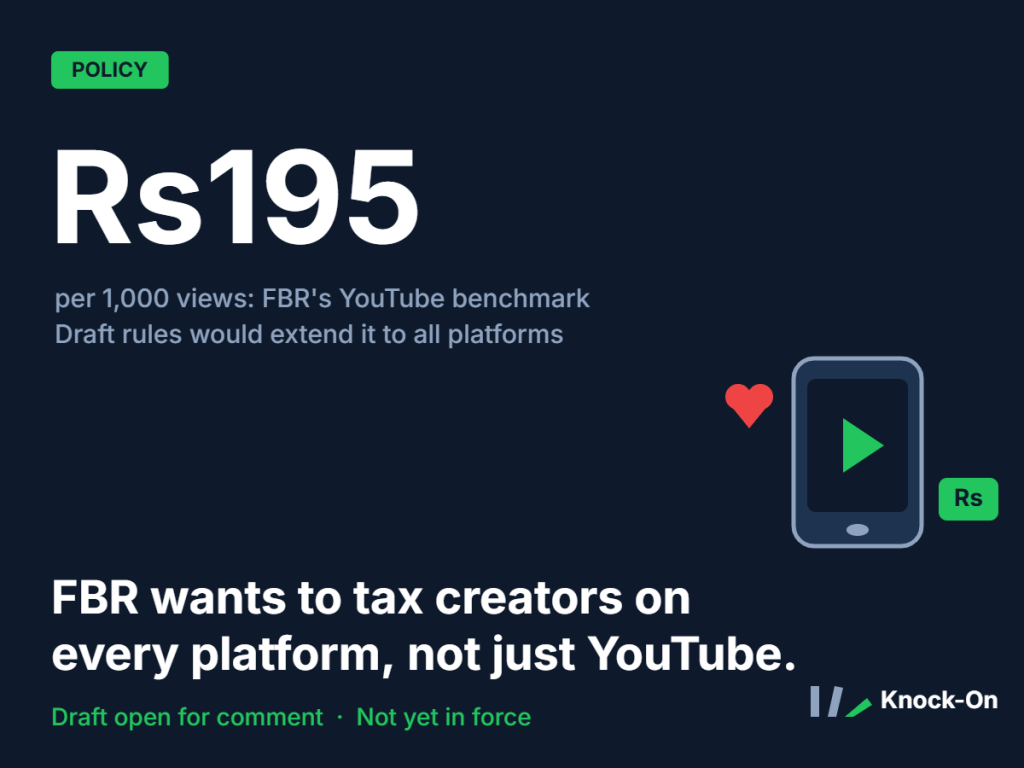
The Federal Board of Revenue has drafted rule changes that would extend its tax procedure for YouTube income to all social media platforms. For the creators, agencies and brands that make up Pakistan’s influencer economy, the change would mean earnings from platforms beyond YouTube come under the same scrutiny, including a benchmark that lets the FBR estimate income from views.
The short version
- Two draft amendments to the Income Tax Rules, 2002 would replace the word “YouTube” with “social media platforms”.
- Stakeholders have seven days from publication in the Gazette to send comments. The rules are not yet in force.
- The current YouTube procedure values monetised content at Rs195 per 1,000 views, unless the creator proves lower earnings.
- FBR officials have estimated social media income in Pakistan at Rs4 billion to Rs10 billion a year, much of it untaxed.
What happened
Business Recorder reported on Friday that the FBR has drafted notifications amending rules 13ZP and 19R of the Income Tax Rules, which set out a special procedure for taxing YouTube income. The amendments would widen both rules from YouTube to social media platforms in general. The FBR will consider feedback before finalising them.
Under the YouTube procedure, as described by an FBR official to Arab News this week, a creator’s income is taken as the higher of their actual earnings or Rs195 per 1,000 views on monetised content. Creators can claim up to 30% of revenue as expenses, pay advance tax quarterly and declare the income in a separate section of their return. Sponsorship payments, in cash or in kind, count as income. Creators who earn less than the benchmark must prove it with platform reports, payout statements or contracts, and the tax office can ask to see their account dashboards.
What the Rs195 benchmark implies
Deemed income by monetised views, before and after the 30% expense allowance (Rs)
Separately, in June the National Assembly’s finance committee endorsed a 5% withholding tax, to be deducted by banks, on money received from platforms such as YouTube, Facebook, Instagram and TikTok.
Why it matters
Influencer marketing has become a standard part of how Pakistani brands sell, from telecoms and banks to food delivery and fashion. Most creator income still sits outside the tax net. Extending the rules to every platform closes the gap between a YouTuber, who is already covered, and a TikTok or Instagram creator earning similar amounts, who is not. It also gives the FBR a route to estimate income where records are thin.
The knock-on effects
First order: creators’ paperwork and tax bills
Creators on newly covered platforms would need to file quarterly advance tax, keep payout records and document sponsorship deals. Those with large audiences but modest earnings would need evidence to avoid being taxed on an estimate.
Second order: influencer marketing costs
Because in-kind sponsorships count as income, brands and agencies can expect creators to ask for written contracts and invoices, and some may raise their fees to cover the tax. Paying creators informally becomes harder to justify.
Third order: formalisation of the digital economy
If enforced, the rules would push more creators to register, open business accounts and route income through banks. That widens the tax base, but heavy-handed enforcement risks pushing some payments into informal channels.
Who could benefit
- Tax advisers and accountants serving creators and small digital businesses.
- Talent agencies that can handle contracts, invoicing and compliance for creators.
- Creators already compliant on YouTube, who would no longer be at a disadvantage to peers on other platforms.
Who may face pressure
- TikTok, Instagram and Facebook creators who have not been filing returns.
- Brands and agencies that pay influencers informally or in kind.
What to watch
- The final notifications, and whether the FBR sets a separate views benchmark for each platform.
- Industry responses during the seven-day comment window. Creators have already asked for tax concessions.
- Whether the FBR seeks data from platforms or banks to check declared income.
Sources
- Business Recorder, FBR proposes expanding tax rules from YouTube to all social media platforms, 9 October 2026
- Arab News, Pakistan sets new benchmark for taxing social media creators, 7 October 2026
- Profit, NA body endorses 5% tax on social media earnings, 19 June 2026
- Express Tribune, Content creators, influencers seek tax concessions, October 2026
This is analysis, not tax advice. Figures are as of 9 October 2026.


Leave a Reply